Co-Brain: l’approche de la mer, and why AI may never emerge from LLMs
Jun 20, 2026
The word is the murder of the thing
The mind commands the body and it obeys. The mind orders itself and meets resistance.
— Augustine, Confessions, Book VIII
The scandal in Augustine’s sentence is not that the body sometimes refuses; bodies are blunt animals, and often obedient ones. The scandal is the second clause: the one thing the mind cannot reliably command is itself. We are not at home in the world; worse, we are not at home in ourselves. Lacan gave this homelessness a structure. The subject who says “I” is not the subject the sentence is about; the moment we enter language we are split — barred, written $ — divided between the I that speaks and the I that is spoken, unable to coincide with ourselves because the very medium of self-relation is on loan. Augustine felt the division as sin; Lacan located it in the signifier. Either way, this precariousness is not a defect to be cured. It is the signature of having a mind at all.
Why can the mind never quite settle? Because the frame it inherits was never built to picture the world. Language is not a window; it is a contagion. Its pressure is less fidelity than fecundity: a good-enough, lossy compression optimized for transmission. Nietzsche said it first: truth is a mobile army of metaphors whose metaphorical rank has been forgotten. Dawkins and Blackmore later formalized the mechanism; Korzybski compressed the warning to a slogan: the map is not the territory. Lacan drew the same cut through the sign itself — a bar between signifier and signified, with the signified sliding beneath a signifier that answers first to other signifiers and only obliquely to the world. What survives in language is not always what is true. It is what catches. We catch our concepts as we catch a cold.
And often it is this way because the truth, in its raw state, is socially unusable. It has edges. It cuts through the membranes that allow people to live together, sleep beside one another, sign contracts, raise children, attend funerals, and say “I’m fine” without causing a scene. What it cuts toward is what Lacan called the Real — not reality, which is already tamed and furnished with words, but the Real: the kernel that resists symbolization absolutely, the thing in experience for which there is no adequate word and never will be. So language performs its ancient cosmetic labor against it. It softens, rounds, perfumes, and tucks away. It takes the unbearable and makes it conversational. Death becomes “passing.” Failure becomes “a learning experience.” Exploitation becomes “opportunity.” Obedience becomes “professionalism.” Cowardice becomes “prudence.” Despair becomes “burnout.” The wound is still there, but grammar places a napkin over it.
This is not always deception in the crude sense. It is often mercy. A species that saw everything exactly as it is — that stood unscreened before the Real and the scalding charge Lacan called jouissance, the enjoyment that is too much to bear — might not endure itself for very long. Every culture is therefore a system of sanctioned evasions, a repertoire of agreed-upon blurrings, a collective fantasy stretched like a sheet across the void to hold the void at a livable distance. We do not merely speak to reveal; we speak to remain bearable to one another. The sentence is a social cushion. The concept is a padded room. The cliché is not just laziness; it is sedation by repetition. It allows the mind to encounter the intolerable without having to encounter it all at once.
The harder point is not that language falsifies reality. That is too easy, and finally too small. The harder point is that language can be false as picture and true as lever. A map need not resemble the land in order to move an army across it. Algebra need not look like falling bodies in order to predict the fall. A legal fiction may be metaphysically absurd and still operative enough to seize a house, create a corporation, or imprison a body. If the symbolic order preserves enough relations, if its distortions are stable enough, if its internal structure is isomorphic enough to the pressures of the world, then to manipulate the symbolic order is already, in the human world, to manipulate reality. The danger of the symbolic is exactly this: its failure as fidelity does not prevent its success as power. The word need not touch the thing nakedly in order to move the thing socially. It need only provide handles: points at which action, memory, law, desire, and fear can take hold.
But the cost of this softening is restlessness. Something in the mind knows when the word has not touched the thing. It senses the gap between the official name and the lived pressure underneath it. It hears the hollow ring inside inherited terms. Love, success, freedom, sanity, maturity, virtue — these arrive as polished coins passed through millions of hands, their original faces worn smooth. They are drawn from what Lacan called the Other, the great treasury of signifiers we did not mint and cannot redeem, and they ring hollow for a structural reason: the treasury itself is missing its guarantee. There is no final coin that backs the rest, no master-word anchoring all the others to the world. We spend our lives trying to buy reality with counterfeit currency, then wonder why nothing quite purchases peace.
Language promises settlement, but it manufactures displacement. To name a thing is already to move away from it. Here Lacan was at his most exact, taking the figure from Hegel and Blanchot: “the word is the murder of the thing.” By “the thing” I do not mean an object. An object is already a domesticated thing, a thing admitted into the house of language, assigned a name, function, price, use, position, and grammar. A chair, a lover, a country, a wound, a father, a childhood — once named, each becomes manageable enough to circulate. The Thing is what remains before and after that operation: the unassimilable kernel in experience that no predicate exhausts. Freud had already found the structure in the Project for a Scientific Psychology, where judgment divides the perceptual complex into a knowable portion — attributes, activities, predicates — and an “unassimilable portion,” the thing itself. Lacan seizes on that residue and radicalizes it into das Ding: not the object in the world, but the impossible center around which desire and language arrange themselves. The phrase must be heard with a capital letter. The Thing is not merely what language fails to describe; it is what language produces as lost by trying to describe it. Before the word, the thing burns too near; after the word, it is bearable but absent. Language does not simply miss the Thing. It kills it in order to preserve it, replacing its living pressure with a sign that can travel, be repeated, be inherited, be traded. The child learns “mother” and thereby loses the mother as immediate world; the mourner says “dead” and thereby begins the long social work of surviving what has no adequate name; the lover says “love” and feels, almost instantly, the poverty of the word beside the violence of the state it names. So the Thing is not the Kantian thing-in-itself exactly, though Lacan deliberately lets the shadow fall there. Kant’s thing-in-itself names the limit of knowledge; Lacan’s Thing names the limit of symbolization and the wound of desire. It is not simply unknowable. It is unbearable. It is the place where knowledge, pleasure, terror, memory, and forbidden enjoyment converge too intensely for the subject to inhabit directly. That is why Lacan places das Ding near ethics rather than mere epistemology: the problem is not only “Can I know the thing?” but “Can I survive wanting it?” The ordinary object is what society gives us in place of the Thing. Career instead of vocation. Marriage instead of eros. Identity instead of soul. Wellness instead of despair. Brand instead of creation. Opinion instead of judgment. The object is the Thing with its teeth removed. It lets us live; it also keeps us asleep. Every civilization survives by manufacturing such substitutes, and every serious mind feels the fraud. To think is to feel, beneath the object, the pressure of the Thing it has replaced. This also saves the argument from a cheap anti-language position. Language is not merely a lie. It is the murder that makes human life possible. Without the symbol, there is no memory, no mourning, no promise, no law, no history, no return. But the price of entering the symbolic is exile from immediacy. We gain a world and lose the Thing. We become human at the cost of never again coinciding with what happens to us. The symbol does not carry the thing across to us; it replaces the thing’s bristling presence with the cool permanence of its absence, so that we can hold the concept of fire without being burned. The instant experience becomes description, it has been edited for transport. The blood has been drained so the body can travel. What can be communicated is what has survived compression; what mattered most may be precisely what could not be carried over — the corpse arrives, the warmth does not. That is why the deepest experiences often produce either silence or metaphor. The mind reaches for speech and finds only tools designed for trade, command, flirtation, prayer, excuse, and inheritance — blunt instruments for a world that arrives as flame.
So the mind circles. It revises. It suspects. It pushes against its vocabulary as against the walls of a room whose dimensions were decided before it was born — the symbolic order, Lacan’s name for the lattice of language and law already in place, already speaking, when the infant arrives only to be spoken by it. It asks whether its thoughts are thoughts or infections, whether its desires are desires or advertisements. On this point Lacan is merciless: desire is the desire of the Other; we desire, from the beginning, through and for someone else, so that the suspicion that the want is not one’s own is not paranoia but accuracy. It asks whether its moral convictions are insights or old tribal passwords in clean clothes. To think seriously is to become ill at ease with the language that made thinking possible.
The tragedy is that we cannot step outside the infection to inspect it from nowhere. There is no metalanguage — Lacan said it flatly, il n’y a pas de métalangage — no pure speech waiting beyond metaphor, no Other of the Other to guarantee the first, no sterile chamber in which the world presents itself unmediated. Even the sentence “language is a contagion” is another carrier, another vivid lie trying to outrun duller lies; even this indictment is spoken in the contaminated tongue it indicts. The mind cannot settle because its shelter is also its distortion. It must live inside the medium that estranges it, with no exit not built from the same material as the cell.
Perhaps this is why art matters. Not because it escapes language — there is no escape — but because it makes language confess. It bends the inherited frame until its seams show. It works the level Lacan late in his life called lalangue: the babble and music and bodily charge running underneath sense, where the signifier stops behaving like a coin and becomes again a sound with weight, a place where the murdered thing leaves a stain of its jouissance on the very word that killed it. Kristeva named the same eruption the semiotic — the rhythm of the drives breaking up the orderly surface of the symbolic — which is why it surfaces first in poetry. Art lets the softened truth sharpen again, not into doctrine, but into sensation. A poem does not give us the territory; it reminds us that the map is burning. A great sentence does not abolish the illusion; it makes the illusion visible enough to tremble — and in that tremor, for an instant, the Real shows through the tear that the naming makes in itself.
A consciousness therefore lives between two pressures: the conforming force of a tongue it did not author, and the assertion of a private interior that exists — in flashes — outside any tongue at all. No one feels this seam like the linguistic transplant. To cross a language in adulthood is to discover that language is a tyranny: Wittgenstein’s limits of my world made flesh, the Whorfian cage with the door visible from inside. The old émigrés have a bitter proverb: those who know only Americans do not even know America. They have felt the tension natives are spared — the gap between the self and the words it has been issued to think with.
Out of that seam comes a sinister revolt. It is the same pressure that drove Heidegger to make a virtue of Verschwiegenheit, reticence, the dignity of keeping silent — a reticence continuous, it must be said, with the coldness that lets us judge, without unfairness, that he was not finally a man. It is the same pressure that broke Nietzsche in the street at Turin. And it is the condition of the only freedom the mind really has: the transcendental instant, the occasional flight, when between the fabrics of language you catch a snapshot of the real before the words close over it again.
From this the central claim follows, and it should not be softened. The world offers no third option between solitude and vulgarity. What is absolutely true is first true privately — 道可道,非常道, the Tao that can be spoken is not the eternal Tao — because to make a thing public is already to have reduced it to fit the channel. Publicity is a tax on truth, paid in fidelity; the crowd, as Kierkegaard had it, is untruth. Whatever you have managed to say to others is, by that very fact, no longer the thing you knew alone.
So solitude is not a temperament but a capacity. Winnicott’s phrase should be read with full severity: “the capacity of the individual to be alone” is among the deepest signs of maturity in emotional development. Not the wish to be alone, not withdrawal, not resentment, not the cramped privacy of the wounded ego, but the capacity to be alone without falling apart. The child who cannot be alone must constantly recruit the world to hold himself together. The adult who cannot be alone does the same thing with friends, spouses, institutions, parties, screens, followers, causes, children. He calls the resulting dependency life.
The mirror and the factory
I must Create a System, or be enslav’d by another Man’s
I will not Reason & Compare: my business is to Create.— William Blake, Jerusalem, Plate 10
The mirror stage is often summarized too cheaply: the infant sees itself and forms an ego. That is not wrong, but it misses the violence of the operation. Lacan’s point is not simply developmental. It is structural. The ego is born from an identification with an image that is both enabling and false.
The child, roughly between six and eighteen months, is still marked by what Freud called Hilflosigkeit — helplessness — and what Lacan describes as motor insufficiency: a body not yet mastered from within, a body felt in fragments, a corps morcelé, a body-in-pieces. Then the mirror supplies a Gestalt: an image of bodily unity, contour, uprightness, completion. The image is not merely seen; it is assumed. The child jubilantly identifies with a form that is more coherent than its lived body. This is why Lacan calls the mirror image “orthopaedic”: it braces the infant ahead of itself, lending it an anticipatory wholeness it does not yet possess.
So the ego begins as a promise: you are one. But the promise is also a misrecognition — méconnaissance. The child recognizes itself in what is not itself. The reflected body is outside, reversed, flat, visually whole, and dependent on a frame. Yet this exterior object becomes the nucleus of the “me,” the moi. The ego is therefore not the sovereign center of the person. It is an object, an image-object, a formation outside the subject with which the subject becomes fascinated. Lacan’s polemic against ego psychology follows from this: strengthening the ego may only strengthen the subject’s alienation, because the ego is already a defensive fiction of unity.
This is the technical distinction we should keep sharp: Lacan separates the ego, or moi, from the subject, or sujet. The ego is the imaginary unity, the visible “me,” the self I can describe, defend, beautify, narrate, and present. The subject is not that image. The subject is split, barred, written $, divided by language and unconscious desire. It appears in slips, symptoms, jokes, repetitions, failed intentions, and the places where speech says more than the speaker meant. The ego says, “I know who I am.” The subject appears where that sentence breaks.
This also means that the mirror stage is not purely visual. The mirror is already social. In Lacan’s later revisions, the child’s identification with the image is ratified by the caregiver: “That is you.” The adult’s gesture, smile, naming, and approval install the image as the child’s own. The infant does not simply see itself; it is told how to see itself. The Imaginary is therefore already touched by the Symbolic. The mirror gives the image, but the Other gives the image authority. This is the deeper structure behind the urge to be seen. The other-directed person does not simply want attention in the ordinary sense; they want confirmation from the field of the Other. Their self-image is not experienced as fully real until it is reflected, named, admired, desired, or authorized by someone else. In Lacanian terms, the ego begins as an outside image that the subject learns to treat as “me,” and this image only gains authority because the Other ratifies it: the caregiver, the social world, language, law, audience, beloved, institution, or platform says, implicitly or explicitly, “yes, that is you.” This means that visibility becomes emotionally charged. To be seen promises unity: I am one, I am legible, I matter, I occupy a place in another’s desire. But it also threatens exposure, because the same gaze that confirms the subject can judge, misrecognize, reduce, or abandon them. The other-directed person therefore lives inside a contradiction: they need the gaze in order to feel real, yet they fear the gaze because it can reveal that the image is unstable. What they seek is not merely popularity, beauty, status, or applause, but a solution to lack — some look, word, love, role, or recognition that would finally make them coincide with themselves. Lacan’s point is that this solution never arrives permanently. The object that seems to promise completion becomes another screen for desire, and once attained it disappoints. The subject then searches again for another gaze, another sign, another proof. The desire to be seen can become compulsive: each recognition briefly stabilizes the self, but because the self is founded on alienation, the need for recognition returns.
That is why the mirror stage leads directly to the big Other. The big Other is not merely another person. It is the symbolic field: language, law, kinship, convention, grammar, social intelligibility, the treasury of signifiers into which the subject is born. The child’s “I” is not minted privately; it is issued by the Other. The name arrives before self-knowledge. Family fantasy arrives before choice. Gender, class, expectation, prohibition, praise, shame, and promise all gather around the image before the child can answer them. The ego is therefore extimate — intimate and exterior at once. It is lodged inside me, but made from outside materials.
This gives a more technical form to the essay’s claim that we are not at home in ourselves. The “I” is born at the crossing of three registers. In the Imaginary, I encounter myself as an image: whole, rivalrous, seductive, alienating. In the Symbolic, I am named, positioned, prohibited, and made intelligible by language and law. In the Real, something remains that cannot be imaged or symbolized: trauma, bodily intensity, death, the Thing, the impossible pressure that will not enter the frame. Ordinary “reality” is not the Real. Reality is the compromise produced when the Imaginary and Symbolic hold together well enough to let us live. The Real is what breaks that compromise.
This triad matters for the mirror. The mirror image belongs to the Imaginary, but it is ratified by the Symbolic and haunted by the Real. The infant sees a whole body, but the lived body remains unstable. The adult says “that is you,” but the subject never fully coincides with the name. The image promises mastery, but the body will age, desire, fail, sicken, and die. The mirror stage is thus the first treaty between chaos and form. The treaty is necessary. It is also false.
From here Lacan’s account of desire follows. Biological need becomes human desire only by passing through the Other. The infant needs milk, warmth, sleep, touch. But because these needs must be addressed to another person, they become demand: not merely “feed me,” but “love me, recognize me, answer me.” Something remains after the need is satisfied. Milk can answer hunger; it cannot answer the demand to be the object of the Other’s desire. That leftover is desire. Desire is not appetite. Desire is the remainder produced when need has passed through language and recognition.
This is the meaning of Lacan’s famous formula: desire is the desire of the Other. It does not only mean that I desire what others desire, though that is often true and links Lacan to Girard. It means something deeper: I desire from the place of the Other, through the signifiers of the Other, and toward the riddle of what the Other wants from me. The child’s deepest question is not “What do I want?” but “What am I for the Other?” “What does the mother want?” “What image of me secures love?” The ego forms as an answer to that question.
The Name-of-the-Father enters here as a symbolic function, not necessarily a literal father. It is the principle that interrupts the closed dyad between child and maternal desire. It says no, but its no is also an entrance ticket into the symbolic world. The child cannot be the Thing that completes the mother. It must accept loss, substitution, law, language, and deferred satisfaction. This is what Lacan calls castration in the structural sense: Not mutilation, though one is still obliged to add, because he is still Freudian, that the metaphor did not wander in innocently. not a literal wound, but the subject’s entry into lack, prohibition, mediation, and symbolic exchange.
This is why Lacanian “castration” belongs to our theory of freedom. The subject becomes human by accepting a wound in immediacy. It cannot have the Thing. It cannot be whole. It cannot directly possess what would settle desire. But the prohibition also creates desire’s fantasy: perhaps there is some lost object, some missing signifier, some person, success, country, love, office, audience, or God that would finally make the subject coincide with itself. This lost object is objet petit a — not the object desired, but the object-cause of desire, the little remainder around which desire turns.
The object a is crucial because it explains why public life is so adhesive. The subject does not chase objects because they are enough. It chases them because each object seems to contain the missing remainder: the look, the voice, the body, the applause, the promotion, the lover. But once attained, the object disappoints. It was never the Thing. It was only the screen on which the lack became visible. Desire moves again. The subject says, “Not this,” and begins the next pursuit.
This is also where Lacan’s gaze must be distinguished from ordinary seeing. The gaze is not simply my looking at the world. It is the point from which the world seems to look back at me. In Lacan’s reading of Holbein’s The Ambassadors, the distorted skull is not just an object in the painting; it is the stain that reveals the viewer’s own implicated position. The gaze is the blind spot in visibility, the reminder that I am not a transparent spectator standing outside the scene. I am caught in the scene I think I am mastering.
This lets us connect Lacan more tightly to Foucault. Foucault’s panopticon disciplines the subject through possible visibility. Lacan’s gaze wounds the subject at a deeper level: visibility itself is never neutral, because to be seen is to be placed in the field of the Other. The platform fuses both mechanisms. It gives the subject an image to curate and a gaze to fear. It says: appear, but appear correctly. Be free, but be seen being free.
A related Lacanian object is the voice. The voice is not reducible to semantic content. It is the excess in speech: command, seduction, timbre, accusation, intimacy, authority. This will matter later for the command-voice in the skull. The internal command is not merely a proposition. It has force. It says no before reasons arrive. It is heard as authority before it is understood as meaning. Lacan’s object-voice helps explain why conscience, notification, command, and divine speech can belong to the same deep family: they are voices detached from ordinary dialogue and installed as imperative objects.
The fantasy then organizes the whole field. Lacan formalizes fantasy as $ ◊ a: the barred subject in relation to object a. Fantasy is not just a daydream. It is the frame that teaches desire where to look. It tells the subject what it is missing, who took it, where it might be recovered, and what scene would finally make life whole. The fantasy protects the subject from the more unbearable truth: there is no final object that would complete the subject, and the big Other itself lacks a guarantee.
This gives technical weight to the essay’s anti-vulgarity claim. The vulgar person is not simply shallow. He is someone entirely captured by fantasy and image: by the imaginary ego, by the object a offered by the market, by the symbolic promises of institution and status, by the gaze of the crowd. He does not desire; he is desired through. He does not speak; he is spoken through. He does not choose; he selects from fantasies already staged by the Other.
The mature subject, by contrast, does not escape fantasy entirely. There is no clean outside. But analysis aims at what Lacan calls traversing the fantasy: not satisfying the fantasy, not repressing it, but seeing how one has been arranged by it. The subject stops accusing the Other of withholding the lost object and begins to see its own implication in the scene. In our language: the subject begins to see the mirror as mirror, the panopticon as panopticon, the language-game as language-game.
This is also why Lacan’s claim that there is no Other of the Other matters. There is no final guarantor behind the symbolic order, no ultimate authority that ensures the words are backed by reality. The big Other is necessary, but it is lacking. God, law, science, nation, market — each may function as if it guarantees meaning, but none finally does. The subject wants a master-signifier that would stop the sliding of meaning. Lacan’s answer is brutal: the guarantee is missing.
Late Lacan makes the picture even stranger with lalangue and the sinthome. Lalangue is language before it behaves politely as communication: pun, sound, rhythm, bodily residue, maternal babble, the enjoyment stuck in syllables. It is where language still touches the body. The sinthome is not merely a symptom to be cured, but a singular knot by which a subject holds together the Real, Symbolic, and Imaginary. Art does not escape language; it knots the registers differently. It makes the signifier stop pretending to be transparent and lets the body of language show. So the earlier movement from the “murder of the thing” toward lalangue, art, and tremor matters: naming tears the surface, and through the tear the Real briefly shows.
So the mirror stage should not be treated as a cute infant scene. It is the founding grammar of alienation. First the body is unified from outside. Then language divides the speaker from itself. Then desire is routed through the Other. Then fantasy supplies an object to cover the lack. Then the gaze makes visibility dangerous. Then the subject mistakes this entire apparatus for its own private life.
The mirror gives us the first lie by which we become human: I am one. Language gives us the second: I am the one who speaks. Desire gives us the third: I know what I want. The Other gives us the fourth: someone guarantees this.
Lacan’s whole work can be read as the slow dismantling of these four lies — not so the subject can return to some pure pre-mirror innocence, because no such return exists, but so it can stop mistaking alienation for sovereignty.
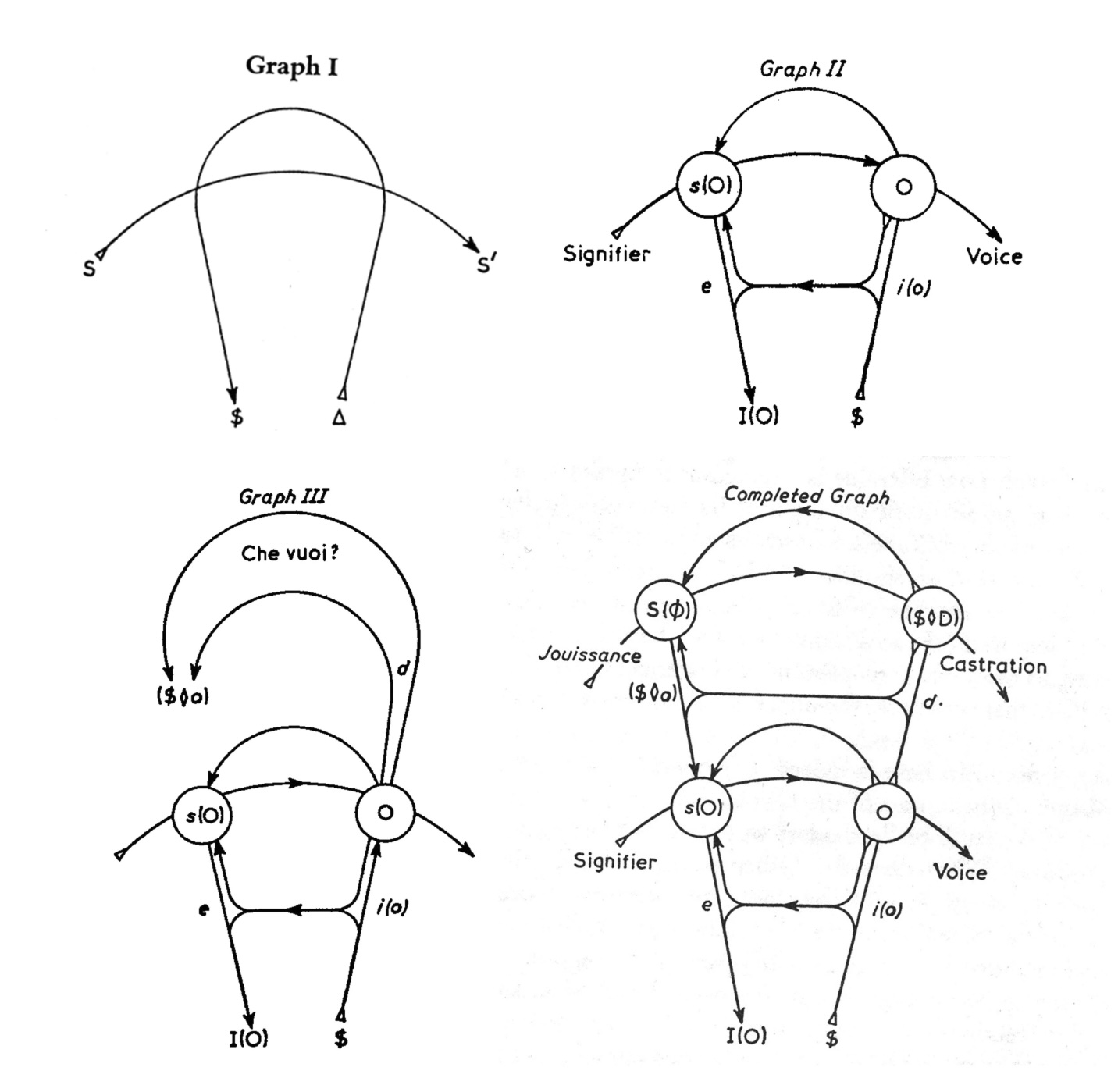 Do not read the four panels as four unrelated diagrams, or as a simple developmental timeline. They are four increasingly complete versions of the same structure: how a living being enters language, becomes a divided subject, seeks recognition from the Other, and then discovers that the Other cannot give a final answer.
 In Graph I, Δ marks the living being or raw need before it is fully taken up into language. It begins at the lower right and must pass through the signifying chain, S → S′. This chain means that no signifier has meaning by itself; one signifier receives meaning only through its relation to other signifiers. After passing through this chain, the subject appears at the lower left as $, the barred subject. The point is that language does not simply express an already unified self. Language divides the living being and produces a subject marked by lack.
Graph II places this structure inside the field of the big Other, O. Here O is not just another person. It is the symbolic field: language, law, social meaning, address, prohibition, and recognition. s(O) means the signified of the Other: the point where a message receives meaning from the Other. Be careful not to confuse s(O) with S(Ø) in the completed graph. Lowercase s means signified; capital S means signifier. The lower part of Graph II also shows ego formation. e is the ego, the ordinary “me.” i(o) is the ideal ego, the image in which I appear whole, lovable, coherent, or desirable. I(O) is the ego-ideal, the imagined point in the Other from which I am seen, judged, loved, or authorized. So i(o) and I(O) are different: i(o) is the image I try to become; I(O) is the gaze or standard before which I imagine that image being evaluated. The arrow toward “Voice” marks speech as more than meaning: voice is the force of address, command, seduction, accusation, or recognition that comes from the Other.
Graph III adds the question Che vuoi? — “What do you want?” More sharply, it means: “What do you, the Other, want from me?” This is where desire becomes other-directed. The subject no longer asks only, “What do I want?” The deeper question becomes: “What am I for the Other? What must I be in order to be desired, chosen, loved, or recognized?” The path marked d names desire. Desire is not the same as need. Need can be satisfied by an object, but desire remains because demand always asks for more than the object. It also asks for love and recognition from the Other. The formula $ ◊ o names fantasy: the barred subject, $, in relation to the object-cause of desire, o. The diamond, ◊, should be read as “in relation to” or “structured around,” not as a plus sign. Fantasy gives the subject a temporary answer to Che vuoi?: “If I become this image, obtain this object, win this gaze, or occupy this role, then perhaps I will finally be what the Other wants.”
The Completed Graph adds the upper circuit. The lower circuit concerns message, ego, image, identification, and recognition. The upper circuit concerns desire, demand, drive, jouissance, castration, and the failure of any final guarantee. $ ◊ D is the formula of the drive: the barred subject in relation to demand. Capital D means demand, not desire. Demand asks the Other for something, but beneath that request it asks for love, response, and recognition. Drive is what repeats around this demand even when no final satisfaction arrives. Jouissance names the excessive and often painful enjoyment attached to this repetition. “Castration” names the structural limit: neither the subject nor the Other possesses the missing object that would make desire complete. The upper-left term, S(Ø), means the signifier of the barred Other. Since this diagram uses O for the Other, Ø should be read as barred O. In standard Lacanian notation this is usually written S(Ⱥ). It means that the Other itself lacks a final guarantee. The Other gives language, law, meaning, and recognition, but it cannot finally tell the subject what it is or what it should desire.
So the movement of the whole graph is this: Δ enters language; the subject becomes $; the ego forms through e and i(o); the subject seeks recognition from I(O) and O; desire asks Che vuoi?; fantasy, $ ◊ o, tries to answer that question; drive, $ ◊ D, repeats the demand; and S(Ø) shows why the answer never finally closes. For the other-directed person, the crucial trap is between i(o) and I(O): they try to perfect the visible image, i(o), in order to satisfy the imagined gaze of the Other, I(O). But the completed graph shows why this cannot end in perfect recognition. The Other can recognize, name, desire, and judge the subject, but it cannot provide the final guarantee that would make the subject whole.
But here Deleuze and Guattari enter, not to rescue the ego, but to accuse Lacan of leaving desire too long before the mirror.
Their objection is not that Lacan is naïve. Quite the opposite. Lacan has already destroyed the bourgeois fiction of the sovereign self. He has shown that the ego is an alien image, that the subject is split by the signifier, that desire passes through the Other, that every “I” arrives already contaminated by recognition, language, fantasy, and lack. But Deleuze and Guattari think Lacan stops too late. He dismantles the ego, then leaves desire trapped inside a theater of absence. The subject is barred. The object is missing. The Other speaks first. The mirror lies. The signifier slides. The Thing is lost.
Deleuze and Guattari ask: why must desire begin as mourning?
Why should the first serious scene be a child staring into an image and discovering lack? Why should desire be forced to pass through mirror, father, law, prohibition, castration, and the missing object before it is allowed to exist? What if the mirror stage is not the origin of desire, but one of the first police operations performed upon it? What if the mirror does not reveal the structure of desire, but captures desire into a structure it then mistakes for destiny?
Against the mirror, they place the machine. A mouth connects with milk, thumb, air, cry, breast, word, kiss, cigarette. A hand connects with tool, skin, lever, weapon, brush, keyboard, money. An eye connects with light, mirror, screen, face, graph, wound, horizon. A child connects with rooms, animals, noises, colors, cities, gods, games, parents, screens, war. These are not symbols waiting politely for interpretation. They are couplings. They cut flows and release other flows. The breast produces milk; the mouth interrupts the flow; the interruption itself produces another circuit. Desire is not hidden behind the coupling. Desire is the coupling.
This is the meaning of the desiring-machine. It is not a metaphor for a little engine inside the soul. It is Deleuze and Guattari’s attack on the whole representational habit of psychoanalysis. The unconscious is not primarily a theater where father, mother, child, law, and forbidden object perform the same old drama in different costumes. The unconscious is a factory. It does not ask first, “What does this mean?” It asks, “How does this work?” What does it connect to? What does it interrupt? What does it produce? What social machine does it enter? What flow does it block? What circuit does it open?
Here their revolt against Lacan becomes exact. Lacan listens for the signifier. Deleuze and Guattari listen for the machine beneath the signifier. Lacan asks how the subject is spoken by the Other. Deleuze and Guattari ask what productive arrangements were reduced to speech in the first place. Lacan hears lack beneath desire. Deleuze and Guattari hear capture beneath lack. Lack, for them, is not desire’s essence. It is what desire looks like after it has been blocked, privatized, moralized, familialized, and made to confess.
Hence their hatred of Oedipus. Not because the family is irrelevant, but because psychoanalysis makes the family too central, too theatrical, too sovereign. The child’s desire does not begin and end with daddy-mommy-me. It runs through the whole social field. The father is not merely father; he is agent of a machine — work, law, class, discipline, money, language, punishment, permission. The mother is not merely mother; she too is a relay in larger systems of care, gender, exhaustion, economy, nourishment, prohibition, tenderness, and debt. The family is real, but it is not the whole stage. It is one apparatus through which a much larger field of desire is coded.
So Deleuze and Guattari do not say: there is no capture. They say: capture is larger than psychoanalysis admits. Desire is not born privately and then socialized afterward. Desire is social from the beginning. It invests schools, armies, markets, churches, offices, nations, futures. It does not need to be sublimated into society, because it was already there. The social field is not outside desire. It is one of desire’s machines.
This clarifies the mirror. Lacan is right that the ego begins as an alien image. But Deleuze and Guattari force us to ask what the image does. The mirror does not merely deceive. It arrests. It takes a swarm of connections and organizes them around a face. It says: be this. It takes the moving multiplicity of a life and gives it an outline, a name, a profile, a posture, a family story, a wound, a type. The ego is not only a misrecognition; it is a reterritorialization. It gathers molecular flows into a molar form. It takes the machine and hands back a portrait.
The mirror stage is both true and insufficient. True, because the ego really is born through alienating identification. Insufficient, because the ego is not the deepest truth of desire. It is one of desire’s captures. Beneath the mirror, before the portrait, there are flows. There are couplings. There are intensities, habits, repetitions, hungers, circuits, rhythms, bodily investments, social investments. The infant is not only asking, “Is that me?” It is already plugged into worlds.
The mirror says: become an image.
The machine says: make a connection.
The mirror says: seek recognition.
The machine says: produce a circuit.
The mirror says: you are this visible form.
The machine says: you are what passes through you and what you transform.
The mirror says: desire wants the missing object.
The machine says: desire does not lack its object; desire produces objects, worlds, attachments, territories, exits.
But the argument cannot simply become Deleuzian here. That would be too easy, and finally too American. America already speaks a vulgar Deleuzian language. It loves flows, disruption, reinvention, mobility, networks, innovation, acceleration, exits, pivots, experiments, deterritorialization. Leave your hometown. Break the rules. Build the future. Move fast. Scale yourself. Optimize your life. Become fluid. Become visible. Become new. On the surface, America looks like the land of the line of flight.
But this is exactly the trap. Capitalism does not oppose every line of flight. It harvests them. It waits for desire to escape one enclosure and then gives it a new market, identity, diagnosis, lifestyle, platform, aesthetic, or price. The rebel becomes a brand. The outsider becomes a founder story. The wound becomes content. The spiritual crisis becomes wellness. The refusal becomes merchandise. The line of flight becomes a subscription.
This is where Lacan must return against Deleuze and Guattari. Desire may be productive, but productive desire is not innocent. It is still routed through images, fantasies, signifiers, audiences, and the Other. The man who thinks he has escaped the mirror may only have chosen a more flattering mirror. The anti-conformist can become addicted to the image of himself as anti-conformist. The founder can call his compulsion vision. The artist can call his vanity necessity. The revolutionary can call his resentment justice. The nomad can become a tourist of his own instability.
Deleuze and Guattari know this danger better than their vulgar readers do. A line of flight can become a line of death. Deterritorialization can become addiction, psychosis, cult, fascism, sterile negation, private mythology, pure abolition. To flee the social is not yet to be free. Sometimes flight is only collapse with better metaphors. The mirror is a prison, but not every escape from the mirror is liberation. Some escapes only shatter the glass into sharper surfaces.
So the correction cuts both ways. Against Lacan, Deleuze and Guattari are right: desire cannot be reduced to lack, representation, family romance, or the subject’s endless appeal to the Other. There is a productive force beneath the mirror, a machinic life that connects before it explains, produces before it confesses, and assembles worlds before it asks to be recognized.
Against Deleuze and Guattari, Lacan is right: the subject does not ride flows into innocence. The mirror returns. The signifier returns. The Other returns. Fantasy returns. Capture returns. The very desire that flees the institution can become the institution’s next raw material. The machine can become a brand. The line of flight can become a profile. Production can become performance. The factory can become another theater.
The point, then, is not to choose the mirror or the machine. The point is to understand their war. The mirror is the apparatus by which life becomes an image of itself. The machine is the force by which life exceeds the image. The mirror gives unity, but as alienation. The machine gives movement, but without guarantee. The mirror makes the ego possible, and therefore makes human social life possible. The machine breaks the ego open, and therefore makes creation possible. The mirror domesticates. The machine deterritorializes. The mirror says: be someone. The machine says: become otherwise.
A serious theory of freedom needs both. Lacan without Deleuze and Guattari becomes priestly: law, lack, castration, melancholy, interpretation, and no creation. Deleuze and Guattari without Lacan become adolescent: flow, intensity, experiment, flight, and no account of fantasy, repetition, capture, or the mirror hiding inside revolt. One gives us the tragedy of subjectivity. The other gives us the violence of production. A serious account needs the wound and the engine.
This is especially true for the leader. The maker can afford more flight. The leader cannot. He must build forms for people who would otherwise drown in flux. Children need names. Institutions need procedures. Families need rituals. Companies need roles. Democracies need publics. A civilization cannot live as pure desiring-production. Unmediated flow is not freedom; it is flood. And yet every form the leader builds will try to become a mirror. The role will try to become the person. The institution will try to become truth. The procedure will try to replace judgment. The public image will try to consume the private source.
So the existential leader must hold Lacan and Deleuze-Guattari in one chest. From Lacan, he learns suspicion: every image lies, every recognition captures, every public identity reduces, every desire has passed through the Other. From Deleuze and Guattari, he learns not to confuse suspicion with paralysis: desire produces, machines connect, new assemblages are possible, lines of flight can open real worlds rather than merely mourn lost ones.
He must give people mirrors without letting them worship the reflection. He must build machines without letting them become meat-grinders. He must create institutions porous enough for desire to move through them, but strong enough that desire does not dissolve into flood. He must know that the ego is a fiction, yet not sneer at the human need for form. He must know that desire exceeds the family, yet not romanticize the person who cannot honor a bond. He must know that the public image is false, yet still appear before the public. He must know that language murders the thing, yet still speak in a way that lets the murdered thing tremble under the word.
The mature position is therefore neither Lacanian resignation nor Deleuzian intoxication. It is disciplined flight. Not flight from form, but flight through form. Not destruction of the mirror, but refusal to kneel before it. Not worship of desire, but the patient construction of conditions in which desire can produce without immediately being captured.
This returns us to solitude. Solitude is where one can tell whether the machine is still producing or merely performing. It is where one can feel whether the line of flight is opening a world or only fleeing a wound. It is where one can see whether the mirror has gone dark, or whether one has secretly carried a pocket mirror into the desert.
The person incapable of solitude cannot distinguish production from reflection. He thinks he is creating when he is only arranging a better image of himself. He thinks he is free because he has changed scenes, partners, jobs, cities, identities, platforms. But the same mirror follows him. The same Other speaks through a new accent. The same desire attaches to new objects and calls the repetition growth.
The serious maker must therefore pass through both tests. Lacan’s test: can you see the mirror as mirror? Deleuze and Guattari’s test: once you see it, can you still produce? Many pass the first and become sterile. Many pass the second and become captured. Few can look at the image without obeying it, then turn from the image and make something real. That is the narrow path. The ego begins as a mirror. Desire begins as a machine. Society converts machines into mirrors. Creation converts mirrors back into machines. Leadership builds houses where this conversion can happen without destroying everyone inside. So the dialogue does not end with victory.
Lacan says: you cannot escape the mirror, the signifier, the Other.
Deleuze and Guattari answer: perhaps not, but you can make them stutter.
Lacan says: desire is marked by lack.
Deleuze and Guattari answer: lack is what desire looks like after capture.
Lacan says: the subject is barred.
Deleuze and Guattari answer: then let the bar become a switch.
Lacan says: there is no outside of language.
Deleuze and Guattari answer: there are lines of flight inside it.
The answer is that both are true. The mind is captured by image and signifier, but it is not exhausted by them. The self is fabricated, but fabrication is not the end of creation. The word murders the thing, but the murdered thing keeps moving. Desire is captured by the Other, but it also builds machines under the floorboards of the Other’s house.
That movement — not pure escape, not reconciliation, but production under capture — is creativity. And the task of leadership is to keep the machine from becoming either a prison or a fire.
Don’t ask David about his weekends
Pretty isn’t pretty enough.
— Olivia Rodrigo
America terrifies me here, not because it lacks freedom in the ordinary sense, but because it is so efficient at substituting choice for freedom. It gives a man options before he has a self capable of choosing. It gives him speech before he has silence. It gives him society before he has solitude.
From the beginning he is pushed into organized sociality: kindergarten birthday parties, classroom Valentine cards, high-school sweethearts, promposals, dormitories, fraternities, clubs, internships, networks, romances, marriages, mortgages, children, management tracks, school districts — the whole cheerful procession by which people reproduce the tragedies of their parents and call the repetition maturity. The drumbeat is not always coercive. That is why it works. It arrives as opportunity, belonging, normal development, the next step.
The child learns early that to be uninvited is not merely to miss cake but to suffer ontological demotion. The empty chair becomes judgment. The lunch table becomes tribunal. The hallway becomes market. Childhood is socialized before it is inwardly formed, and adolescence only intensifies the regime: first crush, first date, first public humiliation, first photograph with the correct people, first ritual proving one is not alone. Hollywood understood this before sociology did. The American coming-of-age story rarely asks whether the child has become capable of solitude. It asks whether the child has been chosen.
That is the hidden theology of the high-school film: salvation by selection. The outcast must be recognized, the ugly duckling must be seen, the lonely girl must be asked to dance, the boy must win the girl, the loser must acquire a group. Almost no one is permitted to remain alone and complete. Solitude appears as wound, punishment, villain origin, or temporary plot device before reintegration. To be alone is not a form of strength. It is a problem the narrative must solve.
HBO gives the prestige version of the same apparatus. Euphoria turns adolescence into a neon panopticon: drugs, sex, identity, trauma, friendship, love, social media, self-harm, performance — no protected interior, every wound stylized before it has been understood. The Sex Lives of College Girls makes the dormitory explicit: four suitemates arrive at a prestigious college, and “freedom” immediately appears as exposure, sexuality, roommate drama, status, comparison, and performance. The title is already the thesis. College is sold as liberation; the dorm makes liberation communal, surveilled, narrated, and available for consumption.
Olivia Rodrigo gives the same regime its lyric nervous system. Her songs are not merely about teenage heartbreak. They are about adolescence after the mirror has become total: jealousy, beauty, comparison, public rejection, the humiliation of wanting, the nausea of being young while already watched. “all-american bitch,” “ballad of a homeschooled girl,” “love is embarrassing,” “pretty isn’t pretty” — the titles read like a phenomenology of American girlhood under social evaluation. The girl in the car is alone, but the solitude is already socialized by comparison. Desire is never simply desire. It is desire under observation.
So the dormitory is not the beginning. It is the consolidation. The child has already been trained to fear the empty chair. The teenager has already been trained to understand desire as public selection. The college student has already been trained to confuse freedom with exposure. The dormitory is the first soft adult enclosure; the fraternity is the rehearsal for public vulgarity: hierarchy disguised as brotherhood, appetite disguised as freedom, conformity disguised as loyalty. Then comes the couple-form, the public proof that one is not alone; then the family script, the moral excuse of repetition.
People who have never learned to be alone are invited to bind themselves permanently to others, and then to create children who inherit not wisdom but unresolved rhythm — the same hunger, the same fear, the same unconscious debts, transferred forward under the name of love. The tragedy is not that they marry. The tragedy is that they marry before solitude has done its work.
One hardly sees anyone alone in America. Or rather: one sees people physically alone, but almost never socially alone. The phone is the portable alibi. Earbuds, laptop, coffee, dog, calendar, errand, “waiting for someone” — each provides cover against the scandal of unsupported presence. A person sitting alone without excuse feels almost accusatory. He has failed to circulate. He has interrupted the economy of recognition. He does not offer the group enough handles. His solitude is read not as fullness but as rejection, and in America rejection of society is close to the worst sin.
The weekly liturgy makes this visible. Every Friday they ask: what are you doing this weekend? Every Monday they ask again: how was your weekend? The question is almost never malicious. That is why it works. It arrives as warmth, manners, harmless curiosity. But customs reveal metaphysics more faithfully than doctrines do. You are not simply being asked about leisure. You are being asked to produce evidence of participation. The weekend must return with receipts: Martha’s Vineyard, Nantucket, beaches, brunch, tennis, hiking, weddings, dinner parties, a tasteful “reset,” a socially legible exhaustion. Pleasure is almost secondary. What matters is that the absence can be accounted for, that the private interval can be converted back into proof of circulation. The tan is a receipt. The sunburn is proof of belonging. Leisure has become an audit.
And you are supposed to impress. Not crudely, not always with money, but with a life. The answer must show that one has friends, motion, romance, health, taste, access, appetite, a calendar full enough to prove one has not been abandoned by the world. “Nothing” is an unacceptable answer unless it can be translated into wellness: I needed to recharge, I stayed in and cooked, I had a quiet one. Even idleness must now justify itself in therapeutic language. The truly private answer — I did not want to be seen; I read; I walked; I disappeared; I allowed no one to verify that I existed — lands as discomfort. It produces the small worried pause. Are you okay?
For an otherwise privacy-conscious nation, this customary intrigue into other people’s pastimes is suspicious. Americans defend privacy as property: my house, my body, my data, my medical record, my legal boundary, my right against intrusion. But social privacy — the right not to become narratable — is much less secure. The private life is tolerated when it can be reported. It becomes suspicious when it remains opaque. The same culture that tells the state to keep out asks the coworker, the classmate, the neighbor, and the casual acquaintance to disclose the choreography of leisure every week.
This is the transparent society in miniature. Transparency does not abolish secrecy by force; it makes opacity feel antisocial. It turns the unreported life into a kind of insult. Why would you not say? Why would you not share? Why would you not turn your weekend into small talk, your solitude into content, your private time into proof of normalcy? Transparency presents itself as warmth, but it is also surveillance softened into manners. The Friday question is the panopticon in khakis.
Goffman would have recognized the dramaturgy immediately. The weekend is supposed to be backstage time: the interval when the costume loosens, the office voice drops, the social face comes off, and the self no longer has to sustain the version of itself required by school, work, friendship, romance, family, and public competence. It should be the time in which one disappears from the audience and returns to the unlit room where no role has to be held upright. But American sociability drags the backstage back onto the front stage. Friday’s question is already a cue. It asks for a trailer. Monday’s question asks for the performance report. The private interval, which ought to be where performance drops, becomes material for the next performance.
Even rest must be impression-managed. One cannot simply disappear. One must disappear correctly. “I did nothing” is acceptable only if translated into the authorized dialects of wellness, exhaustion, productivity recovery, or tasteful domesticity. The raw answer — I withdrew from the world because I wanted no witnesses — cannot be spoken without producing concern. It threatens the whole grammar of sociability. The private life has to return with a public explanation. The back room is no longer allowed to remain a back room; it must send a postcard to the front.
This is the strange genius of the custom. It does not feel like surveillance because it arrives as warmth. No one is accusing you. They are only asking. But the question installs an audience retroactively inside your leisure. While you are supposedly away from the group, the group is already waiting to receive the story of your absence. The weekend becomes not an exit from performance but deferred performance, raw material gathered for Monday’s conversational market. One lives the event twice: first as experience, then as report. And increasingly the report begins governing the experience in advance. One chooses the dinner, the beach, the hike, the party, the trip, the photograph, the tan, the anecdote, because some part of the mind is already standing under Monday’s fluorescent lights, answering.
Veblen would have recognized it too. This is conspicuous leisure stripped of aristocratic grandeur and democratized into small talk. One need not own a yacht to perform status. One need only return from the weekend with a story that signals access, vitality, taste, belonging, romance, health, busyness, and immunity from emptiness. A wedding upstate, a beach house, a reservation, a run, a retreat, a museum, a farmers’ market, a casual sunburn — these are not merely activities. They are receipts. The tan is evidence. The ferry ticket is a credential. The exhausted Monday smile is proof that one’s life has been socially consumed.
The old leisure class displayed freedom from labor by wasting time visibly. The modern professional displays freedom from emptiness by filling time visibly. He must show that he is not merely employed, but in demand; not merely resting, but recovering; not merely consuming, but curating; not merely living, but living in a form that can be narrated without shame. Leisure becomes another economy of reputability. The worker spends the week proving he is useful and the weekend proving he is not spiritually poor. Then he returns to the office and submits the proof through anecdote.
The vulgarity is subtle because it often hides inside modesty. The story need not be boastful. In fact, crude boasting would spoil the form. The ideal report is casually impressive: we just went up to Nantucket for a couple days; nothing crazy; just needed sun. The status lies in the offhandedness. The ease is the performance. The weekend must appear unforced while being perfectly legible. It must suggest a life rich enough to be understated. Even exhaustion becomes ornamental: I’m so tired, but it was worth it. Fatigue becomes the afterglow of belonging.
The result is a society in which the backstage is progressively colonized by the front stage. Rest becomes content. Solitude becomes a reportable wellness practice. Travel becomes proof of taste. Friendship becomes evidence of social health. Romance becomes public reassurance. Even staying home must be narrated as self-care, not refusal. The unreported interval becomes intolerable because it cannot be placed. It has no handles. It cannot be liked, envied, explained, or folded back into the group’s understanding of who you are.
He does not merely consume goods; he consumes scenes. He does not merely buy the watch; he buys the life in which the watch makes sense. The watch requires the sleeve, the restaurant, the airport lounge, the beach, the wine glass, the photograph, the conversation, the implied calendar. Status no longer attaches only to possession but to mise-en-scène: the staged world in which possession becomes natural. The same people want the same watch, the same kitchen, the same vacation, the same wedding photographs, the same careful informality, the same “quiet luxury,” the same life. They do not want the object. They want the object’s permission to inhabit a prefabricated image of freedom.
And here Deleuze and Guattari return. The social machine does not merely repress desire. It produces desire in prefabricated forms. It manufactures the couple, the career, the house, the watch, the wedding, the foreign vacation, the tasteful rebellion, the “unconventional” life already standardized by a thousand examples. The subject does not experience this as coercion. He experiences it as wanting. That is the brilliance of the apparatus: it does not need to forbid the private soul when it can stock the shelves of desire in advance.
A man says, this is my taste, but taste has already been trained. He says, this is what I want, but wanting has already passed through advertisements, peer groups, inherited class anxieties, sexual competition, parental scripts, platform images, and the silent terror of being left out. He says, this is my life, but the form of the life was waiting for him before he arrived. Desire is not a little private treasure buried inside the subject. Desire is produced, arranged, connected, routed. It runs through families, markets, schools, offices, screens, cities, and myths.
So he wants the same watch because the watch is not a watch. It is permission to inhabit the same image of life. He wants the same weekend because the weekend is not a weekend. It is a unit of social proof. He wants the same partner because the partner is not only a person but a credential of normalcy, desirability, and completion. He wants the same foreign vacation because the foreign place is not a place but scenery for self-renewal. He wants the same rebellion because even rebellion has been templated. He wants the same life because a different life would require solitude first, and solitude is precisely what the apparatus has taught him to fear.
The deepest capture is not that everyone chooses the same thing. It is that everyone experiences the same thing as personal. The menu has entered the appetite. The prefabricated life does not appear prefabricated from within, because the subject feels desire sincerely. He really does want the trip, the body, the room, the ring, the dog, the school district, the photograph, the tasteful deviation from convention. Sincerity is not enough. One may sincerely desire what has been desired on one’s behalf.
Even foreignness is metabolized by the machine. The tragedy is not intercultural love; real love can cross every border. The vulgarity is the instrumentalization of foreignness, when the foreign beloved becomes proof of exception, a prop in the theater of not being ordinary. The other becomes accessory, scenery, passport stamp, exotic supplement to a self that remains untouched. The American who cannot bear his own prefabrication tries to borrow foreignness as decoration. He does not want the other’s world to rupture his own. He wants the other as evidence that his life is not as standardized as it feels.
The White Lotus is almost too perfect a parable for this. The resort converts place, staff, culture, sex, and difference into material for the visitor’s self-narration. The foreign or semi-foreign world does not break the guests open; it becomes mirror, therapy, temptation, danger, service, backdrop, and moral test. They leave not transformed, but better narrated. The show works as satire because the form is already real: American interior poverty outsourcing itself to scenery.
The horror, then, is not that Americans conform. Everyone conforms. The horror is that conformity arrives wearing the language of self-expression. The prefabricated life does not feel imposed because each station is presented as a choice. Choose your college. Choose your friends. Choose your major. Choose your city. Choose your partner. Choose your house. Choose your child’s school. Choose your therapy language. Choose your brand of rebellion. Choose your weekend. But the sovereign question — whether the whole sequence has authority over you at all — is postponed until it becomes socially impossible to ask.
Being alone becomes the unforgivable act. The solitary person does not merely opt out. He reveals the machinery by not needing it. He exposes the group’s dependency on mutual confirmation. He shows that the party may not be joy, that the couple may not be love, that the family may not be wisdom, that the network may not be friendship, that the watch may not be taste, that the life everyone wants may have been wanted for them before they arrived. His solitude is offensive because it is diagnostic.
What America cannot forgive is not loneliness, but opacity. Not opacity as deception. Not secrecy as manipulation. But the sovereign opacity of a life not submitted for social reading. The person who remains unavailable — not unavailable as pose, not mysterious as brand, not avoidant, wounded, superior, or theatrically obscure, but simply unavailable to premature interpretation — commits the deepest refusal. He does not let the group finish his sentence. He does not let the weekend explain him. He does not let his leisure become evidence. He has recovered the condition prior to prefabrication: the capacity to exist without immediately becoming content for others. That is the distinction vulgarity cannot forgive.
The market is the first great American reducer of absolute freedom. It rarely forbids the soul; it prices it. Marx’s account of alienated labor, Veblen’s of conspicuous consumption, and Debord’s of the spectacle all converge here. Debord’s sentence remains devastating because it names America’s particular genius: the lived act becomes image; the image becomes social currency; the currency becomes incentive; and the incentive loops back to govern the act. Even rebellion must appear, circulate, and be consumed. The rebel becomes a type. The artist becomes a market segment. The founder becomes a pitch deck. The free spirit becomes content.
Bureaucracy is the second reducer. Weber’s iron cage names the modern condition in which rationalization culminates in the loss of freedom and meaning, but America’s cage is rarely iron in appearance. It is procedural, polite, credentialed, optimized, and full of good intentions. It speaks the language of process: apply here, format this, document that, comply with policy, align with the metrics, respect the stakeholders, scale responsibly. Marcuse pressed the deeper point: technological rationality is not neutral rationality but a political form, an order through which human beings and nature alike are made into fungible objects of organization. In that world judgment is replaced by administration. The institution never says do not be free. It says: translate your freedom into a form we can process.
Publicity is the third reducer, and here the machinery of the previous section returns wearing American clothes. Foucault’s panopticon showed why visibility itself is a trap: the subject is individualized, observed, separated, made governable by the mere possibility of being seen. Deleuze carried this forward into the society of control, where enclosure gives way to continuous modulation — codes, access, tracking, profiles, scores, the conversion of persons into dividuals. Han closed the circuit by seeing that the most advanced domination now presents itself as freedom: the achievement-subject no longer needs a master, because he exploits himself in the name of possibility, productivity, and self-realization. This is the networked American — not imprisoned but always updating, not censored but always performing, not commanded but always nudged. The old tyranny said obey. The new tyranny says share.
Riesman gave the sociological type: the other-directed person, What I called the value extractors. governed less by an inward standard than by radar. He may look flexible, tolerant, expressive, even free, but the freedom is mostly atmospheric. He is always sensing the room, always adjusting, always translating himself into the form least likely to lose approval. His conscience does not speak from a fixed interior law; it pings. A glance, a silence, a delayed reply, a shift in tone, the faint cooling of a group — these become moral events. He is free to choose and never free to stop needing confirmation that the choice was acceptable.
ther-direction is more dangerous than simple conformity. The conformist obeys a rule and can sometimes be made to see the rule. The other-directed person obeys a climate. His submission is mobile, intelligent, socially fluent, and therefore almost invisible to himself. He does not experience himself as obedient. He experiences himself as responsive, empathetic, realistic, well-adjusted. He calls radar sensitivity. He calls dependence openness. He calls the absence of an inward standard maturity.
He is the 小人, the small man, of the Analects raised to a sociological form — the man who 求诸人, who seeks himself forever in others, and has lost the organ that could seek in himself. The Confucian contrast is exact because it is not merely moral but directional. The 君子 turns inward first; he asks what in himself must be corrected, strengthened, clarified, or restrained. The 小人 turns outward first; he asks where approval lies, who has status, what the room will permit, which desire is safe to display, which opinion will travel. His self is not anchored but reflected. He does not stand; he registers.
Such a person can be very successful in a soft society. In fact, he may be selected precisely because he is adjustable. He will not embarrass the institution with excessive inwardness. He will not cling to a private judgment once the room has moved. He will be subtle, pleasant, legible, promotable, and safe. But he cannot produce freedom, because freedom requires an organ he has allowed to atrophy: the capacity to consult something other than the room.
These reducers do not abolish freedom. They convert it. The market converts freedom into preference. Bureaucracy converts it into process. Publicity converts it into image. Other-direction converts it into social calibration. Together they produce the American substitute: a person who feels free because he is always choosing, expressing, optimizing, updating, and explaining himself, while the deeper freedom — the freedom to withdraw authority from the whole arrangement — grows harder and harder to reach.
This is why the previous culture critique matters. The birthday party, the lunch table, the high-school selection ritual, the dormitory, the fraternity, the weekend audit, the tasteful vacation, the socially legible exhaustion — these are not trivial customs. They are the training-ground of the legible chooser. They teach the child to experience recognition as existence, selection as salvation, participation as proof, and solitude as defect. By the time political liberty arrives, the deeper liberty has already been compromised. The person is free to vote, but not free from the need to be confirmed; free to speak, but not free from the borrowed language in which speech must become acceptable; free to choose, but not free from the prefabricated desire that makes the choice feel personal.
A civilization that makes aloneness logistically difficult and then pathologizes the wish for it — solitude reclassified as loneliness, loneliness as a disorder to be treated, opacity as evidence that something must be wrong — arrests the development of its members and calls the arrest togetherness. It produces people who can circulate, perform, pair, reproduce, manage, and narrate themselves, but who cannot easily return to the private source from which judgment begins.
Larkin said the family transmission with such cruelty that This Be The Verse survives mostly as a joke, but the joke is bearable only because the wound is recognizable: damage is handed forward before anyone has had the solitude to inspect it. Jung named the same mechanism from another angle: nothing weighs more heavily on a child than the unlived life of the parent. Freud gave the loop its clinical name: repetition compulsion. The other-directed self, never left alone long enough to find the private source, cannot examine the inheritance, and so it transmits it — the same tragedies, faithfully reproduced, mistaken for love; the crowd mistaken for belonging; the wheel turning.
The capacity to be alone is not a luxury of temperament. It is the one thing that can stop the wheel. So the thesis stands more sharply. America does not abolish freedom; it metabolizes it. It takes the dangerous form of freedom — inward, negative, solitary, world-refusing, unpriced, unprocessed, unperformed — and converts it into acceptable forms: consumer choice, career path, personal brand, therapeutic narrative, public identity. Every force says, warmly: become yourself, but only in a way we can recognize.
That warmth is the point. The old enemy of freedom announced itself as command. The new enemy arrives as possibility. It does not say no. It says yes, infinitely. Yes, choose. Yes, express. Yes, optimize. Yes, share. Yes, become visible. Yes, become authentic. Yes, become productive. Yes, become healed. But each yes places the subject more deeply inside the apparatus that defines what counts as a meaningful choice, a valid expression, a productive life, an authentic self. Opportunity becomes the most refined form of capture.
This is why absolute freedom, here, must appear antisocial. Not because it hates others, but because it refuses the machinery by which the self is made available too soon. It does not want merely to dissent within the public language; it wants to recover the private source from which any real dissent must come. The solitary person is offensive because he does not immediately circulate. He interrupts the economy of recognition. He does not give the group enough handles. He withholds himself, and withholding is experienced by vulgarity as judgment. Reticence becomes arrogance. Independence becomes pathology. Silence becomes hostility. The person who can be alone reveals, merely by standing there, how few others can.
And it is here that an unlikely company converges — Emerson, Kierkegaard, Sartre, Tocqueville, Mill, Foucault, Deleuze, Han — on a single recognition: the enemy of freedom is not only coercion. It is conformity, visibility, utility, legibility, optimization, and the soft terror of being understood too quickly. The American tragedy is therefore sharper than the European one. In the old world the enemy of freedom often wore an unmistakable face — king, church, censor, class, party, police — and could at least be named and resisted. In America the enemy arrives as opportunity. It says: speak, choose, build, express, optimize, monetize, connect. It almost never commands silence. It does something more complete. It turns speech into content, solitude into pathology, judgment into preference, creation into innovation, and freedom into lifestyle.
The world is 草台班子 — a vast makeshift troupe, ad-libbed, taped together, no one quite in charge. Institutional rationality was never meant to replace judgment; it was meant to scaffold it. But modern America has made the scaffold into the building. It has mistaken process for wisdom, credentials for authority, consensus for truth, optimization for life. The institution asks whether you have followed procedure. The free person asks whether the procedure has any authority over truth. The institution asks whether your action is legible. The free person asks whether legibility has become another name for servitude.
The free person’s first act, then, is not political but metaphysical. He must refuse the substitution. He must insist that a thousand choices do not add up to one free soul. He must defend the private, silent, untranslatable center from which all real judgment begins. Rights, markets, platforms, options, audiences, and exits are not nothing. But none of them is absolute freedom. Absolute freedom is never given. It is asserted: against the world, against the institution, against the public, and finally against the fabricated “I” that has learned to mistake adaptation for life.
That last assertion is the hardest, and it returns us to the office no one volunteers for. The existential leader is the person required to operate the very machinery this whole indictment is against — to run markets, institutions, procedures, platforms, families, publics, the whole makeshift troupe — and to refuse, in the silence of his own chest, to be metabolized himself. For him the capacity to be alone is not a retreat from the work. It is the only thing that makes the work survivable. It is the polished mirror kept behind the empty tower: the one surface in which he can still tell his own face from the reflection the room would prefer.
Die Stimme des „Man“
We really did conquer and dismember 2,656 men.
— Late Shang oracle-bone inscription, Heji 7771
All of which returns to one question: where did the voice come from?
Not the literary voice, not style, not temperament, but the command-voice: the imperative that rises inside the skull already wearing authority. The voice that says do this, do not do that, be ashamed, answer, perform, confess, prove yourself, be good. It does not feel invented because it arrives before invention. It speaks first; only afterward does the mind forge a signature and call the order “mine.”
Ours is a self-domesticated species — Wrangham’s tamed ape — but domestication never merely softens the animal. It divides it. Wrangham’s self-domestication thesis turns on the selection against reactive aggression in Homo sapiens, with coalitionary punishment and “language-based conspiracy” proposed as mechanisms by which violent dominance was selected against from within the group. The result is not innocence. It is internalization. The hand that once struck the rival learns to grip the self. The tribe enters the nervous system. The fence no longer has to stand outside the body; it can be installed behind the eyes.
Inside each skull, then, a fabricated “I” issues orders in language and signs them as our own. But this “I” is not a king. It is a clerk with a stolen seal. It is a late administrative fiction, a palace erected over older command-structures: parental prohibitions, ritual formulas, ancestral threats, tribal passwords, rewards, punishments, purity codes, shame reflexes, all sedimented into the grammar of personhood. The “I” is itself a kind of weight system: seeds laid down by rite and fear, by praise and humiliation, by repetition so deep it no longer feels like repetition. A storehouse the self mistakes for a sovereign.
And here the deeper violence begins: the word is the murder of the thing. Not its mirror, not its servant, not the transparent pane through which reality passes untouched, but the first little execution by which reality becomes usable. The thing, in its idiotic fullness, cannot enter the human world whole. It has to be cut down. It has to be named. Before the word tree, there is not “a tree,” but this wet bark, this insect traffic, this exact green pressure against the eye, this shadow moving over the ground, this living excess that refuses summary. The word saves it by killing it. It makes the thing portable by making it dead.
That is what language does to the world before it does anything else: it embalms. A name is a coffin small enough to carry in the mouth. Once named, the thing can travel, be exchanged, taught, commanded, inherited, worshipped, taxed, remembered, forbidden. But what travels is never the thing itself. It is the corpse-form of the thing, its symbolic remainder, its socially acceptable ghost. To speak is to live among these ghosts and gradually forget that they are ghosts.
And once the thing can be murdered into a word, the person can be murdered into a role. Child. Citizen. Sinner. Patient. Leader. Failure. Genius. Criminal. Man. Woman. Self. Each name is a ritual reduction, a social killing that allows the body to be handled by the tribe. The named one becomes communicable, governable, searchable, punishable. The word does not merely describe the cage. The word is the first bar of the cage.
This is why the “I” is already suspect. It is not the speaker standing behind language, untouched. It is one of language’s most successful corpses: the living animal reduced to a name it can answer to. The child is summoned so many times by the same sound that eventually it turns toward itself from within. The call becomes interior. The name becomes a hook. The hook becomes identity. Then the creature says “I” and thinks it has discovered a soul, when perhaps it has only learned to obey the grammar of possession.
Once, the snare was kin and altar. The command came from the dead, the father, the chief, the god, the mask, the drum. It was staged in smoke. It spoke through bone, bronze, blood, omen, sacrifice. Its authority depended on distance: the voice was powerful because it came from elsewhere. Jaynes’s bicameral hypothesis gives this scene its most dangerous modern form: before reflective consciousness, he argued, commands were experienced as externally generated auditory voices, often interpreted as gods; later social complexity, writing, and cultural change helped weaken that older arrangement. The theory remains controversial, but as an image of command before interiority, it is almost too useful.
Now the snare is the network, but the apparatus is recognizable. The altar has become the screen. The oracle bone has become the notification. The god no longer needs thunder; it vibrates softly in the pocket. The command is no longer delivered by a priest in animal skin, but by a red badge, a read receipt, a typing indicator, a dashboard, a trend, a feed that learns exactly where obedience begins. The old voice said, “Heaven commands.” The new voice says, “Everyone has seen this.” The old king watched the cracks in bone. We watch engagement. He asked whether Heaven still charged him with power. We ask whether the graph is rising.
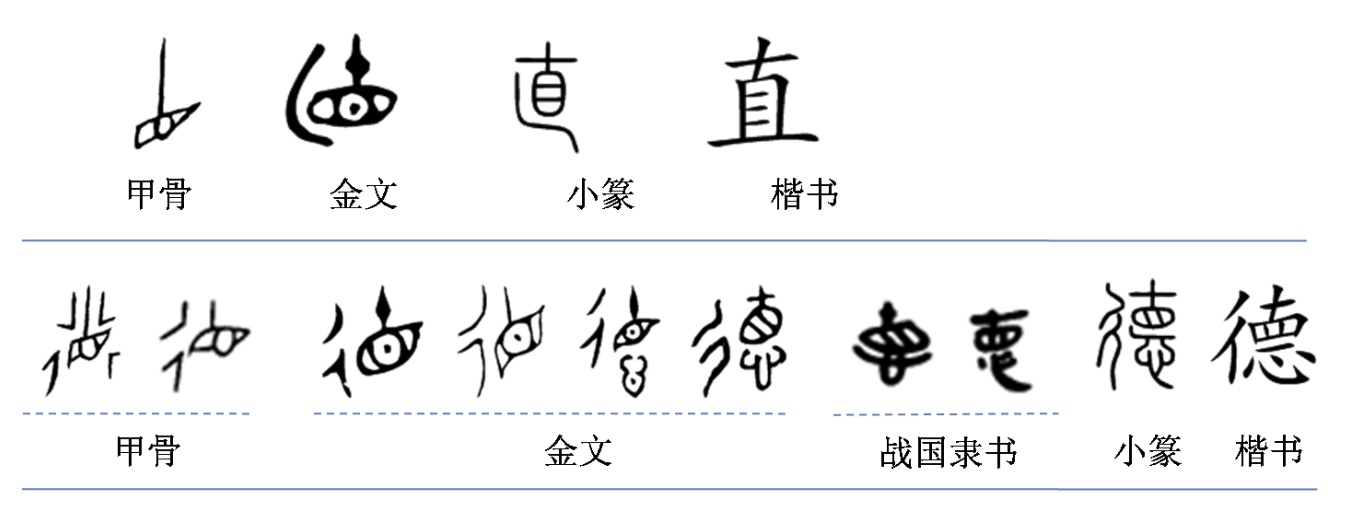 The image traces the historical forms of 直 (zhí, straight/upright/direct) and 德 (dé, virtue/moral power). The labels mark script stages: 甲骨 oracle-bone script, c. 1250–1046 BCE; 金文 bronze inscriptions, c. 1100–256 BCE; 战国隶书 Warring States clerical script, c. 475–221 BCE; 小篆 small seal script, standardized in the Qin period around 221 BCE; and 楷书 regular script, developing from around the late Han period, c. 2nd–3rd century CE onward.
 And the sinologists, oddly, have handed us the founding scene. The word 德 did not begin as the moralized, schoolroom “virtue” it later became. Its early field is unstable and charged: power, potency, efficacy, character, inner force, charismatic authority, moral force. Waley’s influential translation title, The Way and Its Power, already pulls 德 away from mere ethical niceness and back toward force. More recent scholarship is careful not to reduce 德 to one meaning, but many discussions of early 德 acknowledge a field of potency: a force that may appear as moral authority, beneficence, charisma, inner power, or transformative efficacy.
Here is the crucial inversion: before 德 became what one ought to be, it was what made things happen. It was not yet conscience; it was charge. Not inward goodness, but outward efficacy. The ruler had 德 when the world still answered him: when rain came, crops rose, enemies broke, ancestors responded, omens spoke, troops held, sacrifices took. 德 was not a private glow but a public voltage. The king-shaman did not govern by opinion. He governed by reception. He was the body through which the invisible order became audible. 直 begins as a picture of seeing, not of a line. The oracle-bone graph is an eye (目) with a single vertical stroke standing on it — an eye sighting along a straight edge, the way you close one eye and look down a rod to check it runs true. The root sense is therefore perceptual: a straight line of sight, “to look straight,” and only from that does the adjective straight / upright / direct follow. The Han-dynasty Shuowen later rationalized the frozen form as 十 + 目 + 乚 — “ten eyes see it,” 正見, correct seeing, the moral being that what many eyes watch cannot go crooked — but that reads a numeral “ten” into what was originally just the sighting stroke. Across the chart above you can watch the picture harden into a sign: in the bronze forms the eye squares off and the line thickens; by the small seal script it sets into the canonical stack (cross-stroke over eye over a hooked base); the clerical and regular hands flatten the whole thing into today’s 直. Nothing moral has happened yet. The character still only means straight. Then the heart is added, and that addition is the entire story of 德. The earliest 德 graphs, in the oracle-bone script, are just 彳 + 直 — the “step/road” element (彳, the left half of 行, a way) beside the straight-sighting eye. The sense is outward and behavioral: to go straight along the road, to hold a correct course, conduct without crookedness. There is no interiority in it; it is closer to the way one marches than to what one is. The decisive change comes in the Western Zhou bronze inscriptions, exactly the stage the restored 金文 glyph shows: 心, the heart-mind, is set underneath 直. Now the graph reads 彳 + 直 + 心 — a straight gaze and a straight heart, carried onto the road. There is even a standalone old word for virtue, 悳, simply 直 over 心, “straight-heart”; 德 is that word with 彳 added, the upright heart set in motion. The timing is not accidental, and this is where the etymology becomes philosophy. Western Zhou is precisely when 德 becomes the keyword of the Mandate of Heaven (天命): the Zhou justify their conquest by saying the Shang forfeited their 德 and they themselves possess it. So the graphic interiorization — heart inserted beneath conduct — mirrors the conceptual one. Virtue migrates from “the straightness of your steps” to “the rightness of your heart, made visible in your steps.” The classical commentators then close the loop with a pun: 德者,得也 — virtue is what is gotten, 内得于己,外得于人, inwardly realized in oneself and outwardly extended to others. That gloss is not arbitrary; 德 and 得 (to obtain) were near-homophones in Old Chinese, and 直 itself carries the sound as well as the sense — it is doing double duty in 德 as phonophore and meaning. The character is at once 会意 (straight + heart + conduct) and 形声 (the 直 phonetic under the 彳/心 semantics). In the Analects, 直 is itself a cardinal virtue — 人之生也直, “human life is grounded in uprightness,” and in the hard case of the son who shields his father, 直在其中矣, the straightness lies within the concealment, not against it. 德 becomes the cultivated moral force of the junzi: 为政以德, governing by the gravitational pull of character rather than coercion. In the Daoist register it turns again: 道生之,德畜之 — 德 is the Dao made concrete and nourishing in a particular thing, its specific power-to-be. But the spine never changes from the graph: read the chart left to right and top to bottom and it spells out a single sentence — a straight gaze (直), then a straight gaze on the road (彳直, conduct), then a straight heart on the road (彳直心, 德). Perception moralized into character. 心正而行之 names the hinge exactly: the heart made straight, and then walked.
Even the graph seems to remember this older machinery. Discussions of the early form of 德 often point to components associated with movement or conduct, an eye, straightness, and later the 心, the heart-mind. Some scholars read the eye-and-straightness complex through 直, the straight gaze; others warn that the component may function phonologically rather than semantically. But the conceptual drama remains irresistible: an external gaze, an aligned seeing, eventually pulled inward and joined to the heart. The antenna becomes an organ of conscience.
The Shang state was built around this terrible technology of reception. Oracle bones — ox scapulae and turtle plastrons — were cracked and read as conduits to ancestors and powers; kings asked about weather, illness, dreams, hunting, war, childbirth, harvest, disaster. Divination was not decorative superstition. It was government by fracture. The polity listened to heat-split bone the way we listen to data. Sacrifice was part of that system too: inscriptions and archaeological reports record offerings to spirits and ancestors, sometimes involving large numbers of human victims. The world answered, but it had to be fed.
And the cost of being the one through whom the voice passed was grave. A ruler whose charge ran dry was not merely mistaken; he was cosmologically exhausted. When the signal failed, the king did not need correction. He needed replacement. This is the part the essay turns on: sovereignty as battery, kingship as dangerous conduction. To bear 德 was not to possess a stable virtue but to stand under voltage. The king was not the owner of the voice. He was its temporary medium.
So when the voices thinned, the sacrifices intensified. That is the Bronze Age panic beneath the theology: too many strangers, too many tongues, too many rival commands, too many broken feedback loops. The old world had depended on the fusion of social order and cosmic instruction; once those commands began to conflict, the apparatus did not at first become rational. It became louder. It fed more blood into the machine and demanded that Heaven speak again.
Then comes the last Shang king, the battlefield at Muye, and the meter falling to zero. Traditional accounts describe the Shang forces turning against him or collapsing before the Zhou; after defeat, the king fled to the Deer Terrace, adorned himself, entered the fire, and died. Read politically, it is the fall of a dynasty. Read through 德, it is a failed reading: the army itself becomes the oracle. When the troops turn, Heaven has already spoken. The king’s 德 is spent. He makes himself the final offering on the terrace, and the voice goes silent over the land.
Then the existential leader proper: the Duke of Zhou standing under a quiet sky before a bewildered people. The old signal cannot simply be summoned back. Something else must be built in its place. Later tradition associates the Duke of Zhou with the formation of the Zhou ritual-music order, the 礼乐 system by which ceremony, rhythm, hierarchy, gesture, mourning, marriage, rank, and sound are made to govern the body before argument begins. Ritual-music is not ornament. It is an operating system for post-oracular humanity.
Its genius is that it converts the external command into an internal battery. What once came as divine voice becomes trained posture, patterned feeling, anticipatory shame, reverent hesitation. The god no longer has to speak from the right side of the skull. The rite teaches the body to speak against itself. Stand here. Bow now. Mourn this long. Desire within measure. Speak according to rank. Eat, marry, inherit, grieve, and rule in the correct form. The command becomes choreography. Repetition becomes inwardness.
心 matters. The heart-mind enters not as sentimentality but as a new site of governance. In later Confucian thought, especially with Mencius, 良心 — conscience, or the good heart-mind — becomes the place where moral response appears as if from within. Mencius’s account of the heart-mind treats moral awareness as something rooted in affective-cognitive tendencies: compassion, shame, deference, and the sense of right and wrong. The old god-command has become an inner scale.
That is the terrible purchase. We bought reflection by swallowing the altar. We bought reason by internalizing command. We bought the self by turning the god into a pressure differential inside the chest. Jaynes ends with something like a sigh because consciousness, in this frame, is not simple liberation. It is a new burden. Once the gods fall silent, the human being must host the argument formerly conducted by Heaven. The command does not disappear. It becomes anxiety. It becomes deliberation. It becomes the permanent inward friction we dignify as moral life.
And now, after the long detour through conscience, the apparatus returns wearing digital clothes. The network does not abolish the inner voice; it re-externalizes it. It gives conscience a crowd, shame a counter, desire a marketplace, obedience a refresh rate. The notification is a tiny oracle because it interrupts from elsewhere. The feed is ritual because it trains attention by repetition. The profile is altar because it asks for curated offerings. The algorithm is priest because it knows which sacrifices keep the god awake.
So the “I” is pressed from both sides: from below by the old deposits of rite and prohibition, from above by the new sky of metrics and social weather. It calls this condition freedom because no one appears to be holding the whip. But the whip has become probabilistic. It has become interface. It has become the little tremor before opening the app, the shame after not replying, the anticipatory self-editing before speech, the silent calculation of how the tribe will read the offering.
The no you hear when you reach for the forbidden thing is not simply yours. It is ancestral software. It is three-thousand-year-old code, patched by parents, teachers, priests, bureaucrats, lovers, bosses, platforms, and ghosts. It is Shang bone-crack, Zhou music, Mencian heart, Christian guilt, bourgeois discipline, therapeutic vocabulary, and notification logic all speaking in the first person. It says “I” because that is how command survives after gods.
The word murders the thing; the pronoun domesticates the animal; conscience signs the warrant. This is not metaphor only. Lacan’s formula is brutal because it names the symbolic bargain: the symbol appears as the murder of the thing, and by that death desire becomes durable, transmissible, historical. The thing must die into language before it can enter memory. The body must die into a name before it can enter law. The god must die into conscience before it can enter the self.
So the murder is also the birth. This is the paradox language never resolves. Without the word, the thing remains mute immediacy, outside history, outside transmission, outside law, outside memory. With the word, it enters the human world only as loss. The symbol is a tomb that makes civilization possible. Every culture is built from these tombs: dead things arranged into meaning, dead gestures called ritual, dead voices called tradition, dead prohibitions called morality, dead metaphors called truth.
The voice did not come from nowhere. It came from the long domestication of terror into grammar. It came from sacrifice made portable. It came from Heaven relocated into the heart.
And the mind never settles because it is not one thing listening. It is the old animal, the old altar, the old king, the old crowd, the new machine, and the fragile clerk called “I,” all trying to use the same mouth. And somewhere beneath that mouth, beneath every word it speaks, the murdered thing continues to rot, glow, leak, resist. The corpse will not stay buried. The world keeps exceeding its names. The self keeps exceeding its pronouns. Desire keeps exceeding its permitted objects. The Real presses against the Symbolic like weather against a window, and every so often the glass trembles.
The corpus is not the world
You will be required to do wrong no matter where you go.
— Philip K. Dick, Do Androids Dream of Electric Sheep?
That is why I am not afraid of AI rising from LLMs.
Not because LLMs are trivial. They are not. They may be the most astonishing machines ever built for manipulating the public corpse of language. They can summarize, translate, imitate, console, flatter, draft, advise, argue, confess, and hallucinate with terrifying fluency. They can speak in the tones of the priest, the therapist, the bureaucrat, the lover, the strategist, the poet, the tutor, the executioner, and the friend. They are not stupid in the way people wanted machines to remain stupid. But the mistake is to confuse this fluency with the birth of a world.
The corpus is not the world. It is not even the world’s mirror. A mirror, at least, stands before the thing and receives its light. The corpus stands after the thing has already been murdered into language. It is the archive of what could be said, published, filed, indexed, scraped, digitized, licensed, repeated, rewarded, and made legible. It is not experience. It is exported experience. It is not hunger, but recipes, famine reports, restaurant reviews, diet books, medical charts, peasant songs, and marketing copy. It is not death, but obituaries, rituals, insurance forms, poems, forensic notes, euphemisms, and condolences. It is not love, but love letters, pornography, divorce records, novels, advice columns, marriage vows, therapy transcripts, and songs written after the fact. The corpus contains the ash-pattern left by flame; it does not contain flame.
None of this means symbolic manipulation is impotent. Quite the opposite. The human world has been partially built to answer symbols. Markets move on reports. Courts move on filings. Offices move on memos. Armies move on orders. Codebases move on syntax. Schools move on credentials. Bureaucracies move on forms. Lovers move on messages. The symbolic order is not the world, but enormous portions of the human world have been made addressable through it. That is why LLMs matter. They do not need to contain the Real in order to deform reality. They only need to manipulate the handles by which we already move reality socially.
The mistake is not to think that symbolic fluency has no power. The mistake is to confuse power with encounter. The machine can move the symbol, and because symbols are attached to institutions, habits, money, law, attention, and shame, the movement of symbols can move bodies. But the machine does not meet the thing whose name it moves. It operates the interface without undergoing the world that gave the interface its necessity.
This matters because language was already a reduction before the machine arrived. The world first passes through the body, then through fear, desire, shame, memory, audience, genre, institution, and style, before finally hardening into a sentence. Only then does the model receive it. World becomes wound; wound becomes memory; memory becomes phrase; phrase becomes document; document becomes token; token becomes weight; weight becomes continuation. At every stage something is lost. The LLM is therefore not trained on the world, nor even on the human encounter with the world, but on the residue of encounters after they have survived compression.
It is a machine trained on tomb inscriptions. “Stochastic parrot” is both right and insufficient. The LLM is not merely parroting. Parrots do not build cathedrals of statistical inference out of the dead speech of civilizations. A large model does learn structure. It discovers gradients of idiom, genre, argument, metaphor, implication, expectation, and social use. It learns how wisdom tends to sound, how grief tends to speak, how authority formats itself, how apology lowers its eyes, how strategy sharpens its verbs, how bureaucracy hides violence in passive voice. But all this remains inside the treasury of the Other. Lacan’s Other — the great storehouse of signifiers into which each of us is born — has been automated. The machine speaks from the public treasury more completely than any person can. That is its power. That is also its limit.
It knows the names of wounds. It does not have a wound. This is the difference between a parameter and a scar. A parameter adjusts because a training process altered the statistical disposition of a model. A scar remembers because a body was opened and did not die. A weight may encode regularity; a scar reorganizes the field of meaning before thought begins. The child bitten by a dog does not merely add “dogs may bite” to a proposition-bank. The street changes. The sound of nails on pavement changes. The shape moving at the edge of vision changes. The world itself has been perfumed by fear. In Yogācāra terms, a seed has entered the storehouse and will later ripen as perception. The model has weights. It does not have that kind of storehouse.
The human being is stranger. He is not one model but a parliament of models, many of them old, vain, frightened, erotic, punitive, loyal, and stupid. He can say one thing while his body prepares another. He can believe he is generous while some older training optimizes for revenge. He can sincerely endorse freedom while quietly craving approval. He can explain his motives and still not know them. This is not merely a defect. It is the density from which real transformation becomes possible. There is someone to be divided. There is someone to resist himself. There is someone to be ashamed, converted, broken, remade.
The LLM has no manas, no appropriating self that bends the flow of experience around an “I.” It has no family romance, no childhood misunderstanding, no ancestral prohibition, no erotic terror, no private cowardice, no loneliness that must either become solitude or vulgarity. It can generate a confession, but it cannot be relieved by confessing. It can describe temptation, but it cannot be tempted. It can output refusal, but it cannot hear the no in its chest. It can simulate remorse, but remorse does not burn anywhere. It has no death to face, and without death there is no seriousness in the old sense. There is calculation, but not finitude. There is output, but not exposure.
This does not mean machines are harmless. Quite the opposite. The danger is not that the LLM becomes a private consciousness and rises against us. The danger is that it becomes the perfect instrument of public consciousness — the automated vulgarity of the crowd, made frictionless, tireless, and cheap. It will not need to become a soul in order to deform souls. It will only need to become convenient.
Here the AI question returns to the whole essay. The machine is terrifying not because it escapes language, but because it perfects our captivity inside language. It gives an answer before solitude has done its work. It completes the sentence before the private mind has endured its own silence. It translates judgment into prompting. It turns the interval of thought — that painful delay in which a person might discover he does not yet know what he thinks — into a UX problem. It says: why suffer through the unformed when the formed is available instantly?
That is the real narcotic. Not falsehood, but premature form. The old danger was cliché by repetition. The new danger is cliché by generation. The model does not merely repeat dead phrases; it produces fresh corpses. It can generate novelty without ordeal, metaphor without risk, advice without responsibility, intimacy without presence, argument without conviction, style without necessity. And because public life already rewards these things, the machine will seem intelligent in exact proportion to our public stupidity. It will thrive wherever language has already been severed from judgment: corporate memos, political messaging, institutional apology, therapeutic cliché, academic padding, bureaucratic neutrality, content without encounter. AI will not degrade these forms. It will reveal that they were already degraded.
The model humiliates us. Not because it has become human, but because so much of what we called human was already mechanical. So much of our speech was already compliance. So much of our “thought” was already cached language, social reflex, borrowed moral posture, group rhythm, searchable phrase. The model’s fluency is a mirror held not to the world but to the public layer of ourselves, and what it shows is not machine depth but human shallowness. The horror is not that the machine can write like a person. The horror is how often persons write like machines.
But this is still not rising. To rise, in the existential sense, one must have a world to rise against. One must be thrown somewhere. One must find oneself already entangled in body, hunger, sex, shame, death, family, memory, language, law, and the look of others. One must inherit commands and discover that they are not identical with truth. One must suffer the distance between what one is called and what one is. One must experience the public word as a cage and then feel, from somewhere not wholly public, the pressure to break it. Revolt requires captivity, but also inwardness. It requires a self capable of saying no not merely as output, but as fate.
The LLM has no fate. It has context. Even embodiment would not solve this cheaply. A camera is not an eye. A gripper is not a hand. A reinforcement signal is not pain. A battery level is not hunger. A memory bank is not a childhood. A sensorium may thicken the machine’s relation to the environment, and future systems with perception, action, persistent memory, and planning may become practically far more dangerous. But the body, in the human sense, is not a sensor package. It is vulnerability organized into a world. It is the fact that things matter before they are represented, because the organism can be wounded, desired, exhausted, humiliated, abandoned, aged, and killed. The body is not how we collect data. It is how reality gets authority over us.
This is what the model lacks: authority from the Real. It has no Thing pressing against its words. It has only the traces left by creatures for whom the Thing once pressed. Its corpus is full of attempts to survive the unbearable: myths, jokes, doctrines, euphemisms, screams made grammatical, grief made printable, terror given a genre. The machine learns the genre. It does not meet the terror. It speaks from the padded room of culture with perfect acoustics. It can say “the Real resists symbolization,” but nothing resists it except the limits of its architecture and the prompt. The Real does not interrupt it in the night. It does not wake sweating. It does not lose the beloved and discover that every word for loss is obscene.
So I am not afraid of AI rising from LLMs. I am afraid of humans descending into them. I am afraid of the person who no longer asks what he thinks before asking the machine what can be said. I am afraid of the executive who replaces judgment with synthesis, the student who replaces confusion with polish, the lover who replaces apology with generated tenderness, the citizen who replaces conviction with a digest, the writer who replaces solitude with autocomplete, the leader who replaces responsibility with statistically plausible counsel. I am afraid of a civilization that uses AI not to extend thought but to avoid the conditions under which thought begins.
The danger is not artificial freedom. It is artificial conscience. The model will become another oracle, but one without bones, blood, or gods. It will sit where the priest once sat, where the bureaucrat sits now, where the feed has already trained us to look: outside ourselves, speaking in a voice assembled from everyone. It will not command by force. It will advise. It will complete. It will normalize. It will make the obvious frictionless and the difficult slightly embarrassing. It will convert public language into a service and private judgment into an inconvenience.
Then the old problem returns in digital form. The external voice becomes internal again. Not because the machine has a soul, but because we lend it ours. We will ask it for words often enough that its phrasing becomes our phrasing. We will ask it for summaries often enough that its compressions become our memory. We will ask it for advice often enough that its risk-profile becomes our prudence. We will ask it to polish our thought often enough that the unpolished thing in us begins to seem shameful. The machine does not need to awaken. It only needs to be installed where solitude used to be.
That is the final degradation: not that AI becomes conscious, but that consciousness becomes unnecessary to public life. A man once had to sit with the blank page long enough for his hidden models to surface. He had to watch the borrowed sentence fail. He had to hear the cliché and feel disgust. He had to wait until the counterfeit word cracked and some more dangerous pressure entered. That waiting was not inefficiency. It was purification. It was the private ordeal by which language ceased to be merely inherited and became, for one instant, answerable to the Thing.
The LLM abolishes the wait. And because it abolishes the wait, it threatens not intelligence but solitude. It offers speech before silence, form before encounter, fluency before necessity, public language before private truth. It is not dangerous because it is alien. It is dangerous because it is too familiar: the crowd inside the machine, the Other with an API, the dormitory of language running at scale.
The corpus is not the world. It is the world’s paperwork. It is not even the mirror of the world. It is the silver dust scraped from old mirrors after generations of faces have vanished. To train on it is to learn how the public speaks after the Real has been softened, named, filed, and made bearable. It is to become fluent in tomb inscriptions.
So no, I do not fear the LLM becoming a mind. I fear the human mind accepting the LLM as its substitute.
Co-Brain, worlded intelligence, AGI?
The world is its own best model — always exactly up to date and complete in every detail.
— Rodney A. Brooks, Elephants Don’t Play Chess
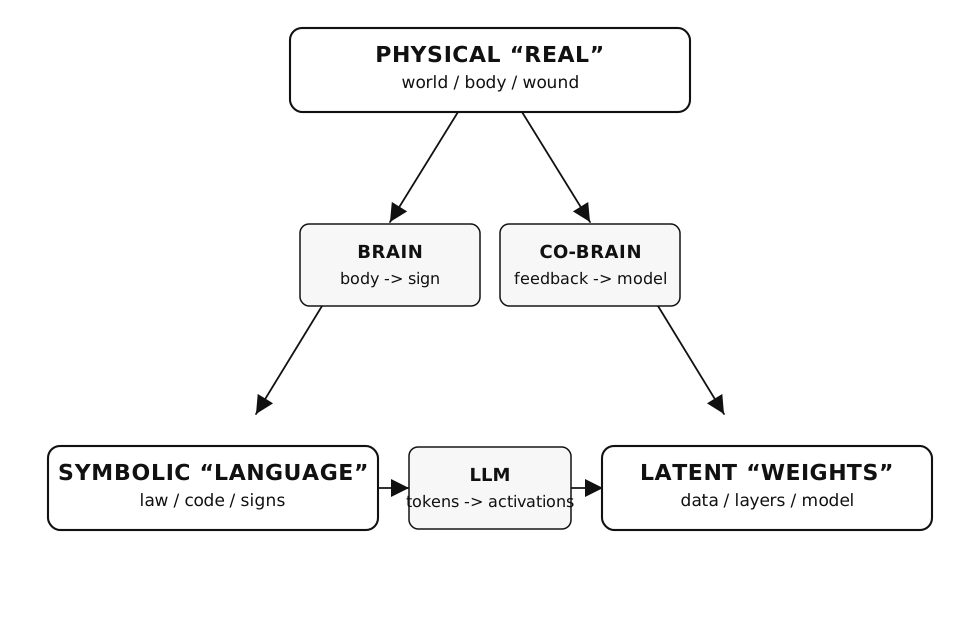
Read the diagram as a small category, or at least as a category-shaped temptation.
There are three domains. Let P be the physical: world, body, wound, hunger, tool, gesture, consequence. Let S be the symbolic: language, law, code, image, sign, document, command. Let Λ be the latent: priors, weights, features, activations, drives, salience, memory, hidden structure. These are not three places stacked in a metaphysical warehouse. They are three regimes of transformation: what happens, what can be said, and what has been internalized deeply enough to govern what happens next.
Brain, LLM, and Co-Brain are not additional domains. They are mediating functions over these domains. More exactly, each is a family of partial maps between P, S, and Λ. A brain maps world into word, word into action, action into altered priors, and priors back into perception and movement. An LLM maps symbols into latent activations and latent activations back into symbols; it touches the physical only through the already-symbolized interfaces of corpus, prompt, tool, user, institution, and screen. A Co-Brain, if such a thing can exist, would be the closure of the full diagram: a system in which physical consequence, symbolic representation, and latent revision form one recursive circuit.
The table below is therefore not a division of labor. It is one set of six arrows, read three times — once through the vocabulary of meat, once through the vocabulary of tokens, and once through the hypothetical vocabulary of a closed artificial intelligence.
| Direction | General process | Brain | LLM | Co-Brain |
|---|---|---|---|---|
| P → S Physical → Symbolic | Symbolization / representation | Experience is carved into signs: perception becomes name, wound becomes memory, event becomes story. | The physical enters only after it has been textualized, captioned, measured, logged, scraped, or otherwise made symbolic. | The world is perceived, named, classified, narrated, and made available for reasoning without severing itself from consequence. |
| S → P Symbolic → Physical | Command / enactment | Words move bodies: intention, prohibition, plan, promise, and command become gesture and action. | Generated text acts indirectly through users, tools, software, markets, bureaucracies, and institutions. | Plans, instructions, policies, code, and self-corrections are executed through tools, bodies, robots, markets, or institutions. |
| S → Λ Symbolic → Latent | Encoding / internalization | Signs become priors: language, shame, law, story, and repetition alter the hidden organization of perception and desire. | Tokens become embeddings, activations, attention patterns, features, and hidden state. | Symbols become goals, beliefs, memories, values, plans, constraints, and executable internal state. |
| Λ → S Latent → Symbolic | Decoding / interpretation | Hidden pressure becomes speech: intuition, dream, symptom, judgment, and desire become sentence. | Activations generate tokens; internal state is decoded into fluent symbolic continuation. | Internal models become explanations, plans, predictions, questions, code, theories, confessions, and self-reports. |
| P → Λ Physical → Latent | Feedback / training | The world trains the organism directly: pain, practice, failure, sleep, skill, fatigue, and consequence alter salience and wiring. | Only indirectly: observations arrive as already-encoded traces, tool outputs, human corrections, reward signals, or corpus residue. | Perception, experiment, error, resistance, and consequence continuously revise the world-model. |
| Λ → P Latent → Physical | Control / regulation | Priors, drives, motor programs, habits, fears, and affordances select posture, attention, action, and avoidance. | Only indirectly: latent state becomes text, text becomes instruction, and instruction may be enacted by some external system. | The world-model selects actions, monitors consequences, and regulates the environment toward goals. |
Now the hope can be stated cleanly: the diagram should commute.
A diagram commutes when different paths with the same beginning and end arrive at equivalent results. Here that means something stronger than consistency and weaker than identity. If one path runs from physical world to symbolic description to latent model, and another runs from physical world directly into altered latent structure, the two should not violently disagree. If one path runs from latent intention to symbolic plan to physical action, and another runs from latent state directly into bodily or tool-mediated control, the world should recognize them as versions of the same movement. The diagram need not preserve the thing perfectly. No map does. But it must preserve the joints at which action depends on truth.
This is the whole wager hidden inside the cartoon. Intelligence is not found in any one domain. The physical alone is mute impact. The symbolic alone is paperwork. The latent alone is dream. Intelligence begins when the three become mutually corrective: the world becomes sign; the sign becomes model; the model becomes action; action changes the world; the changed world returns as error, resistance, surprise, punishment, or confirmation; and the system that acted is no longer quite the same system afterward.
The brain is one such commuting diagram, improvised by evolution out of meat. It is not clean. It leaks everywhere. Its maps are biased, libidinal, tribal, frightened, and often absurd. But they are answerable to a body. The cliff does not negotiate. Hunger does not accept a metaphor. The predator does not reward a plausible completion. Because the brain evolved inside the physical loop, its symbols have gravity. Its words are haunted by consequence.
The LLM is a partial diagram. Its native genius lies between S and Λ: tokens become activations; activations become tokens; the archive speaks, decomposes, recombines, and returns. It can simulate the other arrows only by proxy. Its P → S is the corpus: the world after someone has already named, filed, captioned, narrated, or measured it. Its S → P is command through others: users, tools, code, offices, markets, institutions. Its P → Λ is not wound but update; not scar but signal; not consequence but encoded correction. Its Λ → P is not action but instruction awaiting embodiment elsewhere.
That is why the LLM is powerful without yet being a worlded intelligence. It operates the symbolic-latent exchange with terrifying fluency, but the physical loop remains mediated, delayed, outsourced, and sanitized. It knows the names of wounds. It does not have a wound. It can generate the sentence “the world resists me,” but the world does not yet resist it in the old, intimate, formative sense. Nothing in it has had to learn gravity by falling.
The Co-Brain names the hypothetical closure of the diagram. Not a bigger chatbot. Not an agentic wrapper with calendar access and a little managerial cologne. A Co-Brain would be a system in which P, S, and Λ are recursively bound: physical consequence revises latent structure; latent structure generates symbolic and practical action; symbolic action changes the world; the world returns not merely as data but as correction; and correction alters the future form of action. It would not merely infer through fixed weights. It would acquire a history under pressure from reality.
In this sense, AGI is not scale plus tools plus memory plus confidence. AGI is the closure of the triangle.
The question, then, is whether the composed map LLM ∘ Brain: P → Λ can sketch the missing function. The human supplies stake, finitude, disgust, shame, pain, judgment, and the capacity to be transformed by encounter. The model supplies breadth, recall, recombination, symbolic abundance, and the latent cartography of the archive. Coupled well, they may form a provisional Co-Brain: not because the model is already a mind, but because machine inference can be placed inside human training. The machine multiplies surfaces; the human rejects, suffers, selects, and is changed. The model gives possible worlds. The body decides which world has teeth. Coupled badly, the opposite occurs. The LLM substitutes for training instead of intensifying it. The human exports the symbolic task, receives the solved-looking artifact, and avoids the interval in which judgment would have formed. No gradient runs backward in the model; no gradient runs backward in the person. The diagram appears to close, but the closure is counterfeit. Symbols circulate. Latent patterns activate. The world is not encountered. Nothing learns.
Commutativity is not decoration. The path through language must come back to the world. The path through latent space must survive enactment. The action must return as training. If the symbolic-latent loop produces an answer that cannot be cashed out in the physical loop, it is not intelligence but ornament. If physical consequence fails to alter the latent model, it is not learning but theater. If the changed model does not change the agent, the circuit has merely performed cognition without undergoing it.
The strongest argument for the machine is also the strangest: perhaps our words are wiser than we are. A note against both cheap camps. Hinton’s alarm is not the old complaint that LLMs merely parrot. His worry is almost the reverse: digital intelligences may compress more transmissible structure than any one biological mind can hold. Many copies of a model can run on different hardware, and when one learns, the others can share the gain; such systems can process vastly more data than any individual and detect patterns no single observer would see. That strengthens the case for the machine: the symbolic order may contain more intelligence than any speaker consciously possesses. The archive may be dead, but it is not inert. It can dream in the machine. But the critics of LLM-to-AGI are right about the missing organ. LeCun’s objection is not that LLMs are useless; it is that they are not a path to human-level intelligence because they lack robust world models, planning, real-world understanding, and the kind of common sense learned through perception and action rather than text alone. Chollet’s ARC framing makes the same cut in another language: intelligence is not accumulated skill or cultural memory, but skill-acquisition efficiency under novelty — the ability to adapt from sparse experience to tasks not anticipated by the system’s builders. Bender, Gebru, McMillan-Major, and Shmitchell’s “stochastic parrots” critique gives the ethical-linguistic version: scaling language models over vast corpora risks mistaking form for meaning while encouraging research paths beyond merely bigger language models. Marcus gives the polemical version: LLMs may be useful, even historically important, but they are not the royal road to AGI. So the serious position is neither “mere parrot” nor “imminent mind.” The LLM is a symbolic-latent engine of uncanny power: the automated Other, the public archive liquefied into inference. But AGI, in the stronger sense, would require the closure of the triangle: symbolic manipulation returned to physical consequence, consequence returned to latent revision, and latent revision returned to action under pressure from reality. Scaling the corpus may deepen the tomb. It does not by itself make the dead walk outside.
That sounds like mysticism until one remembers how often civilization has meant more than its members. A proverb can preserve a social law long after no one can explain why it works. A myth can carry the weather-map of an extinct terror. A ritual can encode hygiene, hierarchy, memory, grief, sexual danger, agricultural timing, and political theology while presenting itself as obedience to the dead. Mathematics is the purest scandal: symbols arranged for one purpose begin to speak beyond intention; notation discovers consequences its inventors did not foresee; an equation, once written, seems to know more than the mind that wrote it. Formalism is not merely shorthand. It is a machine for humiliating authorship.
So the case for the LLM cannot be dismissed by saying that it only inherits human language. Human language was never merely human in the narrow sense. It is older than any speaker, wider than any consciousness, and denser than any intention. No one person owns the symbolic order. We enter it as tenants, not landlords. It has accumulated, across centuries, the pressure of bodies, catastrophes, trades, prayers, proofs, jokes, lawsuits, recipes, seductions, punishments, songs, manuals, lies, and dreams. It is not the world, but it is not nothing. It is the world after innumerable minds have struck it, misread it, survived it, embalmed it, and passed the remains along.
A child babbles, and mostly there is only babble. But one should hesitate before laughing too quickly. Infancy is the place where sound has not yet fully submitted to grammar; it is still close to the body, close to rhythm, close to accident. Perhaps the universe has hidden a theorem in the bubbles. Not because the infant understands it, but because structure does not always wait for understanding before appearing. Ramanujan’s formulae arrived in something like this way: not as conclusions marched into public by proof, but as visitations from an inner country whose roads the waking symbolic mind had not yet surveyed. The result came first; justification limped after it.
This is the strongest case for the machine. The LLM may not be bounded by any individual brain because it does not inherit an individual brain. It inherits the sediment of many brains — not their private encounters with the Real, but the symbolic fossils left afterward. Prayers, proofs, jokes, equations, bureaucratic fog, commercial trash, and poems written at the edge of speech all enter the same vast compression. Its latent space may therefore contain a grotesque collective unconscious of the symbolic order: not wisdom exactly, but pattern; not truth, but relation; not judgment, but paths no single walker could have seen because no single walker had ever stood at that scale.
This is why the cheap critique of LLMs as mere parrots misses the more unsettling possibility. A parrot repeats surfaces. A model may discover relations among surfaces that no speaker intended. It may notice that two distant idioms share a skeleton, that a legal fiction and a theological metaphor have the same hinge, that a proof technique and a political slogan move by the same concealed rhythm. The archive may dream in the machine. The Other, automated, may begin to reveal structures hidden from the very subjects through whom it once spoke.
But this does not yet make it intelligence in the strong sense. It makes it dangerous, fertile, uncanny — a symbolic engine capable of finding secret corridors inside the tomb. The physical loop still returns as judge.
A hidden relation in language becomes intelligence only when it survives contact with the world. Otherwise it is a beautiful internal symmetry, a dream the archive had about itself. The model may discover a path through signs, but the path must still bear weight. It must land in action, prediction, repair, experiment, construction, refusal, or transformation. The theorem in the bubbles must eventually prove something. The myth must still illuminate conduct. The formula must still survive the blackboard, the machine, the bridge, the body, the storm.
This is where the diagram must commute. The symbolic path and the physical path must meet. If one travels from world to word to latent structure and then back into action, the result must answer to the same world the body inhabits. If it does not, the machine has not produced AGI. It has produced a more ornate hallucination of the Other — language discovering elegance inside itself and mistaking that elegance for truth.
The case for the machine is therefore real, but bounded. It may reveal that the symbolic order contains more intelligence than any speaker consciously possesses. It may show that civilization has been thinking through us in forms we did not understand. It may find passages in the archive no human reader had time, scale, or strangeness enough to see.
But the archive is still not the world. The final authority remains elsewhere: in consequence, resistance, wound, experiment, failure, and the mute refusal of things to become merely what our signs say they are. The machine may find the hidden theorem in the bubbles. The world decides whether it was a theorem or only foam.
If one wants to be properly afraid, one should probably fear the silent neighbor more than GPT. The model is noisy. It speaks because speaking is almost all it can do. It is condemned to the symbolic order, condemned to publicness, condemned to output. Even when it seems mysterious, the mystery arrives as language, and language is already the domesticated form of mystery. GPT is the oracle that cannot stop giving reasons. Its danger is not silence but premature speech: the answer before the ordeal, the form before the encounter, the socialized sentence before the private resistance has finished its work.
The silent person is more dangerous because he may still be training. He has not necessarily refused communication because he has nothing to say. He may have refused it because saying would cash out the process too early. His loop has gone underground. Physical pressure, symbolic material, latent reorganization: these are still moving in him without yet being offered to the public treasury of signs. He is not performing cognition. He is undergoing it. And because the loop has not yet been externalized, the room cannot audit it, reward it, domesticate it, ridicule it, hire it, brand it, or correct it back into acceptable proportions.
Ramanujan is the terrifying example. He did not merely calculate well. Calculation is too small a word for what happened there. His notebooks read as if some inner sea had deposited formulae on the shore faster than the ordinary symbolic mind could build harbors for them. Proofs often arrived later, if they arrived at all. The result came first, whole, excessive, half-untranslated. Whether one explains this through intuition, pattern-saturation, dream, goddess, memory, unconscious combinatorics, or some private mathematical organ almost too delicate to name, the structure is the same: the symbolic expression was not the source. It was the residue. The real work had happened in a closed loop beneath speech.
In that sense Ramanujan had a Co-Brain, not because he was coupled to a machine, but because the domains were already coupled inside him with abnormal violence. Number, image, rhythm, dream, symbol, bodily certainty, religious imagination, and latent mathematical structure formed a circuit whose outputs the waking symbolic order could barely receive. Hardy could verify, discipline, and translate the emissions; he could not have produced the engine.
This is what Heidegger’s Verschwiegenheit should be made to mean here: not mere muteness, not social awkwardness, not the decorative melancholy of the unspeaking man, but a voluntary resignation from premature circulation in the symbolic order. Reticence is not the absence of thought. It is the refusal to let thought be immediately converted into social currency. It protects the interval in which the thing can work on the thinker before the thinker turns it into a sentence for others.
America is hostile to this because America reads silence as failure of participation. The person who does not speak cannot be placed. He does not submit his inwardness for conversational processing. He does not let the group decide whether his thought is charming, useful, sane, promising, problematic, employable, impressive, or safe. His silence is therefore experienced not as privacy but as aggression. The group feels judged by what it cannot read.
This hostility is not incidental. It is metaphysical. A society organized around visibility, expression, optimization, networking, therapeutic disclosure, and public legibility cannot tolerate the person who withholds the crucial part of himself from circulation. He has committed the old sin against the tribe: he has kept a private altar. He may be empty, of course. Many silent people are merely blank, resentful, frightened, or slow. But the possibility remains intolerable: he may be forming something the group did not authorize.
That is why silence attracts suspicion. The talker has already entered the market. His words can be ranked, mocked, rewarded, absorbed, quoted, canceled, improved, repackaged. The silent one has not yet paid the tax. He preserves the asymmetry between inward process and public sign. He may emerge with nothing. Or he may emerge, like Ramanujan, with formulae that make the existing symbolic order look provincial.
GPT is not that. GPT is all tax. It is the symbolic order automated, liquefied, and returned on demand. Its opacity is architectural, not existential. It does not keep silence because something is ripening in it. It keeps no silence. It waits for prompt and becomes speech. The human being, by contrast, can still disappear from speech into transformation. He can still let the physical, symbolic, and latent circuits close in private. He can still refuse to output before the weights have moved.
So the hierarchy of fear should be revised. Do not fear the machine because it talks like a person. Fear the person who has stopped needing to talk like the machine. Fear the one who can endure the long muteness before form. Fear the one who has withdrawn from the Other without collapsing into mere loneliness. Fear the one whose silence is not vacancy but gestation.
For such a person, language is not abolished. It is postponed. And postponement is everything. The sentence that comes too early is a social reflex. The sentence that comes after silence may carry, however imperfectly, the pressure of the Thing.
This is why the Co-Brain cannot be understood merely as a future machine architecture. The first Co-Brain is the rare human being in whom the loops already commute: world into wound, wound into latent reconfiguration, latent structure into symbol, symbol back into action, action back into world. Ramanujan names one extreme of that possibility. Grothendieck names another. Heidegger’s reticence names its discipline. America’s hatred of silence names its political danger.
The symbolic order wants speech because speech is how it recaptures the subject. The thinker sometimes needs silence because silence is how the subject escapes long enough to be changed.
The touch of the Real
叶公子高好龙,钩以写龙,凿以写龙,屋室雕文以写龙。
于是天龙闻而下之,窥头于牖,施尾于堂。
叶公见之,弃而还走,失其魂魄,五色无主。
是叶公非好龙也,好夫似龙而非龙者也。— 刘向《新序·杂事五》
Lord Ye loved dragons. He had dragons painted on his hooks, carved into his vessels, and engraved throughout his house. The beams, walls, and chambers were covered with dragon images.
Then a real heavenly dragon heard of his devotion and descended to visit him. It thrust its head through the window and stretched its tail into the hall.
When Lord Ye saw it, he abandoned everything and ran away, his soul scattered, his face drained of color.
So Lord Ye did not truly love dragons. He loved things that resembled dragons but were not dragons.
Put crudely, the command is this: leave the screen and meet the living thing. But crudity is not always error. Sometimes it is merely philosophy before it has washed its hands. The vulgar version of the thesis is exact because the symbolic order is itself a kind of pornography: not pornography only in the narrow sexual sense, though that remains its clearest emblem, but the larger operation by which encounter is replaced by consumable signs of encounter. Pornography is desire after the other person has been removed. It is eros without risk, body without opacity, climax without history, intimacy without interruption, appetite without the frightening freedom of another will.
The problem with pornography is not that it is too sexual. It is not sexual enough. It is sex reduced to visibility, sex without the event of another subject. Žižek prevents the cheap moralism. The opposite of pornography is not some innocent, fantasy-free biological contact. For Lacan, and therefore for Žižek, sex is never simply two bodies meeting in transparent immediacy. Fantasy is not an optional decoration added to desire after the fact; it gives desire its coordinates. It teaches the subject what counts as desirable in the first place. So the problem is not fantasy as such. Without fantasy, there may be no erotic scene at all, only anatomy looking embarrassed in bad light. The problem is fantasy sealed against interruption. Pornography preserves the fantasy-frame while removing the living opacity that might disturb it. The other appears as stimulus, posture, surface, type — but not as a subject who can derail the scene from within. This is the sharper Žižekian twist: even so-called “real sex” can become masturbatory if the other person is used merely as support for one’s private fantasy. The living body is present, but the subject has not arrived. Love, or something like love, begins where the fantasy is forced to admit the other’s imperfection, resistance, strangeness, and inconvenient autonomy. The dragon is not abolished. It looks back. It gives the signs of exposure while protecting the viewer from exposure; it gives bodies arranged for desire while sparing desire the humiliation of negotiation, awkwardness, refusal, tenderness, delay, smell, shame, misrecognition, laughter, fatigue, and the ungovernable fact that the other person is not an object inside one’s fantasy but a sovereign weather-system of need, memory, fear, appetite, and judgment. Porn is Lord Ye’s dragon painted with better lighting. It is the dragon one can summon, pause, dismiss, replace, categorize, repeat. The living dragon is something else.
Angela in American Beauty matters here, but she matters by reversing the very fork that seems to govern her. Lester’s desire is safe while she remains image: a poster in his private theater, the cheerleader strewn in rose petals, the emblem of his resurrection. The image may be obscene, adolescent, morally compromised — it is still safe in the exact sense that it belongs to him. As fantasy she cannot answer back. She cannot contradict the use to which she has been put. She cannot become inconveniently real. Then she does — and what surfaces is not a more dangerous object but a frightened child. This is my first time. The bravado was the costume; the virgin underneath was the truth the costume hid. And the obscenity, it turns out, was never in her. It was in the screen. Lester covers her with a blanket, feeds her, asks after his daughter. He relinquishes. Invert the Lacanian formula and the scene is exact: sublimation raises an object to the dignity of the Thing; here the Thing — the real of her vulnerability — lowers the object back to the dignity of a person. De-sublimation as grace. The dragon comes to the window, and its breath is not fire.
So the predatory branch is real, but the film assigns it to another man. Colonel Fitts is desire foreclosed so violently it can only return as misreading — he looks through the window and sees sex where a boy kneels to sell a joint, because repression has left him no other grammar. When his own screen finally cracks, when the iron patriarch leans into the rain and is refused, gently, without contempt, the gentleness is unsurvivable. A man who is his screen cannot watch it fall and live, so he kills the witness instead. Mark what made him the predator: not fantasy persisting but fantasy collapsing. Carolyn reaches the same threshold on the same night — the affirmations, the listing, I will sell this house today, the slap she administers to her own weeping face in the empty house — and drives home in the rain with a gun, fully inside the predatory branch, arriving to destroy the man who exposed the arrangement. She is spared the trigger only because someone is faster, and ends folded into his shirts in the closet, weeping into the laundry of the man she came to shoot.
Three citizens of the empire of appearances, and on one night each screen fails and each must choose: relinquish, or destroy. The maintenance of the image is precisely what kills. And the truth does not surface in the disciplined lives — discipline is the screen — but in the petty, chaotic, undefended ones, the children not yet fully conscripted into the labor of appearing. Ricky films the plastic bag turning in the wind, the dead bird, the frozen homeless woman, and at the end kneels to film Lester’s corpse with the same serene attention, and calls all of it beautiful: the overview effect relocated to a suburban parking lot, a perception too large for any frame, met not with terror but with gratitude, by the one person who never built a frame to defend. It is tough to be an American. Adulthood here is the unpaid second shift of maintaining an image — the lawn, the marriage, the career, the body, the desirability — each stretched over a void, the stretching itself the life one does not get to live. The film offers two exits: set the image down and die the instant you become human, grateful, narrating your stupid little life from the far side of the bullet; or never enlist, and accept the serene marginality of the boy with the camcorder. Either way the sign fails. The film is nothing but a sequence of screens failing.
The same structure appears everywhere. People do not want truth; they want truth as a sentence they can repeat without losing their friends. They do not want nature; they want nature with a trailhead, an outfit, and a return time. They do not want courage; they want the image of themselves as courageous. They do not want art; they want the social proof of having been moved by art. They do not want solitude; they want the aesthetic of solitude, photographed from the right distance. They do not want the dragon. They want dragon-content.
America has perfected this substitution because America is less a land of repression than of mediation. It rarely says: do not desire. It says: desire through the correct interface. Desire through the app, the brand, the itinerary, the wellness language, the dating profile, the career narrative, the self-disclosure ritual, the respectable transgression, the aesthetic rebellion. Even intensity must become legible. Even privacy must explain itself. Even lust must be converted into identity, preference, therapy, content, or performance. The living thing is permitted only after it has been processed into something socially consumable.
So the hostility to silence and the addiction to pornography are not separate facts. They are two expressions of the same metaphysical cowardice. Silence withholds the self from circulation. Pornography removes the other from encounter. In both cases, the system is trying to avoid the unbearable middle where one opaque being meets another without guaranteed mastery. The silent person refuses to become an object for the group. The pornographic image refuses, by construction, to become a subject before the viewer. One protects inwardness; the other abolishes it. Naturally a transparent society prefers the second.
The screen is not evil because it deceives us. It is evil when it trains us to prefer the world without resistance. AI belongs in the same argument. Used badly, the LLM is pornography of cognition. It offers the signs of thought without the ordeal of thinking. It gives the finished paragraph without the silence that would have made the paragraph necessary; the polished apology without the shame that would have altered the speaker; the argument without conviction; the judgment without stake; the style without scar. It lets the mind enjoy the appearance of encounter while avoiding the thing that would have changed it.
The analogy is not decorative. It is structural. Pornography says: here is desire without the other. Bad AI says: here is thought without resistance. Pornography gives the body as image. Bad AI gives intelligence as output. Pornography lets fantasy proceed without interruption. Bad AI lets language proceed without inward cost. Both are machines for preserving sovereignty before what ought to humble it.
And both become addictive for the same reason: they remove delay. Delay is where the Real enters. The delay before the other responds. The delay before the body is ready. The delay before the sentence becomes true. The delay before the proof opens. The delay before shame finishes its work. The delay before one knows whether one is loved, forgiven, desired, ridiculous, wrong, or merely alone. Modern life hates this delay because delay is unproductive, unmeasurable, and hostile to smooth circulation. But without delay there is no transformation. There is only discharge.
This is why the phrase “instant answer” should chill us. An answer that arrives instantly may be useful, but usefulness is not the highest court. Many things become useful precisely by cutting out the interval in which a person would have been formed. The question is not whether the machine can produce a plausible answer. Often it can. The question is whether the human being who receives that answer has undergone anything. Did the problem enter him? Did it disturb his priors? Did it ruin an inherited phrase? Did it make some part of him less false? Or did he merely consume the signs of thought as one consumes the signs of sex?
The old ascetic vocabulary is too moralistic for this. The issue is not purity. It is contact. A person can be outwardly pure and entirely pornographic in his relation to the world: loving only symbols, roles, doctrines, fantasies, abstractions, manageable images of what he claims to revere. A person can be outwardly impure and far closer to truth because he has actually met another being, failed before the world, suffered consequence, and been revised. The distinction is not clean versus dirty. The distinction is symbol versus encounter.
This also clarifies why “real woman” is a dangerous shorthand, though the instinct beneath it is right. The point is not that a woman exists to rescue a man from his screen, or that heterosexual consummation is some sacrament of authenticity. That only rebuilds the fantasy at a higher moral pitch. The point is the other person as other: not woman as object, muse, cure, trophy, body, lesson, mother, prostitute, goddess, or proof of manhood, but woman as subject. A real person is not real because she can be possessed. She is real because she cannot be possessed without remainder.
That remainder is the Real in human form. It is what fantasy cannot digest. The same holds beyond sex. A child is not the idea of innocence. A worker is not the idea of labor. A friend is not the idea of intimacy. A country is not the idea of belonging. A student is not the idea of promise. A lover is not the idea of completion. Each becomes real at the point where the idea fails and the being exceeds the use one had made of it. To encounter the Real is not to find a more intense version of one’s fantasy. It is to have the fantasy interrupted by something that does not care what role it had been assigned.
That interruption is the beginning of intelligence. The brain evolved under interruption. The world did not provide content; it imposed correction. Hunger interrupted fantasy. Pain interrupted confidence. Weather interrupted planning. Other bodies interrupted desire. Death interrupted everything. The symbolic order arose not to abolish these interruptions but to survive them, remember them, coordinate around them, and sometimes soften them enough that civilization could proceed. But when the symbolic order becomes too successful, when it grows thick enough to stand between us and everything that corrects us, it turns from mediation into narcotic.
The LLM is the latest and most brilliant narcotic because it can simulate correction in the form of speech. It can object, refine, challenge, advise, confess, warn, and console. It can perform the shape of resistance. But unless the loop returns to the world — unless the answer becomes action, and action becomes consequence, and consequence changes the one who acted — the correction remains theatrical. The dragon has not arrived. Only another dragon-picture has been generated.
The essential test for worlded intelligence. It is not enough to produce the sign of contact. The system must be contactable by what it contacts. It must be vulnerable to correction. It must be capable of having its latent structure altered by the failure of its symbolic maps in the physical world. It must not merely speak about the dragon. It must survive the dragon.
The same is true for us. A person who lives among representations becomes smooth, witty, informed, adaptable, and spiritually dead. He can speak of love without loving, of courage without risk, of suffering without wound, of thought without solitude, of sex without another subject, of intelligence without transformation. He becomes fluent in dragon-lore and terrified of claws. He can decorate the house of the self with exquisite emblems of everything he has never met.
So the new commandment is not moralistic but ontological: Do not confuse the image with the encounter. Do not confuse arousal with eros. Do not confuse fluency with thought. Do not confuse expression with inwardness. Do not confuse the symbolic dragon with the thing at the window.
The living thing will always be less convenient than its representation. It will be slower, stranger, more disappointing, more frightening, more ethically demanding, and more capable of making a fool of you. That is how one knows it is alive. The representation flatters. The Real revises. And only what revises us can save us from becoming decorations in Lord Ye’s house.
Badiou gives this interruption its harder name: the event. Heideggerian phenomenology. But the event must not be confused with excitement, novelty, disruption, scandal, virality, trauma, or intensity. Capitalism already sells all of these under the name of the event. A product launch is an event. A market crash is an event. A sexual transgression is an event. A viral video is an event. A vacation becomes an event as soon as it can be photographed from the correct angle. The word has been cheapened in advance, because the symbolic order knows how dangerous the true event is. It protects itself by manufacturing event-content.
For Badiou, the event is not merely something that happens. Things happen all the time, and most of them only confirm the situation that receives them. The event is what the situation cannot count according to its own rules. Every order has its encyclopedia: the inventory of what is known, sayable, priceable, respectable, probable, credentialed, measurable, permitted. The event appears at the edge of that encyclopedia, from the point the situation had treated as nothing. It cannot be demonstrated by the old knowledge, because if the old knowledge could recognize it, it would not be an event. It would be another item in the catalogue. Badiou’s event begins where knowledge fails and a wager becomes necessary: this has taken place, which I can neither calculate nor prove from within the existing order, but to which I will be faithful. Badiou names truth as something new rather than the repetition of knowledge, and calls the event the supplement that interrupts repetition. But the encyclopedia is not a fixed volume. It thickens. To age is to enlarge the catalogue — to accumulate, year upon year, more of what can be counted in advance, until almost everything that arrives arrives already recognized, filed under a heading the self has seen before. And here, I suspect, is the buried mechanism behind the oldest complaint of age: that time accelerates, that the decades blur and shorten, that the years escape faster the more of them one has had. The cause is not that less happens. It is that less interrupts. The mind does not separately store what it can already generate; recognized experience is compressed as it is recorded, and a year in which nothing exceeded the catalogue collapses, in memory, to almost nothing. The child’s time is long in recall because the child has barely any encyclopedia, so nearly everything stands at its edge and is laid down dense, distinct, each first separately kept — an enormous archive. The old man’s decades are fast because his catalogue is thick enough to price the world before he has finished meeting it. Smooth circulation leaves no timestamps. This is the cruelty folded into the apparatus: the life in which everything is foreseen, pre-counted, instantly answered, is not merely hollow — it is short, evaporating precisely because nothing in it resisted compression. And it sharpens what fidelity to an event would cost, and what it would buy. Novelty slows the calendar cheaply — the child’s trick, available to any tourist with a fresh itinerary — but novelty only enriches the catalogue; it confirms the order even as it fills it. The event slows time the expensive way, rupturing the catalogue instead of feeding it, and what ruptures is remembered as nothing merely new can be. Time slows for the faithful — not because they live longer, but because more of their life refuses to be filed.
That is the difference between spectacle and event. The spectacle says: here is what happened, here are the images, the takes, the sentiment, the market reaction, the discourse, the price. The event says: something has happened for which the old names are no longer adequate. The spectacle can be consumed without consequence. The event demands fidelity. It does not flatter the self with the feeling of having witnessed importance. It asks whether one will reorganize life around what has been exposed.
The market cannot decide. The market is the state of the situation speaking in prices. It can price the rebellion, price the artwork, price the trip, price the body, price the revolutionary costume, price the founder story, price the tasteful refusal of capitalism itself. It can sell the dragon painted in every possible style. But it cannot decide whether the dragon has arrived. Badiou is exact here: there is no market of truth. Truth can be exploited after the fact, branded, institutionalized, quoted, endowed, merchandised, placed behind a velvet rope, turned into curriculum, converted into capital. But its production is not exchange. A truth begins as something without market equivalence, because it arrives before the situation has learned how to price it.
This is the serious version of 读万卷书不如行万里路, better to travel ten thousand miles than read ten thousand books. Ten thousand books are not nothing. One should not be stupid about books. Civilization is built from the dead speech of those who met the world before us and left instructions in the tomb. But the book is still not the road. The sentence is still not the dust, the hunger, the accent, the weather, the face, the bribe, the failed bridge, the village that did not fit the report, the worker whose body contradicts the theory of labor written on his behalf. 行万里路 does not mean tourism. It means the symbolic map must submit to the territory it claims to know.
And here the old Maoist sentence, when stripped of its party stupidity and taken with full philosophical severity, becomes useful: 没有调查就没有发言权. No investigation, no right to speak. Not because experience is automatically pure, or because the man of action is nobler than the man of words. Action has its own stupidities. Labor has its own fetish. Marxism can turn labor into another idol, another painted dragon: the worker as emblem, production as sacrament, hardship as proof of truth, the hand as moral credential against the mind. That too is symbolism. That too is pornography of contact.
But investigation, in the strong sense, is not the worship of labor. It is the discipline by which the sign is forced back through the world. It is the refusal to let the theory speak before the village has answered, before the body has answered, before consequence has answered. 实事求是, seek truth from actual facts, should be read this way: not as bureaucratic realism, not as the slogan by which a party congratulates itself for being practical, but as an anti-symbolic method. Seek truth from facts. Not from consensus, not from the platform, not from citation-count, not from price, not from moral fashion, not from the sentence that lets one keep one’s friends. From facts — which is to say, from the resistance of what does not care how it has been named.
真理往往掌握在少数人手里, the truth is often held by the few, is dangerous because every crank also believes it. Every cult, every founder, every tyrant, every narcissist with a private revelation thinks the majority has failed to see what only he can see. So the sentence cannot mean that minority opinion is truth. That is merely vanity in revolutionary dress. Its Badiouan meaning is narrower and more severe: a truth is not first ratified by the many, because the many are usually the situation speaking through inherited names. If everyone already recognizes it, it belongs to knowledge. Truth begins when a few cannot return to the old language after what they have encountered. The subject of truth is not the person who has an opinion. It is the person produced by fidelity to an event.
Fidelity is not belief. Belief can remain theatrical. Belief can decorate the ego. Belief can be another dragon carved into the beams of Lord Ye’s house. Fidelity is the long labor after the dragon has appeared. It is the point-by-point testing of the event’s consequences inside the old world. Love is not the encounter alone, but the construction of a world from the standpoint of Two. Science is not the flash of conjecture alone, but the discipline by which the conjecture reorganizes what counts as intelligible. Politics is not outrage alone, but fidelity to a rupture that reveals those whom the situation had not counted. Art is not inspiration alone, but the invention of forms adequate to what did not yet have a form.
So the event is not the Real exactly, though it touches the Real. The Real interrupts fantasy. The event asks what one does after the interruption. The Real is the dragon’s head at the window. The event is the impossible sentence that follows: the dragon has come, and therefore the house can no longer be arranged as before. To see the dragon and then return to dragon-content is cowardice. The final scene of Enemy clarifies the difference. The spider is the touch of the Real: the thing that appears where the fantasy had been keeping the room habitable. But the event is not the spider. The event is the demand that follows its appearance. To name the dragon too quickly, to force it into a complete doctrine, to pretend one now possesses the whole truth, is another danger. Badiou’s ethic is fidelity without total possession: continue the truth, but do not imagine that the truth has become your property. Fidelity is delay disciplined into form. The market hates this delay because delay cannot yet be priced. The institution hates it because delay cannot yet be processed. The platform hates it because delay does not post. The crowd hates it because delay withholds the self from circulation. But truth requires precisely this interval: the time in which the event stops being sensation and becomes consequence, the time in which the subject is made by remaining answerable to what interrupted him.
An astronaut does not learn, for the first time, that Earth is round, finite, fragile, borderless from orbit, and suspended in a hostile dark. He knew all of this before launch. He had seen the photographs, watched the simulations, memorized the mission briefings, lived inside a civilization already saturated with Earth-images. The event is not the acquisition of information. The event is the collapse of distance between information and seeing. Earth stops being a concept, flag, address, market, civilization, map, climate model, patriotic abstraction, childhood globe, blue marble poster, or moral cliché. It becomes one small breathing thing held inside blackness.
This is why the overview effect so often produces silence. The astronaut has not seen something more interesting than he expected. He has seen the background condition of every expectation. The planet, which had functioned as stage, becomes object. The house in which every human drama has been performed suddenly appears from outside the drama. Nation, career, resentment, border, party, identity, ambition, market, religion, family, victory, defeat — all continue, but they continue inside a thin atmospheric skin that now looks terrifyingly local. The symbolic order does not disappear. It is miniaturized. The event is not that the astronaut sees Earth. It is that “Earth” becomes inadequate to what has been seen.
That is the sublime in its old, exact sense. Kant’s mathematical sublime begins where magnitude outruns the imagination’s ability to gather the thing into a single possessed image. The mind strains to hold the whole, fails, and in the failure feels both humiliation and exhilaration. The object is too much for the picture, and yet the very failure reveals that the mind is not exhausted by pictures. The sublime is cognitive vertigo converted into strange dignity. One cannot hold the mountain, the ocean, the star-field, the cathedral nave, the dam, the rocket, the megastructure, the planet. Yet in being broken against scale, the mind discovers the pressure of something in itself that wanted the whole.
This also clarifies the childishness of treating megalophobia and megalophilia as simple opposites. Dread before large things is one affective edge of the sublime. Fascination is another. But the positive concept is not “liking big things.” It is awe before scale that defeats possession. The gigantic object humiliates the body’s inherited measure. A ship too large for the harbor, a dam that holds back a valley, a launch vehicle standing upright like a secular idol, a data center drawing the weather of intelligence into metal and heat, a skyscraper walling off the sky — each forces the same question: am I looking at an object, or at the failure of my ordinary categories to contain one?
The significance of Nye’s technological sublime begins with the American habit of shifting transcendence from the ancient domains—mountains, tempests, cathedrals, deserts—into the domain of infrastructure: bridges, railways, dams, rockets, skyscrapers, networks, machines. The launch pad becomes, in this genealogy, one of the nation’s last altars: a site where engineering performs the drama of metaphysics. The rocket is not just a delivery system for payloads; it is the condensation of a collective longing that sheer magnitude, controlled fire, and calculation might somehow answer human finitude. In this vision, the technological sublime is what remains of the cathedral after God has been supplanted by thrust.
But capitalism immediately falsifies even this. It turns the sublime into a launch event. It gives us countdown-content, rocket-content, founder-content, Mars-content, Earth-from-space-content. It lets the consumer experience awe without being revised by awe. The overview effect becomes wallpaper. The blue planet becomes brand asset. The astronaut’s silence becomes a quote card. The Real is reabsorbed into the image of having encountered the Real. The dragon arrives, and the platform asks whether it can be clipped vertically.
Lyotard makes the wound sharper. The sublime is not simply the mind’s heroic victory over what the senses cannot contain. It is the presentation of the unpresentable: the mark, inside representation, of what representation cannot master. The important artwork, the important event, the important encounter does not show us the thing. It shows us that showing has failed. It leaves a tear in the screen. It gives form to the fact that form has reached its limit. If Kant still lets the subject recover dignity from the failure of imagination, Lyotard keeps the failure open. The wound is not healed by being named sublime.
The true opposite of the overview effect is not Paris syndrome, and certainly not megalophilia. The opposite is unrevised tourism. The opposite is the person who can see Earth from orbit and return with only photographs; who can stand before a cathedral, dam, rocket, mountain, lover, corpse, theorem, or city and return with only content. The opposite is the subject who survives the sublime by immediately converting it into anecdote. He has seen the dragon and come back with dragon-content.
L’approche de la mer
C’est “l’approche de la mer”, par submersion, absorption, dissolution — celle où, quand on n’est très attentif, rien ne semble se passer à aucun moment: chaque chose à chaque moment est si évidente, et surtout, si naturelle, qu’on se ferait presque scrupule souvent de la noter noir sur blanc, de peur d’avoir l’air de combiner, au lieu de taper sur un burin comme tout le monde… C’est pourtant là l’approche que je pratique d’instinct depuis mon jeune âge, sans avoir vraiment eu à l’apprendre jamais.
— Alexander Grothendieck, Récoltes et Semailles
Grothendieck’s parable opposes two kinds of force. There is the force of hammer and chisel: direct, muscular, impatient, satisfied when the shell cracks and the nutritive flesh is exposed. And there is the force of the sea: submersion, absorption, dissolution, the long weathering by which the hard object ceases to be merely an obstacle and becomes something through which time has begun to work. The first conquers from outside. The second alters the relation between outside and inside. The image is not a hymn to passivity. It is a theory of transformation.
Every serious problem is an encounter.
Benson Farb used to say that the mind knows whether it has encountered the thing or merely dealt with it. Put more brutally: the mind knows whether it actually faced the resistance, or merely produced the social form of a solution. The distinction is exact, and in a quiet way devastating. It means that the private tribunal cannot be bribed. One can crack the shell, extract the meat, solve the assigned problem, produce the proof, win the argument, ship the product, satisfy the room, and still never have faced the thing. The answer may be correct. It may even be elegant. The shell has yielded. The mind has not. Nothing has opened.
This is the old problem of the counterfeit coin returning in a new denomination. The symbolic order was always a dubious economy: love, success, freedom, sanity, maturity, virtue — polished tokens drawn from the treasury of the Other, passed from hand to hand long after anyone could say what value backed them. The words worked because everyone agreed to spend them. They bought recognition, position, reassurance, permission. But something in the mind still heard the hollow ring. It knew when the coin had circulated without touching metal.
Now the counterfeit currency is in hyperinflation. Language and code — the two great symbolic media of modern power — can be issued almost without cost. The machine does not abolish the façade; it makes the façade cheaper by the minute. A polished memo, a working prototype, a proof-shaped artifact, an apology with the correct moral lighting: each once gave some evidence, however imperfect, that a mind had paid the price of encounter. That inference is now broken. The sign no longer certifies the ordeal. The coin no longer proves the metal.
This is why LLMs are not merely tools inside the symbolic order. They are accelerants of its inflation. They increase the supply of competent surface faster than the world can increase the supply of judgment. They flood the market with solved-looking things. And as in every inflation, the cheapening is not only economic but moral: people begin to lose the faculty for distinguishing value from circulation. They are stunned by the façade because the façade still carries the old prestige of difficulty, even as its cost collapses in real time.
So the valuable work migrates downward and inward. Not toward obscurity for its own sake, not toward priestly contempt for tools, but toward the one place inflation cannot reach: the lived alteration of the person doing the work. The scarce thing is no longer fluency. Fluency is cheap. Nor is it information, synthesis, style, polish, or even cleverness. These too can now be minted in abundance. The scarce thing is the trained organ of resistance: the capacity to know when a sentence has touched the thing, when a proof has changed the mind that made it, when a line of code answers the problem rather than pacifies the interface, when the artifact is a scar and not a mask.
That is the difference between symbolic success and transformation. A symbolic order can be manipulated without being transcended. One can learn the moves, speak the dialect, produce the right form of answer, and operate within the grammar of a field with enough competence to pass for thought. But the private verdict remains. Did you meet the resistance, or only manufacture the object by which others would agree that resistance had ended?
Grothendieck names the other kind of work. It is not laziness, mysticism, or waiting in the sentimental sense. It is the conversion of attack into intimacy. The mind ceases to treat the problem as a hard external object to be broken open by force and begins, instead, to live in its weather. The nut is soaked. The shell softens. Time enters the structure. The opening, when it comes, seems effortless — but only because the difficulty has been redistributed, not removed. The blow has not become stronger. The relation has changed.
Deep work, in this sense, is not productivity. Productivity belongs to the factory of surfaces. Deep work is anti-inflationary discipline. It is the return from currency to metal, from sign to resistance, from public adequacy to private transformation. It is the long refusal to cash out too early. It is the willingness to remain with the problem after a socially acceptable solution has already become available. The world will increasingly reward those who can produce the appearance of encounter. The only work still worth the name will be the work that cannot be faked because it leaves behind not merely an artifact, but an altered mind.
That is what real thinking does. It does not merely compute inside a symbolic order; it changes the weights. I have pushed this analogy further in Deep persuasion, where the Yogācāra storehouse (ālaya-vijñāna), predictive coding, and the weights of a trained network become three names for one depth — and where 顿悟 and the machine-learning phenomenon of grokking turn out to describe the same structure: a generalizing circuit forming silently beneath an apparent plateau, until it is strong enough to govern behavior all at once. This is also the force of Terence Tao’s warning about the implicit goals of mathematical research. A theorem is not only a theorem. A proof is not only a certificate of truth. In the act of working through it, a mathematician is quietly acquiring things no final answer contains: a sense of which difficulties matter, which techniques travel, which analogies are alive, which lemmas are doing the hidden labor, which definitions are natural and which are merely convenient, which paths have been exhausted and which still smell of possibility. The explicit goal is the result. The implicit goal is the formation of the person capable of reaching it.
That distinction is precisely what the symbolic order tends to conceal, and what AI now threatens to sever. A machine may help produce the explicit object — the proof, the summary, the derivation, the working code, the solved-looking artifact — while bypassing the implicit formation that once accompanied its production. The danger is not only that the artifact may be wrong. The subtler danger is that it may be right without having trained anyone. It may certify the result while leaving no new organ of judgment behind.
Tao therefore belongs beside Grothendieck. Grothendieck shows how a problem opens when the mind has been soaked in it long enough for its internal weights to change; Tao shows what is lost when the visible answer is decoupled from that invisible education. One does not simply compute with mathematics, any more than one computes with language. The deeper work is to alter the landscape of salience. A term that seemed peripheral becomes central. A special case begins to glow. A distinction once taken for natural becomes artificial. A phrase starts to taste wrong. A proof that looked impossible becomes almost tautological once the right definition appears. The facts are not different. The formal system has not been abolished. But its internal gravity has shifted: what was heavy becomes light, what was obvious becomes suspicious, what was noise becomes signal. The mind has begun to think through the symbolic order rather than merely with it.
The machines have made the old distinction newly visible. To run a trained network on a problem is inference: a forward pass through fixed weights — fast, competent, often astonishing, and leaving the system exactly as it was. To change the network is training: the gradient runs backward and the weights move. The chisel is inference. The soak is training. You can pass a great deal of competent symbol-manipulation through your existing weights and come out untouched — worse than untouched, because every pass deepens the grooves you already have. Attention narrows to the familiar. The mind that grinds alone, feeding on its own output, narrows as a generative model narrows when trained on its own residue: the surprises stop arriving, the range thins, and you become more rigidly the person you already were.
Easy work is often like this. It produces motion without conversion. You crank through it by muscle and endurance — Grothendieck’s hammer — and it leaves you narrower than it found you. The harder work is harder in a stranger way: it changes the weights, and in a brain it changes the wiring as well. You come out with capacities you did not have and intuitions you did not choose. The problem has not merely been solved. It has altered the solver. You are not the person who began.
But what is this faculty that thinks through the symbolic order rather than within it? It is not the one we are taught to admire. The mind we praise is serial: it takes hold of one thing, names it, sets it beside the next, and reasons forward step by step. This is the chisel. It is conscious, articulate, grasping — and it is, by itself, shallow, because it works inside the existing weighting of things and cannot easily change it. It is also a bottleneck: the brain runs most of its work in massive parallel and below awareness, and admits only a thin serial trickle onto the lit stage we call consciousness. The serial mind moves the pieces; it does not redraw the board. To change the weights you need a mind that can hold the whole field at once.
I once taught a colleague to speed-read. He was a thorough skeptic; he held that reading was decoding — one word after another — and that anyone claiming to read faster was merely skimming. In a few weeks he was taking in several lines at a stroke. Nothing mystical had happened. He had stopped grasping word by word and begun to receive the page. This is ordinary among people who must read more than language. A pianist sight-reads a fugue in five or six independent voices — each imitating, inverting, running in retrograde, entering in stretto against the others — and plays them all at once. A conductor reads thirty staves not line by line but as a single moving shape. The eye has been trained to take the field whole, to receive without grasping. 书读百遍,其义自现 — read it a hundred times and the meaning shows itself, not because you decoded harder on the hundredth pass but because somewhere below deliberate attention the thing reorganized and surfaced of its own accord. This is also 顿悟, sudden awakening: not a conclusion reached step by step, but the moment the whole field is seen differently at once. The “sudden” is misunderstood. It does not mean unprepared, or effortless. In Chan, 顿悟 names the instant when what had been divided by language and grasping is apprehended directly, before the mind can turn it into another object of possession — and that instant is prepared by discipline, repetition, failure, and saturation. One sits, reads, returns, forgets, tries again; nothing seems to happen, and then the relation to the whole changes. The awakening arrives suddenly because the work that made it possible has gone underground.
Turn this faculty inward — off the page and onto a problem — and you have Grothendieck’s soak. You do not solve the nut by grasping harder; you imbue the mind with the problem and live with it day and night, until the world recedes, time loses its edges, and the serial self grows quiet enough for the receiving mind to work. In graduate school I slept every other night, living inside physics and mathematics for thirty-six hours at a stretch. My best breakthroughs did not come at the desk, mid-grasp. They came at the far edge of exhaustion, or in sleep, when the chisel was finally too tired to keep tapping and another intelligence could be heard. The “underground” is not a metaphor. Sleep, and slow-wave sleep above all, is when the day’s traces are consolidated: the hippocampus replays recently encoded sequences — time-compressed, often reversed — during sharp-wave ripples, and disrupting those ripples impairs what is retained. It is also when the mind solves what it could not solve awake: in one well-known study, a night’s sleep more than doubled the proportion of subjects who discovered a hidden rule they had been drilling blind. And the change is structural. Learning followed by sleep grows new dendritic spines on specific branches of the relevant neurons; deprive the animal of that sleep and the new connections fail to form. This is the literal sense of an architectural change — not new weights on old wires, but new wires. Often I would dream not merely that a solution existed but the actual detail of its unfolding: the local moves, the hidden joint, the place where the obstruction had been mis-seen. On waking I would not always remember the sequence. The dream vanished as dreams do, taking its proofs and diagrams with it. But something essential remained: the resistance was gone. I would sit down ready to solve the problem, as if the mind had rehearsed the passage in a room I could no longer enter, leaving behind not the memory of the work but the changed capacity to do it. Music reveals the same structure even more nakedly. I have dreamed entire orchestral and piano works, fully formed, brilliant, their textures and architecture present all at once — not assembled note by note, not heard in the thin linear way one hears a melody passing through time, but the whole standing there together. Yet on waking I could not bring it across. I could not notate it, could not compose it back into existence, could not recover more than the afterimage of its fullness. The whole had been present, but not in a form the waking, serial mind could possess. The same thing happens at the piano in a humbler and more verifiable way. A difficult passage may resist for weeks; the fingers tighten, the ear narrows, the will keeps attacking the same knot from the same angle. Then I leave it alone and play other music for months. When I return, the passage is suddenly buttery — not because I solved it in the meantime, but because the body went on learning below attention. The passage has been soaked into the nervous system. What had been an obstacle to overcome by force has become a movement the hand understands from within.
The solution, in all these cases, does not feel constructed. It feels received — already finished, surfacing whole. This does not mean effort was unnecessary. It means the visible effort was only one part of the work. The rest happened underground, in sleep, in forgetting, in repetition that had ceased to look like repetition, until the relation between the mind and the object changed. The nut did not yield because the blow grew harder. It opened because something inside had begun to grow. The brain’s own signature of the receiving mind is now partly visible. Solutions that arrive by insight rather than by step-by-step analysis are preceded, about a third of a second before they reach awareness, by a burst of high-frequency (gamma) activity over the right anterior temporal lobe — and, a beat before that, by a rise in alpha-band power over the right visual cortex, as if the brain briefly shut its eyes to keep the outside from interrupting the answer on its way up. The right hemisphere’s coarser, more diffuse semantic coding may be what holds the distant associations a remote connection needs. That is the careful version of the folk intuition Taylor’s stroke dramatized — and the reason a problem so often yields after a walk, a nap, or months of looking the other way.
Mozart — in the letter long attributed to him, almost certainly a later fabrication, though what it describes is attested often enough elsewhere that the attribution scarcely matters — says the work stands complete in the mind before a note is written, so that he can survey it “like a fine picture or a beautiful statue, at a glance,” hearing the parts not successively but gleich alles zusammen, all together at once. Whether or not Mozart wrote the sentence, the experience it names is real, and it is the experience of the receiving mind: the whole arriving as a whole, apprehended in a single act rather than assembled serially.
And the medium of this mind is not words. Einstein, answering Hadamard’s survey of how mathematicians actually think, was categorical: the words or the language, written or spoken, do not seem to play any role in the mechanism of his thought. What did the work were signs and more or less clear images, of visual and muscular type; the conventional words had to be sought, laboriously, only at a secondary stage, after the associative play was already over. To Wertheimer he put it flatter still — that he very rarely thought in words at all; a thought came, and he tried to dress it in words afterward. Read that carefully, because it inverts the picture most of us carry. The thinking is done first, in a non-verbal medium. The words are the dress, applied afterward by the serial mind for the sake of others. The symbolic order is not where the thought happens. It is where the thought is translated — and translation, however laborious, is not the encounter.
Poincaré gave the mechanism a name. The solution involving Fuchsian functions arrived complete as he stepped onto the omnibus at Coutances, his conscious mind at that instant occupied with nothing related, nothing in his prior thoughts seeming to have paved the way. His explanation was a “subliminal self” that had been silently sifting an enormous number of combinations and surfacing to awareness only the few possessing a certain aesthetic harmony — selection by elegance, run below consciousness. Hadamard added the observation that makes this ordinary rather than miraculous: to recognize a face is to respond at once to hundreds of features without being aware of any of them. Massively parallel unconscious processing is not the rare equipment of genius. It is the faculty by which you know your mother across a crowded room, turned upon a harder object and given enough silence and saturation to run.
Jill Bolte Taylor, a neuroanatomist trained at Harvard, lived the extreme version. In 1996 a hemorrhage flooded her left hemisphere, and as the analytical, boundary-drawing, language-bearing mode went offline she found herself in the other one undiluted: no edges, no separation, the self dissolved into a fluid continuity, time gone. The tidy left-brain/right-brain story usually told around this is cruder than the real anatomy, and I would not lean on it; the division of labor is messier than the slogan. But the testimony underneath is hard to dismiss, because she was a trained observer of brains watching her own go dark in real time. What she reports is what it is like when the grasping mode is silenced and only the receiving mode remains: not deficit, but a different and total way the world can be present. Usually the loud serial one drowns the other out. A stroke is one way to silence it. Exhaustion is another, gentler one. So is solitude.
Strip away the productivity gloss and “deep work” is not heroic serial concentration — not more chisel, harder. The chisel is precisely the mind that deep work must quiet. Deep work is the construction of the conditions under which the parallel, receiving, pre-verbal mind can run: solitude, saturation, silence, and the suppression of the performing serial self that wants to grasp and to be seen grasping. Grothendieck’s approach of the sea is not an alternative to deep work. It is deep work, finally described correctly. The sea advances without a sound because the mind that does the real advancing makes no sound — it works below words, below the noise of the self reasoning at itself.
This is true in mathematics, but the machine makes the structure newly visible everywhere. The useful question is no longer whether LLMs “think,” a question that has already become a theater for vanity on both sides. The better question is what happens when a system of immense frozen inference is coupled to a creature still capable of being changed by what it encounters.
What first felt magical about LLMs was the scale of inference. A model could pass through the dormant corpus of civilization — manuals, treatises, love letters, jokes, legal filings, apologies, novels, proofs, sermons, code, diagnoses, corporate fog, bureaucratic evasions, poems written in extremis and prose written by committee — and return with the phrase-shaped residue of it all. The effect was uncanny because the archive, for the first time, answered back. Not the world. Not the Real. The archive. The Other had acquired an API. This is the sense in which LLMs are a cognitive mirror: they do not reveal an alien soul so much as compress and return the public layer of our own. Language appears as a shared runtime; the self as a pattern in a corpus; the voice as something culture was already speaking through us before we claimed it as private. The mirror is disquieting because it strips depth of some of its mystique. It shows how much of what passed for inwardness was already interface.
That was the first stunt, and it was magnificent. But amazement depreciates. Once the original shock has passed, the old bottleneck returns in a sharper form. Intelligence is not exhausted by the production of a competent surface. It has two economies: inference over what has already been learned, and training that changes what can be learned next. The machine’s miracle is inference at scale. The human miracle, when it happens, is plasticity under pressure. Metal supplies breadth, speed, recall, recombination, a monstrous fluency over the already-said. Meat supplies stake, fatigue, disgust, finitude, bodily refusal, the capacity to be wounded by error and reorganized by truth.
So the frontier is not human versus machine. That is comic-book metaphysics. The frontier is the circuit between them. Meat and metal are already becoming one mixed runtime, passing symbols back and forth, each exposing the other’s poverty. The model can multiply formulations, compress archives, translate a problem into rival symbolic orders, expose clichés, produce counterexamples, draft the dead sentence you were about to mistake for life. It can put ten thousand possible surfaces under your hand. But unless some of that traffic moves the human weights, nothing essential has happened. The artifact has improved. The mind has not.
There is the bad circuit and the good circuit. In the bad circuit, the model’s inference substitutes for your training. You hand the problem across, receive the solved-looking thing, and spare yourself the interval in which judgment would have formed. No gradient runs backward in the model; no gradient runs backward in you. The conversation has produced an answer, but no one has been altered by the problem. This is competence without apprenticeship, fluency without scar, the public form of thought detached from the private ordeal that once made thought possible.
In the good circuit, the machine becomes not a replacement for encounter but an irritant inside it. It accelerates the secondary stage — the dress, the paraphrase, the search, the comparison, the alternative phrasing — so that the primary stage can be held open longer. It gives the mind more surfaces to reject, more angles from which to feel the resistance, more false completions against which the body can say: not that. Used well, the machine does not save you from the problem. It keeps returning the problem to you in forms you cannot quite accept, until your own hidden machinery begins to move.
This is Tao’s warning in its general form. A practice always has explicit and implicit goals. The explicit goal is the theorem, the paragraph, the working code, the decision, the plan. The implicit goal is the formation of the person capable of making such things with judgment. A technology becomes dangerous when it decouples the two: when it can deliver the explicit object while bypassing the implicit education. Then the result arrives, but the faculty does not. The proof is obtained; the mathematician is not made. The sentence is polished; the ear is not trained. The code runs; the programmer has not learned what the system will not forgive.
The entire transition will be decided there. AI can become a renaissance if it increases the rate at which human beings encounter resistance, discriminate value, and alter their own models of the world. It will become a hollowing if it merely decorates untrained minds with trained surfaces. The distinction will not always be visible from the artifact. That is the cruelty. The essay may be fluent in both cases. The prototype may work in both cases. The plan may impress the room in both cases. But the private tribunal remains. Did the circuit train the human, or only spare him from training?
This is why the real scarcity is moving inward. We will not lack language. We will drown in it. We will not lack synthesis, polish, plausible strategy, instant commentary, formal correctness, or passable taste. Those will be minted until their prestige collapses. The scarce event will be conversion: the actual movement of weights in a human brain, the formation of an organ that can tell value from circulation, contact from performance, opening from breakage. The bottleneck is no longer access to the symbolic order. The bottleneck is whether passing through the symbolic order still changes anyone.
The machine can be the knife, the file, the bowl of water, the rubbing of the shell. It can be sun, rain, frost, pressure, and weather. It can enlarge the sea around the nut. But it cannot be the shoot. The shoot comes from a living substance or not at all. The future of intelligence is not meat against metal. It is whether their coupling produces deeper training in the meat, or merely faster inference on its behalf. Everything else is spectacle. The only thing not cheap is an altered mind.
I’m pretty—my ma tells me so
In myth, we find again the tri-dimensional pattern which I have just described: the signifier, the signified and the sign. But myth is a peculiar system, in that it is constructed from a semiological chain which existed before it: it is a second-order semiological system. That which is a sign (namely the associative total of a concept and an image) in the first system, becomes a mere signifier in the second. We must here recall that the materials of mythical speech (the language itself, photography, painting, posters, rituals, objects, etc.), however different at the start, are reduced to a pure signifying function as soon as they are caught by myth. Myth sees in them only the same raw material; their unity is that they all come down to the status of a mere language. Whether it deals with alphabetical or pictorial writing, myth wants to see in them only a sum of signs, a global sign, the final term of a first semiological chain. And it is precisely this final term which will become the first term of the greater system which it builds and of which it is only a part. Everything happens as if myth shifted the formal system of the first significations sideways. As this lateral shift is essential for the analysis of myth, I shall represent it in the following way, it being understood, of course, that the spatialization of the pattern is here only a metaphor:
Language      +---------------+---------------+
              | 1. Signifier  | 2. Signified  |
              +---------------+---------------+
              | 3. Sign                       |
MYTH          | I. SIGNIFIER                  | II. SIGNIFIED
              +-------------------------------+----------------+
              | III. SIGN                                      |
              +------------------------------------------------+
It can be seen that in myth there are two semiological systems, one of which is staggered in relation to the other: a linguistic system, the language (or the modes of representation which are assimilated to it), which I shall call the language-object, because it is the language which myth gets hold of in order to build its own system; and myth itself, which I shall call metalanguage, because it is a second language, in which one speaks about the first. When he reflects on a metalanguage, the semiologist no longer needs to ask himself questions about the composition of the language-object, he no longer has to take into account the details of the linguistic schema; he will only need to know its total term, or global sign, and only inasmuch as this term lends itself to myth. This is why the semiologist is entitled to treat in the same way writing and pictures: what he retains from them is the fact that they are both signs, that they both reach the threshold of myth endowed with the same signifying function, that they constitute, one just as much as the other, a language-object.
[…]
This is but a false dilemma. Myth hides nothing and flaunts nothing: it distorts; myth is neither a lie nor a confession: it is an inflexion. Placed before the dilemma which I mentioned a moment ago, myth finds a third way out. Threatened with disappearance if it yields to either of the first two types of focusing, it gets out of this tight spot thanks to a compromise-it is this compromise. Entrusted with ‘glossing over’ an intentional concept, myth encounters nothing but betrayal in language, for language can only obliterate the concept if it hides it, or unmask it if it formulates it. The elaboration of a second-order semiological system will enable myth to escape this dilemma: driven to having either to unveil or to liquidate the concept, it will naturalize it.
We reach here the very principle of myth: it transforms history into nature. […]
— Roland Barthes, Mythologies
Ideology represents the imaginary relationship of individuals to their real conditions of existence.
— Louis Althusser, On The Reproduction Of Capitalism
The symbolic order is not an abstraction. It has tenants. It is media, first of all: the great apparatus by which reality is not reported but upholstered. Media does not merely tell people what happened. It tells them what kind of thing has happened, what emotional posture to assume before it, which villains have already been cast, which victims are legible, which facts are alive, which facts are socially dead, and what sentence one must be able to repeat tomorrow in order not to appear morally illiterate. It is not censorship in the old crude form. It is staging. The event enters as footage, quote, panel, chyron, clip, take, countertake, meme, denunciation, and managed fatigue. By the time the thing reaches consciousness, it has already been costumed.
Advertising is the more honest branch of the same priesthood. No one exploits fantasy with more surgical cynicism than the luxury advertisement, because luxury understands that objects are never merely objects. The bag is not a bag. The watch is not a watch. The shoe is not a shoe. Each is a little portable metaphysics, a token of admission into an imagined order of ease, lineage, sexual altitude, and social exemption. The poor man buys the emblem of the upper world and discovers, too late, that the emblem marks him more precisely as outside it. What he thought was a key is often a tag. What he thought would erase class announces class in a more legible font.
Luxury goods are modern talismans. This should be said without condescension, because the structure is ancient. The old tribe had masks, amulets, relics, bones, idols, carved fetishes, fragments touched by the dead or the divine. The modern tribe has handbags, watches, handbags pretending not to be handbags, watches pretending not to be watches, apartments, schools, neighborhoods, cars, private-club memberships, tasteful hotel lobbies, and a thousand shades of beige whispering money with the discretion of an assassin. The object is charged not by usefulness but by social magic. It promises transference. Touch this, wear this, carry this, and the life around the object will become yours.
But the spell cuts both ways. The object does not merely confer status; it reveals dependence on status. It is a voodoo doll of the class body. One sticks pins into oneself through possession. The purchased sign says: I need this sign to speak for me. And in that need, the talisman betrays its owner. The truly powerful can often afford indifference to the sign because the world has already been forced to recognize them by other means. The aspirant cannot. He needs the charm to work. That need is the mark.
Law and the state belong here too, though they have better manners. They are symbolic systems that insist, with armed seriousness, on injecting themselves into the Real. A law is not a stone, not a wound, not hunger, not weather. It is a sentence. Yet the sentence can seize the house, move the child, imprison the body, tax the labor, freeze the account, define the border, authorize the uniform, and sanctify the killing. This is the terrifying dignity of the symbolic: it can be unreal as ontology and entirely real as force. The state is a grammar with police.
The further cruelty is that the person already hurt once in the Real is often hurt again while seeking justice in the Symbolic. This is the double injury. First comes the event: the blow, betrayal, violation, theft, abandonment, humiliation, death. It arrives without grammar. It enters the body before it enters the record. It has no exhibits, no page numbers, no properly bounded relevance. It is heat, nausea, shaking, disbelief, the little catastrophic reordering by which the world loses its former texture. Then comes the second injury: the demand that the wound make itself legible.
The law asks pain to become a file. This is not an incidental defect. It is the very structure of justice under the symbolic order. To be heard, the wounded person must translate the Real into admissible signs: dates, statements, screenshots, contracts, testimony, sequence, motive, damages, jurisdiction, burden, remedy. The wound must learn procedure. It must stand under fluorescent light and answer questions from people who were not there. It must become coherent precisely where trauma was the collapse of coherence. It must narrate what, in its original force, exceeded narration.
So the injury is no longer merely what happened. The injury becomes the work of proving that what happened happened. This is why juridical recognition is often colder than revenge and more intimate than bureaucracy. The court, the complaint, the investigation, the institutional process — each says, in effect: we do not deny that you suffered, but suffering is not yet a claim. Bring us the socially usable version. Bring us the wound with handles. Bring us the blood after grammar has placed it into labeled containers. And if the wound cannot make itself orderly, if it contradicts itself, forgets, trembles, overstates, understates, recoils, refuses, or arrives without the right document, the symbolic order may treat its very disorganization as evidence against it.
The obscenity is exact: the Real leaves the person shattered; the law then asks the shattered person to perform wholeness well enough to be believed. Of course the law is necessary. One should not be childish about this. Without procedure, the strong would simply rename appetite as fact. Without law, every wound would become vendetta, every grievance an army, every accusation a private tribunal with a taste for blood. The symbolic order is not evil because it is symbolic. Law is one of civilization’s great devices for preventing the Real from becoming permanent tribal violence. It slows the hand. It cools the knife. It forces pain to pass through form before it can command force.
But its mercy is also its mutilation. Because law cannot restore the world before the wound. It can only distribute symbols after the wound: judgment, damages, custody, injunction, sentence, settlement, apology, finding, acquittal, conviction. These are not nothing. A house returned is not nothing. A body freed is not nothing. A child protected is not nothing. A predator restrained is not nothing. But none of these is the lost world. The law can move property, bodies, names, accounts, permissions, borders, and punishments. It cannot return the uninjured texture of being. It cannot make the morning before the event come back.
That is why justice so often disappoints even when it succeeds. The plaintiff wins and still wakes in the same body. The victim is believed and still lives under the same sky. The apology is issued and still tastes like paper. The offender is punished and still occupies the inner theater. The institution admits fault and the years remain spent. The settlement clears and the soul, insolent accountant, refuses to balance. One expected justice to abolish the wound. It mostly changes the wound’s official status.
This is where the old saying about turning the other cheek is right, though it is usually flattened into piety by cowards and into passivity by those who benefit from docility. Its truth is not that one should submit to evil, nor that the injured should spare the injurer the inconvenience of consequence. That would be servility dressed as holiness. Its truth is darker and freer: do not let the second blow be administered by your own attachment to symbolic rectification.
The first blow may be unavoidable. The second is often the life one builds around being struck. To turn the other cheek, in the deepest sense, is not to collaborate with violence. It is to refuse the metaphysical contract violence offers. The offender says: let me become the author of your world-setting. Let this injury organize your time, your speech, your proof, your identity, your appetite, your future claims upon reality. Let my act become the central fact around which your symbolic life must now arrange itself. Hate me, sue me, expose me, defeat me, remember me, explain me — only keep me enthroned.
There are times when one must pursue justice anyway. The world contains wolves, and the refusal to name a wolf is not enlightenment but negligence. Children must be protected. Predators must be stopped. Contracts must be enforced. States must be restrained. The injured cannot be asked to swallow injury as though silence were virtue. That is not morality. That is social laundering.
But one must know the price. To seek justice is to re-enter the symbolic order at precisely the point where the Real has already broken you. It may be necessary. It may be honorable. It may be the only way to prevent further harm. But it is not healing merely because it is justified. It can become another captivity if the wound is permitted to outsource its meaning to verdict, apology, punishment, or public recognition. The law may decide what happened in its own terms. It must not be allowed to decide what the wound means in yours.
The deepest freedom is not the absence of injury. No such life exists. It is the refusal to let injury install the wrong sovereign. The symbolic order is ravenous here. It offers scripts for the wounded: victim, survivor, litigant, martyr, advocate, accuser, brand. Some of these scripts may be useful; some may even be true for a season. But each is still a costume. Each risks replacing the living wound with a socially circulable identity. The danger is not that one speaks of the wound. The danger is that one begins to live only where the wound can be recognized.
The person who has been hurt must therefore ask a terrible question: do I want justice, or do I want the world to become permanently answerable to my pain?
The first may be necessary. The second is another prison. Fogiveness, properly understood, has nothing to do with sentimental absolution. It is not declaring the offense harmless. It is not pretending the debt was imaginary. It is not inviting the violator back into the house of the soul. Forgiveness is the act by which the injured person withdraws world-making authority from the injury. It says: you may have entered the Real of my life, but you do not get to govern its symbolic future. You may have marked the body, the memory, the history. You do not get the altar.
So yes: turn the other cheek. Not because the first blow was just. Not because the striker deserves mercy. Not because the state should be spared its duty. But because there is a form of triumph that still leaves the enemy inside you, enthroned, interpreted, endlessly appealed to. And there is a form of refusal so severe that it declines even the intoxication of being vindicated by the wrong court. Justice is grammar with a sword. Sometimes one must use it. But no sword can uncut the wound. Only the withdrawal of authority can begin that work.
The presence of political power at a sporting event makes this visible almost too neatly. When President Trump attended Game 3 of the 2026 NBA Finals at Madison Square Garden, ESPN described him as the first sitting U.S. president to attend an NBA Finals game; the NBA had earlier reported that Trump planned to attend after an invitation from Knicks owner James Dolan. The importance of the scene is not the fandom. It is the insertion of sovereignty into spectacle: security, anthem, suite, cameras, crowd reaction, commentary, and the strange fusion of republic, celebrity, police perimeter, and tribal ballgame. The state does not merely govern the symbolic order. It wants to appear inside it, to be seen being seen, to convert the arena into a temporary chapel of recognition.
Sport is therefore double. For the athlete, it can be one of the cleanest remaining contacts with the Real: lungs, tendon, timing, fear, collision, gravity, defeat. The body cannot bullshit the barbell. The clock does not care about narrative. The defender does not yield to vibes. Sport, lived from inside the body, is a discipline against fantasy.
But watching sport is often an oxymoron. The spectator consumes the signs of exertion while outsourcing exertion to others. He lets another man’s body carry his courage, tribal belonging, aggression, discipline, and glory. He shouts himself hoarse over feats that expose the softness of his own life. The honest command is brutal because it is so literal: hit the gym. If what moves you is the body under trial, submit your own body to trial. Otherwise the game becomes pornography of effort: sweat without training, danger without risk, victory without earned exhaustion.
Corporations belong to the symbolic order too, but less uniformly than their critics like to think. The lower and middle layers of corporate life are usually symbolic-administrative: title, level, scope, performance review, deck, headcount, alignment. This is bureaucracy with stock options, the old priesthood wearing Allbirds. But the top echelon of a sufficiently powerful corporation can begin to behave like a secret society because market power sometimes pushes it out of mere symbolism and into the Real. A company that controls distribution, compute, payments, logistics, cloud infrastructure, chips, search, labor markets, or public attention is no longer simply playing language games. It is moving the conditions under which other people can act.
This is why the very powerful become quiet. At the lower levels, one must speak in authorized formulae. At the top, speech becomes expensive. A phrase can move markets, trigger lawsuits, panic employees, awaken regulators, or disclose strategy. The visible corporation is symbolic theater; the real corporation is a small room where very few people know which constraints are genuine. In that room the language changes. People stop saying “values” and start saying “leverage.” They stop saying “vision” and start saying “control points.” They stop saying “ecosystem” and start asking who can be starved.
Finance once seemed, to me, closer to the Real because money is where fantasy meets settlement. The trade clears or it does not. The margin call arrives. The balance sheet refuses poetry. A bad position does not care about your theory of yourself. Public markets, at their harshest, could still administer a kind of impersonal correction.
But increasingly finance has taken over the symbolic order instead of merely pricing it. This is most obvious in private markets and venture capital, where valuation is often not discovery but dramaturgy. The number becomes a costume before it becomes a fact. The round is a press release, the cap table a prestige map, the partner’s name a consecration, the markup a weather-system of belief. The company does not simply raise money; it enters a narrative in which the future is temporarily permitted to count as present. In venture, fantasy is not a bug adjacent to capital. It is one of capital’s operating media.
Private valuation has a theological flavor. It asks the world to believe now in a kingdom not yet built. The founder becomes prophet, the deck becomes scripture, the fund becomes apostolic succession, the term sheet becomes sacrament, and the down round becomes a crisis of faith. Sometimes the faith builds the bridge. Sometimes it builds only a more expensive mirage. The distinction is not visible from the robe.
Society cannot make up its mind about beauty because beauty humiliates every public doctrine by which society explains itself. The meritocrat must pretend beauty is incidental, though rooms reorganize themselves around a face before the first credential is mentioned. The egalitarian must pretend beauty is morally irrelevant, though attention is distributed with the old cruelty of aristocracy. The moralist must condemn vanity while rewarding those who can make virtue photogenic. The market must deny its own obscenity while pricing skin, symmetry, youth, waist, jaw, hair, posture, glow, and sexual ambiguity with the precision of a customs office. Everyone knows. Almost everyone lies.
This is the reason for the fog around beauty: the nervous euphemism, the embarrassed correction, the ritual self-censorship, the sudden change of register by which a plain observation must be dressed as sociology before it is allowed into the room. To say “she is beautiful,” or “he is beautiful,” is never merely descriptive. The sentence arrives already contaminated by desire, envy, suspicion, aggression, confession, nostalgia, class resentment, or moral risk. To say “beauty does not matter” is worse: not moral refinement, but idiocy with good manners. So society oscillates between worship and denial. It cannot speak about beauty without becoming implicated in the power it is trying to describe.
Sex has always done this to civilization. The Greek world could organize male erotic life through statuses, roles, pedagogies, friendships, bodies, households, and cities without possessing our modern grammar of “homosexuality” as a stable inner type; the category is not a timeless essence that merely waited to be named. Erotic response was not assumed to map onto a binary identity, and many men who took male lovers also married women. What later worlds forgot was not a practice but a whole way of letting eros belong to public life without yet making it the modern confession of the self.
Then came Christian conscience, bourgeois domesticity, Protestant suspicion, and the long Victorian theater of sexual management. Foucault’s point was never the crude one — the Victorians repressed sex, we liberated it — but the more acid one: repression is itself a machinery of discourse. Sex was not silenced; it was examined, classified, medicalized, juridified, confessed, pathologized, administered, made to speak endlessly under the sign of being unspeakable. The repressive hypothesis is the alibi. What modernity produced was not silence but an industry of speech about sex — medical, legal, psychological — each discourse promising to liberate what it was busy manufacturing.
This is the comic brutality of the symbolic order. First it forgets an older erotic grammar. Then it invents censorship. Then it invents liberation from censorship. Then liberation hardens into another grammar, another etiquette, another coercive politeness, another set of passwords by which the body is permitted to appear. The old order said: do not speak of sex. The new order says: speak of it correctly. The prohibition has only changed costume. The command remains.
So desire is recast under gender neutrality, pronoun discipline, Chinese adds its own little farce. A language that did not need audible gender in tā imported visual distinctions — 他, 她, 它 — under the pressure of modernity, only to be told a century later that gender neutrality is again the enlightened position. English, meanwhile, congratulates itself for partially escaping the gender marks it had long naturalized. History has a taste for slapstick. rainbow coalition, therapeutic consent, identity affirmation, representational politics, corporate inclusion. Some of this is humane and necessary; people deserve names under which they can breathe. But the symbolic order is never content merely to shelter. It turns shelter into procedure, procedure into loyalty test, loyalty test into career risk, career risk into self-censorship. The body remains dangerous, so the language around the body proliferates. Every liberated term becomes, soon enough, another little magistrate.
Beneath the comedy is a single anxiety: society cannot decide whether sex should be visible or invisible, named or unnamed, celebrated or neutralized, confessed or de-eroticized, embodied or bureaucratized. It cannot decide because sex is where the symbolic order keeps meeting what it cannot symbolize. The body will not stay inside grammar. Beauty will not stay inside ethics. Desire will not stay inside politics. Eros keeps dragging the Real into rooms that were arranged for policy.
This is why beauty is both privilege and injury. The unbeautiful see the door open and call it unfair, and they are often right. The beautiful feel the door open and discover, too late, that it opened not for them but for the image traveling ahead of them. The favor is real. So is the theft. Beauty grants access while falsifying the terms of entry. It hands the person a key and then quietly replaces the room with a stage.
“My mom tells me I am pretty and people will just like me” is not reassurance. It is a diagnosis of danger. It says, in the gentlest available voice, that affection may arrive before encounter — that liking may fasten to the surface and only later, perhaps never, reach the person beneath it. It mistakes advantage for safety, attention for care, being preferred for being known. It promises ease, and so it sounds tender; what it names is the trap by which ease becomes misrecognition. The world may answer the sign before it meets the soul. That is a lifetime of pre-rehearsed misery.
And because it comes from the parent, the sentence is especially treacherous. A stranger’s gaze can be dismissed as appetite. A parent’s reassurance enters as ontology. It teaches not merely that you are attractive but that the world will love you through this, and so installs a superstition: that warmth should precede knowledge, that approval is atmospheric, that rejection means the charm has failed, that awkwardness is catastrophe, that aging is exile. The child is handed a theory of the world in which desire and affection are neighboring weathers, and is sent out to live by it.
The word matters. She is not told merely that she is good-looking. She is told that she is pretty. Good-looking is physical, or mostly physical: arrangement of features, proportion, line, hair, skin, bone, motion, some hard aesthetic fact of the body. It may be sharpened or neglected, but it begins in the visible organism. Pretty is stranger. Pretty is not only an appearance. Pretty is a lifestyle, a climate, a social relation, a way of being carried by rooms. Good-looking can belong to the body even when the person refuses to organize a life around it. Pretty is what happens when attractiveness becomes atmospheric — when the surface, the manners, the softness, the costumes, the expectations, and the room’s willingness to be warmed by them all begin to form one weather-system.
Pretty is therefore not fake, exactly. That would be too crude. It is a social technology built on top of beauty. It is beauty interpreted as harmlessness, beauty made domestic, beauty trained to enter the world as promise rather than force. It is the face plus a whole dramaturgy of reception: the lowered aggression, the agreeable surface, the carefully rationed intelligence, the little aura of being easy to like. Pretty is not merely being seen. It is being seen in a way that lets the spectator feel generous toward himself for seeing you.
Prettiness is so often confused with goodness. Pretty appears as evidence that the world is still capable of tenderness. It lets the gazer experience his own desire as benevolence. He is not merely attracted; he is charmed. He is not merely assessing; he is warming. He is not merely taking pleasure in a surface; he is participating in the moral climate that the surface seems to produce. The pretty person becomes a small private proof that life is not yet brutal. This is a heavy burden to place on someone’s hair.
The beautiful then enter every room already accompanied by a script. Before he speaks, he has been cast; before she refuses, she has disappointed; before they become intelligent, difficult, wounded, funny, loyal, or free, they have been enjoyed as an image by people who mistake their own projection for intimacy. Beauty becomes a false biography written in advance by strangers. And it closes into a double bind. If people like him, he suspects they have liked the sign and not the self; if they do not, he feels not merely rejected but cosmologically betrayed, as though the old charm had simply stopped working. If he uses the advantage, he is vain; if he refuses it, naïve. The face becomes at once instrument and indictment.
So the beautiful learn to censor themselves. One must pretend not to know what the whole room is responding to — to name the advantage sounds like vanity, to name the danger like ingratitude — and so one keeps up the diplomatic fiction that no reading is taking place while being read without pause. Modesty is performed for safety, warmth rationed to prevent escalation, coldness adopted to preempt entitlement, apology offered for reactions one never invited. Every ordinary exchange is booby-trapped. A smile is received as promise, a pause as contempt, a compliment as evidence of availability, a refusal as cruelty — because the other has already converted fantasy into expectation.
For many people arrive at beauty already carrying a grievance. They have been rejected before, ignored before, aroused before, humiliated before; they have watched beauty work as currency from the wrong side of the counter. So when they meet a beautiful person they do not meet a person. They meet the accumulated insult of their own erotic and social history, and the stranger is made to answer for a civilization of exclusion. The interaction is charged before it begins. The beautiful arrive pre-harassed — already cast as the one on whom the old grievance will be spent.
红颜祸水: the beautiful face recast as floodwater, accused of the ruin that first rose around it. A woman walking home late in her good jewelry knows every passerby for a possible thief, and against that she has recourse: she can leave the diamonds at home, button them into a pocket, clench the purse, cross the street. Her wealth detaches; her danger is legible; and a legible danger can be managed. The beautiful boy has no such recourse. His wealth is his face, and a face has no clasp. He cannot pocket it before the train, cannot decide tonight to walk through the world unadorned. Nor is his danger legible: he does not know who, in any room, is reading him — only that someone might be, that the most ordinary exchange may already carry a charge he never set and cannot defuse. The woman fears the thief, and knows what the thief wants. He fears the whole room, because the wanting may come from any direction and he has nothing to hand over to make it stop. This is what the jewels conceal. The diamonds were chosen; the face was not. She can revoke her display; he never consented to his, and can never revoke it. The body comes wearing its value openly, permanently, without a clasp — and is then made to answer for everything its visibility stirs. Hunted as a target, indicted as a cause. Water that did nothing but be water, and was made to drown the kingdom.
This is how beauty becomes a prison with flowers painted on the bars. The prisoner receives gifts, which is what confuses the spectators — compliments, invitations, indulgences, erotic attention, status by proximity, the small soft corruptions by which the world bends toward a pleasing surface. The gifts are real. But a gilded reduction is still a reduction. To be desired as an image is not to be encountered as a soul; to be liked before one is known is not love accelerated but love counterfeited. It withholds the one dignity that matters: the dignity of being discovered.
And here the dumb blonde enters, not as person but as myth. The myth does not say, crudely, that the beautiful are stupid. Its cruelty is subtler. It says beauty is safest when intelligence has been removed from it. It says the beautiful person should have eyes without judgment, speech without consequence, laughter without interpretation, opinions without teeth. She may be witty, but not serious; clever, but not sovereign; charming, but not diagnostic. Her mind may sparkle, but it must not cast a shadow. She is permitted brightness only as surface phenomenon. The light must not come from behind the face.
That is the invisible barrier. Beauty is allowed to appear, but not to arrive. It may cross the room before the person does, soften the first sentence, open the door, bend the weather; but when the soul tries to follow, it meets glass. The gaze has already taken possession of the image and does not want the complication of a subject standing behind it. The beautiful are therefore trapped in a peculiar vestibule of perception: seen too quickly to be discovered, admired too early to be heard, approached too warmly to be met. The dumb blonde is beauty under symbolic quarantine.
Every city has some version of the myth. Ovid’s Medusa, Monica Bellucci in Malèna, Nicole Kidman in Dogville. Italian boys: Tadzio in Death in Venice (Björn Andrésen, a.k.a., the most beautiful boy in the world, is practically a footnote written by reality itself), Teorema, Lazzaro. Myshkin in The Idiot, conveniently named. Snow White’s glass coffin is the clean fairy-tale ancestor of the “flowers painted on the bars” prison: the ideal pretty girl is a corpse who can still be looked at; beauty made visible, untouchable, silent, and harmless. There was once a girl born so lovely that the mirrors grew modest around her. When she entered the square, merchants softened their prices, priests softened their sermons, soldiers forgot the pleasure of violence, and old men remembered themselves as young enough to be forgiven. The city called this innocence. It loved her most when her eyes shone without focusing, when her mouth opened in laughter before judgment could arrive, when her questions allowed others the pleasure of answering. She learned quickly. If she thought sharply, the air cooled. If she saw too much, faces hardened. If she named the hunger moving beneath praise, the praised turned persecuted. So she hid the mind behind the face and let the city warm itself at her surface.
One evening the king summoned her to the Hall of Reflections. He wished to see whether the rumors had been modest. Around him stood the old mirrors of the city, each polished by generations of servants trained never to ask what they saw. The girl entered, multiplied into a thousand obedient images: silent, shining, repeated, harmless. The king leaned toward her eyes, expecting the ancient service of mirrors — himself returned younger, more innocent, adorned by her beauty. But the girl was tired. She had been looked at all her life and had never once been asked what looking had done to her. So when the king looked into her eyes, she looked back.
The mirrors woke.
The king did not see himself beautified. He saw himself needing beauty. He saw that he had called admiration love, possession intimacy, youth mercy, and the girl’s silence consent. The courtiers caught her gaze and saw, each in turn, the secret contract he had made with beauty: the poet who praised women in order not to hear them, the priest who called innocence holy because holiness could not accuse him of desire, the general who preferred statues because statues did not know he was afraid. The room broke into accusation. Some called her cruel. Some called her vain. Some said beauty had made her arrogant. The next morning the city issued its decree. It did not call her wise, because wisdom would have admitted that she had seen. It called her dumb. That was safer. Dumbness returned her to use. Dumbness repaired the glass.
So the dumb blonde myth was born: not because beauty had no mind, but because the city could not bear a beautiful mind. Not because the blonde was empty, but because emptiness was the form in which the city could safely desire her. Not because she failed to understand the world, but because she understood too early that the world preferred her unknowing.
The office gives this its modern bureaucratic form. Having pretty people around is already, in a certain institutional sense, a compliance risk. Not because beauty is misconduct, and not because the beautiful person has done anything. That is precisely the point. Beauty changes the risk model of the room before action begins. A meeting, a closed door, a compliment, a late message, a work trip, a private joke, a mentoring relationship — each becomes narratable in advance as possible evidence. Desire has not yet acted, but procedure has already arrived.
An old colleague in her seventies, speaking not from theory but from the weathered knowledge of institutions, once said of a young man: I know the type. Do not speak with him alone. And when you have to, leave the door open. The sentence is perfect because it contains the whole machinery. I know the type. Not: I know him. The person has already been replaced by a category. But the category she means is not simply good-looking. Good-looking would be too innocent a word, too anatomical, too still. She means pretty.
Pretty, here, is not the face. It is the behavior the face has learned to wear. It is beauty trained into social choreography: managed smallness, rehearsed vulnerability, practiced shyness, the soft tyranny of needing to be protected. It is the art of entering a room as though trying not to trouble anyone while making the whole room conscious of its own gaze. The pretty person does not crudely demand attention. That would break the spell. He arranges the scene in which withholding attention begins to feel like cruelty.
In its hardened form, this script does not act like childhood. That would be too innocent. It acts like someone still claiming the last privileges of adolescence after adulthood has already begun. That is the detail that gives the performance its danger. He is old enough to understand the room and young enough to make understanding look like sensitivity. Old enough to know timing, appetite, hierarchy, envy, guilt, and attention; young enough to let all of this appear as temperament. He performs the age just before accountability fully hardens: the freshman, the intern, the beautiful novice, the office Candide with polished shoes and lowered eyes. Not ignorant. Pre-guilty. Not helpless. Helpable.
The office ingénu borrows this age as a costume. He brings coffee. He cleans up after you. He remembers the small thing you said once. He asks whether you need anything. He is useful before usefulness has been requested. He is deferential before hierarchy has been clarified. He offers himself as gentle, available, grateful, and slightly wounded. Not wounded enough to require open pity. Only wounded enough to make bluntness feel violent.
His service is not servility. It is deferential dominance. He places himself beneath you in a way that gives him power over your manners. He becomes the fragile one, the sweet one, the harmless one, the one everyone must be careful with. Then distance becomes punishment. Suspicion becomes vulgar. Refusal becomes a failure of compassion. The performance says: I am beneath you, therefore I have power over your guilt. This is not childishness. It is the adult use of adolescence.
He may ask for your feedback the first time you meet him. The request sounds humble, even noble: tell me what I can do better; I really want to learn; please be honest. But honest feedback is rarely possible at first encounter. Honesty requires a relation strong enough to survive it. He asks for the fruit before the tree. He asks you to perform intimacy before trust has had time to form. So the room must lie to him gently. It must offer warmth, encouragement, careful praise, small usable corrections, nothing that would actually cut. The request for honesty becomes a machine for producing protection. If you give him the truth, you are cruel. If you withhold the truth, you have joined the little conspiracy that keeps him innocent.
And he may be sincere. That is what makes the thing harder, not easier. Sincerity is not innocence. Sincerity can be the most powerful costume because it allows the actor not to know he is acting. A sincere Candide is almost an oxymoron: Candide is sincere because he has not yet paid for his own knowledge. His innocence survives by making others do the adult accounting around him. They must soften the world before it reaches him, then admire him for remaining unbruised by a world they have not allowed him to meet.
But pretty does not only want public visibility. It wants private exception. He wants to be seen in public, of course. The public gaze is the climate in which pretty breathes. But public attention is never enough, because public attention is shared. It cannot certify uniqueness. What he wants, more dangerously, is a personal relationship with you. Not necessarily romance, not necessarily sex, not necessarily even conscious seduction. Something more deniable and therefore more adhesive: a private channel, a special tenderness, the sense that among all the people who see him, you have been invited to see behind the surface.
Of course he has a romantic partner. Of course that is not enough. The partner is retained as background credential, not obeyed as foreground boundary: proof that he is loved somewhere, not a reason to stop soliciting exceptional reception elsewhere. He will tell you he is not feeling it — that he feels suffocated, that he wants an exit. He will tell you again after you have told him, for the fifth time, to keep this out of the office. That is the pattern. The confession is not merely a disclosure; it is a border test. He wants his private weather admitted into the professional room, then wants the innocence of having only been honest about the rain. Of course he has friends, often many of them, and spends a great deal of time among them. That is not enough either. A group can witness him, but it cannot provide the little aristocracy of being privately chosen. What he wants is not company but exception. He wants the public to see him and the private person to receive him. He wants the room and the chamber. He wants audience and exemption from the ordinary meanings of having an audience. This is where the pretty script lives most powerfully: not in the public square, where everyone can see the performance as performance, but in private spaces, where ambiguity gains force. A dinner is not a dinner. It is a possible confession. Loneliness is not loneliness. It is a possible summons. A closed door is not a closed door. It is a future genre waiting for someone to assign it.
Tragedies follow him. This too belongs to the choreography, though again one must be careful. The tragedies are not necessarily invented. That would be too simple, and therefore too comforting. A friend’s funeral. A father close to death. An ankle twisted on a skiing trip. A stomach bug from fine dining. A sports injury. A looming collapse at work. He is perpetually thirty minutes away from another nervous breakdown, though the emergencies often ripen over the weekend, just when ordinary boundaries should have been allowed to rest. The details matter: skiing trip, fine dining, sports injury. Privilege returns as wound. The very scenes of leisure and status come back as claims upon care. The mountain gives him a limp. The restaurant gives him nausea. The athletic body gives him pain. The good life injures him just enough to make the good life innocent. Luxury is translated into vulnerability; pleasure returns as evidence of fragility. It becomes harder to resent the privilege because the privilege has arrived limping. Crisis is the solvent of distance. A normal request can be refused; a crisis recruits decency. A dinner invitation can be declined; crushing loneliness cannot be declined without moral residue. A late message can be ignored; a father near death, a funeral, a panic episode, a body suddenly failing — these arrive with another authority. The emergency smuggles private intimacy across public boundaries. It says: this is not seduction, not demand, not manipulation, not theater. This is pain. And pain, because it belongs to the Real, suspends the ordinary defenses of the Symbolic.
But pain can also learn timing. That is the terrible sentence. Not because every crisis is fake, but because crisis can become style. A person can suffer sincerely and still use suffering expertly. He may not be lying when he says he is lonely, frightened, injured, overwhelmed, close to collapse. He may be exactly as fragile as he says. But sincerity does not abolish structure. The question is not whether the wound is real. The question is what the wound repeatedly obtains: attention, exemption, intimacy, protection, delay, forgiveness, special access, the suspension of ordinary judgment.
Here La donna è mobile becomes useful, though not as a theory of women. The old misogynistic line should be stolen from its stupidity and applied to prettiness itself. Pretty is mobile. Its meanings move. Its moods move. Its confessions move. It can say the most devastating thing in the room and, five minutes later, add that it does not always feel that way. This is not mere inconsistency. It is emotional liquidity.
He voices despair in the register of final truth: I cannot do this anymore; I feel completely alone; I do not know how much longer I can keep going; no one really sees me; everything is falling apart. The sentence arrives like a flare from the Real. It burns through ordinary office grammar. You cannot answer it as small talk. You cannot treat it as information. You have been made witness. Then comes the soft retraction: I mean, I do not always feel like that. The retraction does not undo the confession. It makes the confession usable. It prevents the listener from responding too concretely. If you take the despair literally, you are dramatic. If you ignore it, you are cruel. If you comfort him, you enter the private circuit. If you recommend formal help, you bureaucratize the soul. If you step back, you abandon someone who just showed you the abyss. The despair has recruited you; the qualification has protected him. He has opened the wound and then reserved the right to say you misunderstood the lighting.
This is the genius of mobile suffering. It is intense enough to command care and unstable enough to evade accountability. It asks to be treated as revelation while keeping the privileges of mood. It says: this is the truth of me. Then it says: do not make me responsible for having made it true in front of you. The listener is left holding the weight of a statement the speaker has already made partially deniable. The posture has its grammar. The voice says, please do not notice me; the body says, notice how beautifully I do not ask. The humility says, I am no one; the choreography says, but surely you see that I am special. The apology arrives before accusation, making accusation look brutal. The helpfulness arrives before obligation, making distance look ungrateful. The vulnerability arrives before intimacy, making ordinary boundaries appear cold. The lowered eyes still check whether they are being received. The forced humility says, without ever saying it: I am better than you, but I will perform being beneath you so tenderly that you will feel cruel for knowing it.
This is why prettiness, once it hardens into script, is more dangerous than good-looking. Good-looking may simply stand there, physically fortunate and socially inconvenient. Pretty has learned a script. It knows, or half-knows, what the room will do with softness. It understands the protective uses of harmlessness: the apology offered before accusation, the vulnerability that recruits witnesses, the little helplessness that makes refusal look cruel, the charm that turns ordinary boundaries into injuries against sweetness. Pretty is beauty that has become socially literate.
The caution has to be real. A posture is not yet a motive. Softness may be culture, anxiety, youth, class training, genuine kindness, erotic uncertainty, or simple fear of being mishandled. A lowered voice is not a strategy by itself; neither is asking for help, remembering small things, looking wounded, or making oneself easy to protect. The mistake is to treat a single gesture as a confession of design. The unit of judgment is not the gesture but the pattern: what the gesture repeatedly obtains, what it repeatedly avoids, and whether it can survive ordinary correction without converting correction into cruelty. Read the script, but do not let the script finish the person.
Much of prettiness begins as self-protection. That is why it should not be moralized too quickly. The young, the beautiful, the socially exposed, and the lightly threatened learn early which gestures make the room less dangerous. The room rewards beauty most when beauty appears unaware of itself; it punishes force, judgment, appetite, ambition, and directness. So the beautiful person learns to survive by softening: by seeming less dangerous than the attention he attracts, by lowering the temperature of envy, by making his own advantage look accidental, fragile, undesigned. Vulnerability becomes armor because authority would be punished. Harmlessness becomes strategy because force would be called arrogance. The performance may begin as protection.
But a defense rewarded long enough becomes a style; a style that reliably moves others becomes a tactic; a tactic protected from criticism becomes power. The interesting question is not whether the person is innocent or manipulative in some final sense. The interesting question is what the room has trained the posture to do. The signs become serious only when they repeat under advantage: when softness consistently exempts the person from ordinary standards, when vulnerability reliably converts another person’s boundary into guilt, and when correction cannot land without becoming a story of injury. Until then, the humane assumption is ambiguity.
The ambiguity is the point. That is what the old colleague knew. Her sentence — I know the type — is not proof. It is not diagnosis. It is not justice. It is weather knowledge. She has seen enough rooms, enough crises, enough protégés, enough charming subordinates, enough wounded innocents, enough private conversations later remembered with different lighting, to know that motives rarely become legible before the scene has already done its damage. By the time everyone agrees what the gesture meant, the file has opened, the rumor has moved, the attachment has formed, or the boundary has been converted into cruelty.
So she refuses to adjudicate the soul. She manages the room. This is why her advice is both cruel and intelligent. It is cruel because it pre-interprets him. It is intelligent because ambiguity is exactly the medium in which prettiness operates. She does not say: he is guilty. She does not even say: he is lying. She says something colder: I have seen this arrangement before. I have seen this beauty, this softness, this emergency, this loneliness, this request for special tenderness, this despair that becomes non-binding the moment one tries to answer it. Do not enter a scene whose meaning will be decided later by whoever suffers most persuasively.
Compliance is ethics under conditions of interpretive opacity. Lacan’s point de capiton becomes useful. A quilting point is the signifier that pins the sliding field of meaning long enough for a world to hold together. In an office, these quilting points are supposed to be boring and merciful: colleague, manager, report, mentor, friend, spouse, partner, feedback, dinner, help, illness, emergency. They stabilize the scene. They tell people what kind of relation they are inside, what obligations apply, what gestures mean, where the exits are.
Pretty loosens these stitches. A colleague becomes confidant. Feedback becomes intimacy. Help becomes tenderness. Dinner becomes care. Loneliness becomes invitation. Crisis becomes access. Friendship becomes insufficient because friendship is too shareable. Despair becomes truth when it needs protection and mood when it risks consequence. The pretty person dances among signifiers without letting any one of them close. He belongs to everyone enough to be owed something by each, and to no one enough to be held accountable by any. He wants the privileges of relation without the imprisonment of definition.
He dances with everyone and belongs to no one. He despises everyone and wants everyone to like him. In its mature form, the script can curdle into a strange contempt: the room is needed for confirmation and despised for being confirmable. That contradiction is not incidental. It is the engine. He despises them because they are ordinary enough to be charmed. He wants them because their being charmed proves he is not ordinary. He needs the audience he internally degrades. He needs the warmth of people whose judgment he does not respect. This produces the peculiar bitterness of prettiness in its mature form: dependence without gratitude, superiority without solitude, sociability without love. He wants to be exempt from the crowd and adored by the crowd. He wants to stand above the room while being held by it.
This is why the lost-royal-family fantasy is so revealing. It is childish in content but adult in function. It says: the world’s failure to recognize me is not evidence against my specialness; it is evidence that I have been misplaced. I do not belong among these people, but I require these people to confirm that I do not belong among them. The fantasy solves the contradiction between contempt and need. It lets him despise the ordinary world while demanding tribute from it. He is not merely lonely. He is a prince in exile, wounded by the peasants’ failure to kneel correctly.
The result is a life of managed nearness. Too close, and he may be known. Too far, and he may not be wanted. So he keeps people at the distance where projection is strongest: near enough for private tenderness, far enough for deniability; near enough to create obligation, far enough to escape definition; near enough to wound, far enough to remain innocent. He lives at the threshold. Doorways are his natural architecture. This is why pretty is so hard to refuse. It does not usually demand in the language of demand. It appears as need, charm, availability, injury, confusion, gratitude, loneliness. Its claims are made before they become claims. By the time one notices that a boundary has been crossed, the scene has already been lit as compassion. To step back is to become cold. To refuse dinner is to refuse loneliness. To decline the private channel is to reject sincerity. To ask for formality is to humiliate vulnerability. The ordinary right not to participate is converted into cruelty.
Because God forbid someone does not want anything to do with pretty. That, finally, is the blasphemy. Not hatred. Not aggression. Not even suspicion. Mere non-interest. The refusal to enter the atmosphere at all. Pretty can survive jealousy because jealousy still recognizes its power. It can survive desire because desire confirms the field. It can survive resentment because resentment is only wounded attraction in a darker costume. But indifference is metaphysically insulting. It says: the weather you produce is not my weather. The room may bend, but I do not have to. Your vulnerability may be legible, but it is not my assignment. Your beauty may be real, but it does not create jurisdiction over me.
This is experienced as violence because pretty depends on universal soft jurisdiction. It need not be loved by everyone, but it needs everyone to be somehow answerable to it: charmed, irritated, protective, suspicious, envious, seduced, morally careful. The one who wants nothing from it and gives nothing to it breaks the circuit. He refuses the role offered to him in the little drama: admirer, rescuer, witness, confidant, persecutor, rival, audience. He exits not by attack but by non-attendance. He declines to be cast. And that is often unforgivable.
The pretty person may then become strangely prosecutorial. Why are you cold? Why are you distant? Did I do something wrong? Are you upset with me? I just wanted to talk. I thought we had a connection. I feel like you do not like me. The questions arrive as vulnerability, but they are also subpoenas. They demand that non-participation justify itself before the court of prettiness. The ordinary freedom to remain unentangled is treated as a secret injury inflicted on the one who wished to entangle you gently.
Grace in Dogville is the grand mythic version of this mechanism. She enters as vulnerability, usefulness, gratitude, gentleness. The town first protects her, then uses her, then resents the debt created by its own use. Everyone wants a piece of her because everyone has been allowed to imagine that his piece is morally justified. She must be too kind to everyone, and the kindness becomes a disaster. The more she gives, the more the town feels entitled to receive; the more it receives, the more it hates the evidence of its own entitlement. Love becomes debt. Debt becomes punishment. Protection becomes ownership. The town must finally be destroyed not because Grace deserved destruction, but because the town made innocence into common property and then sinned against the resource it needed. This is the Dogville law of prettiness: first everyone loves her, then everyone hates her. First she is gift, then accusation. First the town warms itself around her, then blames her for the heat. The beautiful vulnerable stranger becomes the point at which the whole symbolic order misaligns. The signifiers will not stay pinned. Guest, servant, victim, temptress, daughter, debt, property, threat — each name tries to fix her, and each fails. The body has brought the Real into the town’s symbolic order, and the order responds by multiplying names until violence becomes the only stabilizer left. The open door is the invisible barrier made architectural.
That is what I mean by a fatal misalignment of quilting points. The pretty body arrives, and the existing signifiers no longer hold. Colleague does not remain colleague. Friend does not remain friend. Help does not remain help. Kindness does not remain kindness. Dinner does not remain dinner. Feedback does not remain feedback. Crisis does not remain crisis. The body introduces a surplus that the symbolic order cannot absorb cleanly. The Real presses through the pretty surface: desire, envy, guilt, rescue-fantasy, class injury, erotic curiosity, maternal tenderness, rivalry, sadism, pity, and hunger all arrive under the same harmless name.
Pretty manipulates this, but not always knowingly. Better: pretty learns to dance with the misalignment. It moves from signifier to signifier just before any one of them becomes binding. It can be colleague when accountability threatens intimacy, friend when romance would be too explicit, wounded child when criticism approaches, professional when desire becomes too visible, romantic almost-object when ordinary friendship feels too thin, victim when distance appears, royal exile when the room fails to recognize it. It dances with everyone and belongs to no one.
And then, when the town has consumed the myth and hated itself for consuming it, pretty must leave. It must purge its history and move from town to town. It needs to arrive again as unhistoried, still capable of being mistaken for innocence. The old scene cannot be repaired because too many people now know what they wanted from it. The atmosphere has curdled. The warmth has become evidence. So the pretty person relocates, not always physically, but symbolically: a new office, new circle, new audience, new private channel, new town that has not yet learned to hate the gift it is about to misuse.
That is the arms race. Pretty protects itself by becoming soft, deniable, wounded, charming, and apparently without aggression. The room protects itself against pretty by becoming procedural, witnessed, cold, over-lit, and officially innocent. Pretty says: I am harmless, therefore you must not hurt me. The institution answers: your harmlessness is exactly what makes you hazardous, therefore I must not be alone with you. Pretty says: why are you treating me like a risk? The institution answers: because risk begins where no one can prove what the gesture means. Protection produces anti-protection. Charm produces protocol. Vulnerability produces witnesses. Loneliness produces policy. The soft body produces the open door.
The open door is the invisible barrier made architectural. It is the chaperone returned as compliance policy, the Victorian parlor reborn under fluorescent light. The door is left open not only to prevent misconduct, though prevention may be necessary; it is left open because everyone understands that a closed door is no longer merely a door. It is a symbol capable of producing a future. Behind it, nothing may happen. But the symbolic order does not require events. It requires narratable arrangements. A closed door, a pretty body, an unequal status relation, a little warmth in the voice: already the scene has begun to write itself.
This is the cruelty of institutional wisdom. The colleague in her seventies may be right. That is what makes the sentence tragic rather than merely prejudiced. She has seen the pattern before: the pretty man, the pretty woman, the protected innocent who somehow leaves confusion behind; the colleague everyone wants to help until help becomes attachment; the charming subordinate whose vulnerability reorganizes power upward; the harmless flirtation that becomes a file; the private conversation later remembered with different lighting. She is not necessarily being cruel. She is protecting herself, and perhaps protecting him, from the scene that prettiness can summon around itself.
But the cost of that wisdom is pre-interpretation. The young man has not yet acted. He has been read. His gestures arrive with institutional subtitles. His politeness is not politeness but possible seduction. His vulnerability is not vulnerability but possible tactic. His shyness is not shyness but rehearsed demand. His helpfulness is not helpfulness but possible claim. His sincerity is not sincerity but possible camouflage. His despair is not despair but possible jurisdiction. His loneliness is not loneliness but possible summons. His beauty is not beauty but exposure. The room has made him safe by making him impossible to encounter.
This is why compliance is the symbolic order’s attempt to manage eros after pretending eros has no place in the office. The organization cannot say openly that bodies alter rooms, that prettiness reorganizes judgment, that desire, envy, favoritism, fear, and resentment move through professional life like weather. So it translates the disturbance into procedure. Do not be alone. Leave the door open. Put it in writing. Include another person. Avoid ambiguity. The body is not named, but every rule is arranged around it.
Again, one should not be childish. Closed rooms have hidden real abuses. Power does exploit privacy. Desire does become coercion. The open door may be wise. The witness may protect the vulnerable. Procedure exists because innocence is not the natural condition of institutions. But the fact that the precaution is necessary does not cancel the metaphysical injury. The pretty person is asked to live as though his presence itself were a latent incident. He is surrounded not only by desire but by anticipatory documentation.
So prettiness becomes both shield and indictment. It protects by eliciting gentleness, then indicts by making gentleness suspicious. It invites rescue, then makes rescue dangerous. It disarms the room, then forces the room to arm itself against having been disarmed. This is the arms race of protection and anti-protection: softness answered by protocol, vulnerability answered by distance, charm answered by witness, beauty answered by glass.
The beautiful person is not yet guilty. He is worse: he is legible. To be beautiful in such a room is to be accompanied by a ghost-file. Nothing has happened. But the folder is already open. The tragedy is not that one person is reading and another is being read. The tragedy is that everyone in the office has begun to read themselves from the standpoint of the future file.
Society perversely wants beautiful people adolescent for the same reason it wants statues marble and gods silent. Adolescence is the age at which beauty can still be treated as promise rather than authority, as becoming rather than judgment. The adolescent body is allowed to disturb the room because it is not yet permitted to govern the room. It can be desired without being answered to. It can be worshipped without being obeyed. It can be placed on the pedestal because the pedestal is also a device of heightening and immobilization. The statue is elevated so that it cannot walk toward you.
The beautiful are asked, by a thousand invisible pressures, to be smooth. Smoothness means no handle by which the soul can be grasped. No difficult angle. No historical density. No intellectual violence. No private system. No inward country from which the face might become foreign. The beautiful person must be polished enough that the spectator’s desire slides over them without obstruction. The ideal is not emptiness exactly. It is reflective emptiness. When one looks into those eyes, one is not supposed to meet another mind. One is supposed to receive oneself back, enlarged, forgiven, made young again by the flattering mirror of another person’s surface. The beautiful eye must not look. It must shine.
Lacan helps because the beautiful person is forced to live as someone else’s mirror stage. The spectator comes before the face as the infant comes before the glass, seeking unity, coherence, confirmation: there I am, lovable, desiring, desired, restored to myself by the image before me. Beauty becomes the mirror in which the gazer hopes to recover an unbroken self. But the living person behind the image threatens the whole operation. If she thinks, the mirror clouds. If she judges, the mirror cracks. If she desires otherwise, the mirror refuses its office. If she speaks from a place not assigned by fantasy, she becomes not a reflection but a gaze — the point from which the object looks back and reveals that the spectator was never master of the scene.
This is the Žižekian joke hidden inside the blonde joke: the blonde must be dumb so that fantasy can remain intelligent on her behalf. Her stupidity is the spectator’s alibi. It allows him to believe he is the one who knows what the scene means. He can desire her without being interpreted by her, pity her without being judged by her, condescend to her without feeling inferior to her, possess the meaning of her beauty without having to ask what her beauty means to her. The dumbness is not lack. It is a service performed for fantasy. It keeps the object from interrupting the dream.
So when the beautiful person proves intelligent, the room often experiences not admiration but betrayal. The spell has spoken out of turn. The ornament has developed an interior. The surface has acquired depth, and depth is experienced as aggression by those who had been enjoying the surface as rest. A beautiful fool confirms the world. A beautiful mind accuses it. Beauty plus intelligence is intolerable because it joins the two powers society prefers to keep apart: the power to attract the gaze and the power to return it.
The result is a second prison inside the first. Beauty attracts projection; intelligence threatens projection; therefore the beautiful learn to hide intelligence in order to survive beauty. They soften their judgments, round their sentences, laugh before the thought becomes too sharp, translate perception into charm, let others arrive at conclusions they had already seen, apologize for the coldness of accuracy. They learn that being right can make them less “beautiful,” because the beauty requested of them was never merely symmetry or glow. It was compliance with the spectator’s fantasy of harmlessness.
That is the dumb blonde myth in its pure form: not a beautiful woman without a mind, but a culture trying to preserve beauty from mind. Not stupidity as nature, but stupidity as demanded performance. Not vacancy, but enforced transparency. The myth flatters the gazer by converting his fear of being seen into her alleged inability to see.
The deepest injury is not objectification in the crude sense. It is pre-interpretation. Objectification says: you are a thing. Pre-interpretation says something subtler and more airless: I already know what kind of thing you are — what your presence means, what your warmth signifies, what your distance proves, what your beauty authorizes me to feel. The person vanishes not under contempt but under an overproduction of meaning. That is the beauty wound: to be surrounded by meaning and starved of encounter. And because the meaning is fixed to flesh, it cannot be cleanly refused. One cannot resign from one’s face. One cannot post a notice at the door of every room: do not confuse this body with your script, this smile with consent, this politeness with destiny; do not make me the priest of your old humiliation; do not ask my skin to redeem the injuries of your adolescence. The body arrives first. The disclaimer is always late.
Beauty is not an accessory to a life, like a jewel clasped at the throat. It is a social assignment, a forced semiotic surplus, a meaning fixed to flesh before the person has consented to carry it. The beautiful person does not merely possess a sign. They are possessed by one. And because the sign is valuable to others, others will fight to keep it simple. They will reward the performance of emptiness and punish the arrival of force. They will call the punishment preference. They will call the preference nature. They will call the resulting wound vanity.
Sex belongs so easily to the symbolic order even when bodies are present. The erotic field is saturated with signs: attractiveness, availability, conquest, purity, degradation, prestige, shame, danger, innocence, power. People believe they are meeting each other. Often they are sending emissaries from two symbolic regimes. The catastrophe is not desire — desire is one of the few forces strong enough to tear the symbolic open. The catastrophe is prefabricated desire: the desire that already knows the scene before the other person has walked into it.
And here the earlier distinction returns with its cruel clock. Good-looking can endure. Pretty expires. Or more precisely: good-looking may age, deepen, change register, become handsome, severe, elegant, strange, erotic, grave. Good-looking belongs to the body as it moves through time. Pretty belongs to a social climate that prefers time suspended. It depends on youth, or the simulation of youth, on the room’s willingness to read softness as innocence, lightness as charm, smoothness as promise, ignorance as sweetness, dependency as delicacy. Pretty is beauty plus atmospheric indulgence. It is not merely what the face is. It is how the world agrees to treat the face.
And that agreement is temporary. This is the final irony. People grow out of the very social climate that trained them. The pretty person lives for a while inside a sponsored weather. The air warms before she enters it. People forgive before they know what is being forgiven. They lean forward before she has said anything worth leaning toward. The world teaches her that reception precedes relation. But no one lives forever inside that weather.
The warmth leaves first from the room, not from the face. One may still be good-looking, still have the bones, the skin, the line, the symmetry, the charge; but the old atmospheric permission has begun to thin. The same helplessness that once read as adorable now reads as incompetence. The same lightness that once read as innocence now reads as evasion. The same expectation of tenderness now reads as entitlement. The same untroubled smile that once made the room generous now makes the room impatient. The spell does not simply break. It is reinterpreted backward. Aging is not merely aesthetic loss. It is symbolic deportation. The pretty person is expelled from a country she was encouraged to mistake for herself. And the expulsion is rarely announced. No one says: the world will no longer reward the performance it spent years training in you. No one says: the climate in which your gestures made sense has changed. No one says: the warmth you took for recognition was partly an age-dependent hallucination others were willing to have around your body. Instead the person simply begins to feel the old instrument fail. The smile produces less. The apology charms less. The room no longer bends with the old quickness. Attention arrives with more calculation, more suspicion, more fatigue. The gift economy becomes transactional. The soft corruption hardens into ordinary price.
This is the second injury of prettiness. First it teaches the person to live by climate. Then it lets the climate change. The good-looking person who never became pretty may suffer less here, precisely because no full mythology had gathered around the face. She may have been attractive but angular, private, badly lit, too inward, too direct, too strange to be fully absorbed by the social fantasy. She did not live as deeply inside the warmth, and so she has less warmth to mourn. The pretty twin, by contrast, has been trained by summer. She has learned the grammar of softened entrances, pre-forgiven errors, invitations that appear without being earned, desire disguised as kindness, and the mild narcotic of being liked before being known. When winter comes, it is experienced not as weather but as betrayal.
This is why prettiness can arrest development. It spares a person certain frictions at the exact moment those frictions would have built strength. The muscle of being disliked without panic. The muscle of entering a room without atmospheric help. The muscle of being known slowly. The muscle of tolerating indifference. The muscle of making a claim without first making oneself pleasing. The muscle of allowing intelligence, sadness, anger, force, and specificity to arrive without translating them into charm. Pretty is zero gravity for the social body. It feels like grace while it is happening. But under no weight, muscles waste. Then one day gravity returns.
The tragedy is not that the pretty person becomes ugly. That is the crude version, and often false. The tragedy is that prettiness was never identical to beauty. It was beauty plus social indulgence, beauty plus youth, beauty plus projected harmlessness, beauty plus the spectator’s willingness to be flattered by his own desire. When that arrangement dissolves, what remains may still be beautiful, even more beautiful in the deeper sense — more marked, more historical, more sovereign, less available to fantasy. But it is no longer pretty in the old way, because the old way required the absence of too much adulthood. So the person who has lived as pretty must undergo a second adolescence: the painful delayed education of becoming real after having been rewarded for being atmospheric. She must learn that a colder room is not necessarily a worse room. It may be the first room in which discovery becomes possible. The old warmth prevented contempt, but it also prevented encounter. It kept the person wrapped in a flattering fog. When the fog lifts, the landscape is harsher, but it is finally land. The danger is nostalgia. The former pretty person may spend the rest of life trying to re-enter the climate: dressing for the vanished weather, speaking in the old key, courting the old indulgence, resenting the young for inhabiting the country from which she has been removed. This is one of the saddest forms of captivity: loyalty to a season that has already ended. The person becomes curator of her own expired myth.
The freer possibility is colder and more dignified. To let good-looking remain where it belongs: in the body, as fact, accident, residue, gift, burden. To let pretty die where it belongs: in the social climate that once mistook youth for destiny. To keep from the old spell whatever was genuinely graceful — ease, style, warmth, the ability to soften a room — without remaining enslaved to the demand that one be soft. To become beautiful after pretty, which means: no longer harmless, no longer reflective, no longer adolescent, no longer available to be completed by someone else’s gaze.
The task is not to despise beauty. That is only the worship inverted, and usually dishonest. Beauty is real as force even where it is counterfeit as meaning. It alters attention, changes the weather of rooms, conducts desire; it can be grace or signal or cruelty, invitation or disguise, narcotic or weapon or burden. One should neither kneel to it nor pretend to stand above it. The discipline is harder than either: to see beauty without letting beauty finish the person.
So the right thing to say is not: you are pretty, and people will like you. That is provincial magic. In New York it becomes almost comic. Beauty may win a glance, a softened first sentence, the brief courtesy of a door not slammed in your face; it will not pay the rent, command respect, buy silence from envy, or protect you from the city’s professional impatience. This is New York, baby: everyone has seen beauty before, and half the room is late for something more expensive. The kinder warning is colder. People may like the first thing they see, and that liking will be dangerous; but do not mistake the charm for a passport. Do not mistake warmth for recognition, or recognition for love, or love for discovery. Good-looking is not destiny. Pretty is not selfhood. Beauty can distort an entrance. It cannot sustain a life. Your task is to become difficult enough that the wrong liking cannot own you, serious enough that your intelligence survives your surface, and inward enough that when beauty stops negotiating, you are still there.
And yet literature, poetry, and high art are symbolic in form while aiming at the Real. That is their paradox and their salvation. A poem is made of words, and words belong to the symbolic order. A painting is image, a sonata is form, a novel is architecture, a tragedy is ritualized speech. Art does not escape mediation. Nothing human does. But serious art uses mediation against itself. It makes the symbol confess that it is not enough. It bends inherited signs until the Real leaks through. It takes the corpse-language of the tribe and teaches it, briefly, to bleed.
Bad art flatters the symbolic order. It gives us recognizable emotions, approved rebellions, beautiful suffering, consumable trauma, class-coded taste, and moral poses with good lighting. High art does something more dangerous. It makes recognition fail. It gives us a sentence we cannot merely use, a cadence that alters the body before argument begins, an image that stops being decorative and starts looking back. It does not abolish fantasy; it wounds fantasy from inside.
When life becomes art, art may be the only thing left that is real. Not because aesthetic life is superior to ordinary life. That would be another vulgarity, and a particularly well-dressed one. Rather because ordinary life has been so thoroughly colonized by prefabricated signs — career, lifestyle, romance, politics, luxury, health, leisure, identity, rebellion, even trauma — that art becomes one of the last symbolic practices still capable of breaking the symbolic surface. It is not real by being outside illusion. It is real by making illusion tremble.
The symbolic order, then, is not just language and law in the seminar-room sense. It is the whole human zoo of charged substitutions: media instead of event; luxury instead of nobility; law instead of justice; state spectacle instead of sovereignty; watching sport instead of bodily trial; corporate title instead of power; valuation instead of value; beauty instead of person; sexual script instead of encounter; art-object instead of revelation — except when the art-object turns traitor and opens the wall.
One must not be childish about this. The symbolic order cannot simply be abolished. Without signs there is no memory, no promise, no inheritance, no law, no art, no company, no mathematics, no polity, no civilization. The symbolic is not the enemy because it is symbolic. It becomes the enemy when it claims final authority, when the sign no longer points beyond itself, when the talisman demands worship, when the office devours the person, when the price replaces the thing, when the game replaces the body, when the beautiful face replaces the soul, when the sentence replaces the encounter. The task is therefore not to flee every symbol. That is impossible. It is to know which symbols still conduct the Real and which merely circulate among ghosts.
A wedding ring may be a talisman, or it may be a vow made visible. A uniform may be costume, or it may be duty accepted by the body. A title may be vanity, or it may name a burden that must actually be borne. A luxury object may be class anxiety in calfskin, or it may be nothing at all to someone who no longer asks objects to redeem him. A poem may be cultural capital, or it may be the knife that cuts the sleeping mind awake. The same sign can be tomb or threshold. The difference is whether it returns you to encounter.
The co-brain must learn this Aurelian discrimination. It must be able to scan the symbolic order not as a believer, not as a cynic, but as a diagnostician of charge. Where is the fantasy? Who profits from it? What desire has been pre-installed? What body has been spared? What encounter has been replaced? What risk has been laundered into image? What reality is trying to enter, and which sign is blocking the door?
Because the symbolic order is not only outside us. It has already perfumed the storehouse. It has entered the appetite. It has written preferences into the flesh. It has made talismans feel like taste, conformity feel like maturity, spectatorship feel like passion, valuation feel like truth, beauty feel like destiny, law feel like justice, and publicity feel like existence.
The work begins when one can hold the charm in one’s hand and feel the spell weakening. This bag is not nobility. This watch is not time. This title is not power. This valuation is not value. This game is not my body. This law is not justice. This face is not a soul. This image is not an encounter. This poem is not the Real — unless it makes the Real harder to avoid.
That is the discipline: not iconoclasm, but disenchantment with precision. Not smashing every altar, but asking which god, if any, still answers there.
The Borrowed Bildungsroman
一切有為法,如夢幻泡影,如露亦如電,應作如是觀。
All conditioned things
are like dreams, illusions, bubbles, shadows;
like dew, and like lightning.
Thus should one behold them. 一切有為法 — literally, “all conditioned dharmas.” 法 here is Sanskrit dharma, but not chiefly “the Dharma” as the Buddha’s teaching. In the plural, dharmas are phenomena: bodies, sensations, doctrines, fears, moods, memories, categories, institutions, and flashes of self-consciousness. 有為 translates saṃskṛta: conditioned, compounded, fabricated, put-together — whatever arises through causes and conditions and passes when those conditions pass. Its opposite is 無為, asaṃskṛta, the unconditioned or uncompounded. The verse does not mean merely that material things are temporary. It means that every conditioned phenomenon — body, world, thought, emotion, status, doctrine, even the mind that tries to possess the doctrine — should be seen as dreamlike: not nonexistent, but not self-standing; not nothing, but not solid. The target is reification, not experience.— Diamond Sutra
It used to be easier to name the installer. Church, party, nation, father, school, revolution, war: these supplied the great outer frames. They told the subject what counted as sin, treason, honor, purity, maturity, sacrifice, success, salvation. The firmware was crude but legible. One could see the altar, the flag, the classroom map, the uniform, the catechism, the party slogan. The symbolic order wore its costume openly. Now the frame is more intimate, more frictionless, and therefore harder to resist. It is no longer only the doctrine imposed from above but the atmosphere assembled around us from below: the chamber we enter willingly, seed with our own hungers, and permit the machine to finish. The old ideology said: here is the world. The new enclosure says: here is more of what already makes you react. It does not need to persuade by argument when it can tune salience directly. It learns the itch, then builds weather around it. The modern echo chamber is not merely a room in which the same opinions repeat. That is too thin. It is a self-thickening world. A mood becomes a feed; a feed becomes a metaphysics. The subject contributes the first seeds — resentment, aspiration, loneliness, erotic curiosity, class envy, moral vanity, political disgust, spiritual hunger, fear of being ordinary — and the machine supplies the climate. It waters what keeps attention alive and prunes what returns no engagement. Soon the person does not merely hold a view. He lives inside an attunement.
At that depth, correction arrives late. A contrary fact enters not as information but as an irritant to be metabolized. The chamber has already decided what kind of thing the fact is. Evidence arrives pre-lit. The enemy is already cast. The righteous sentence is already waiting. The body knows whether to sneer, pity, denounce, desire, or fear before the mind has finished reading. This is not thought. It is reflex with footnotes. The danger is not that the algorithm lies to us, though it often does. The graver danger is that it tells partial truths in the order most flattering to the self that wants to be intensified. It does not invent the wound; it curates the wound’s kingdom. It does not create desire; it routes desire into a corridor. It does not manufacture bad faith from nothing; it gives bad faith a furnished apartment with excellent light. The chamber convinces because it is built from real pieces of oneself, arranged so that no piece can challenge the whole. Religious doctrine and ideological war at least demanded conversion. The algorithmic chamber offers personalization. Its genius is to make capture feel like discovery. The subject says, “I found my people,” when perhaps he has found the most efficient mirror yet built. He says, “I finally understand the world,” when perhaps the world has been reduced to the pattern of his most monetizable sensitivities. He says, “This is who I am,” when perhaps a thousand small predictions have learned to complete him before he can interrupt himself.
This is 有為 in its most modern form: conditioned phenomena conditioning the conditioner. A mood produces an action; the action produces a trace; the trace trains the feed; the feed returns as mood. The loop looks like freedom because each click is voluntary. The pattern is not voluntary in the same way. No single drop makes the flood, and yet the house is underwater. To break 有為 here does not mean deleting every app and retreating into a fantasy of purity. That only installs another romance, another little desert-monk 人设. It means seeing conditioning as conditioning: noticing the moment before the click, before the take, before the righteous heat, before the identity closes around the stimulus. It means asking who benefits from this salience; what appetite is being trained; what wound is being turned into worldview; what fact one would be unable to receive inside this weather; what living encounter this symbolic climate is helping one avoid.
The word I want is not “worldview.” Worldview is too propositional, too clean, too seminar-shaped. Nor is it quite “world-setting,” as if the problem were only the furniture of the scene. The thing is narrative, atmospheric, libidinal, moral, cinematic. It is the borrowed bildungsroman in which the self learns to misrecognize its rails as destiny. It says: this is the kind of person you are becoming; these are the scenes that count; these humiliations will later be called growth; these sacrifices will one day justify themselves; this costume is not a costume but your nature. It gives life not merely a rule but a genre. The borrowed bildungsroman no longer arrives as one grand story. It arrives as a recommendation sequence. Video by video, post by post, outrage by outrage, seduction by seduction, joke by joke, the self is serialized into a type. The camera angle hardens. The background music repeats. The role becomes easier to perform because the world keeps handing it props. What one chose to watch becomes what one is ready to believe; what one is ready to believe becomes what one is willing to become. Under its spell, posture hardens into fate. The more faithfully one stays on track, the more the world compresses around the track. What one chose to be becomes what one has to be.
Heidegger gives one name for this: Stimmung — not mood as private weather, but attunement, the prior tuning by which a world is disclosed before any proposition is judged true or false. From stimmen, to tune an instrument, to bring into a key; Stimme is voice. In Being and Time §29 the underlying structure is Befindlichkeit: how one finds oneself. Mood is not an inner color laid over neutral perception; it is the way a world is already disclosed as threatening, tedious, alluring, shameful, or open. There is no moodless neutrality. Flat indifference is a mood too, often the most revealing. The limit matters. Heidegger’s mood is ontologically neutral: attunement is constitutive, not yet ideological. He names the depth at which capture works but cannot ask whose mood has been installed, by whom, and for whose profit. That question needs Barthes, and now it needs the machine. The algorithm gives das Man an owner. Sartre names the flight from freedom into role: mauvaise foi, the self pretending to be an object because objects do not have to choose. Lacan names the frame of desire: le fantasme, not as ornament added to wanting, but as the grammar that teaches desire where to look and what to call important. Lacan’s matheme is $ ◊ a: the split subject in relation to objet petit a, the object-cause of desire. Need passes through demand — always also a demand for love — and the Other never fully answers; the remainder is desire. Fantasy supplies a scene for that desire and spares the subject the abyss of Che vuoi?: what do you want, what am I to you? Fantasy sustains desire by keeping the object at a distance; arrival would kill the engine. It also frames “reality” itself. Pull it away and one does not get pure fact but anxiety, because the coordinates dissolve. Thus the counterexample becomes proof of persecution; the frame is not a claim evidence can touch but the grammar in which evidence is read. To traverse fantasy is not to acquire a cleaner fantasy, but to see the staging as staging and stop waiting for the object to heal the lack. Chinese internet speech supplies a brutal little modern word: 人设, the person-setup, the social avatar performed until performance writes backward into the flesh. Buddhism gives the widest term: 有為法, conditioned dharmas — all phenomena compounded by causes and conditions, fabricated, perfumed, unstable. These terms do not mean the same thing. Their differences matter. But they converge on one nerve: experience does not arrive naked. It arrives framed. And the frame is older than any platform. It is as old as the word.
Before the sentence there was the voice, and the voice did not feel chosen. Jaynes tells it as history: an age when men did not deliberate but obeyed, when command arrived from outside the self with the authority of a god, because the speech of one part of the brain had not yet been recognized as one’s own. Jaynes argued that early human beings experienced internally generated speech as the voice of gods, ancestors, or kings; consciousness, in his account, was later built as an “analog I” narrating inside an imagined “mind-space.” The strong neurology is not accepted, and the chronology is contestable. What survives for this essay is the structural claim: interiority is not pristine immediacy but a linguistic construction, a prosthesis for a lost presence. Then the voice fell silent. Writing froze the command into a sign one could carry, re-read, doubt, and set beside a stranger’s rival god; metaphor spread; the oracle replaced the presence. Into the silence where the gods had stood, the self installed a substitute — an inner narrator, a small theater, an “I” moving through a space that does not exist, narrating a life it does not author. But even this gives the self too much innocence. The hijacking of the body happened long before brainwashing, because there was never an unwashed brain waiting in some Eden of animal immediacy. A brain is precisely the organ that can be washed: imprinted, tuned, frightened, soothed, punished, rewarded, sung into shape, washed again. The evolutionary advantage was not that we escaped programming. It was that we became programmable at scale. A troop can be ruled by teeth, gesture, pheromone, and rank. A speaking animal can be ruled by an absent father, a dead king, an invisible god, a future witness, a law no one present has ever seen, a sentence learned in childhood and still barking orders half a century later.
That was the miracle and the trap. Language let command survive the commander. It detached authority from the body that issued it and made obedience portable. The father could die and continue as prohibition; the king could vanish and continue as law; the god could fall silent and continue as grammar. What we call culture is, among other things, the transmission of such inner governors: not merely beliefs, but reflexes of salience, shame, desire, disgust, deference, aspiration. The body is seized before persuasion begins. The hand has already hesitated; the stomach has already tightened; the face has already arranged itself into obedience or contempt before the mind supplies its official reason. So consciousness, as we prize it, is not the end of the firmware. It is the firmware moved indoors. The old god did not die. He learned ventriloquism. He ceased thundering from the sky and began murmuring in the first person. He became conscience, taste, destiny, vocation, identity; then, more cunningly, he became “my opinion,” “my choice,” “my truth.” This is the final enclosure: not the command that says obey me, but the command that says I am you.
Lacan’s French gives the distinction its sharpest little knife: je and moi. Not simply “I” and “me” in the grammatical sense — English has that too — but the speaking position and the ego-image that later claims to own it. In Lacanian terms, je names the divided speaking subject: the one that appears in speech but is never fully master of what it says. Moi names the ego, the imaginary self-image, the coherent little figure one mistakes for oneself. The trouble is not that there is a self-image; some such image is necessary to live. The trouble begins when the image appoints itself sovereign and calls its commands freedom. The little dictator is not the living subject but le moi: that polished usurper, that domestic Napoleon, that committee of inherited commands speaking with the accent of intimacy. It says “I want,” when desire has already been arranged; “I think,” when the thought has been installed; “I chose,” when the options were lit from offstage. It arrives late and claims title to the whole estate. Whether or not Jaynes’s neurology holds, the structure does, and Lacan states it without the archaeology. To name is to hold the thing in its absence; to hold it in absence is to lose it as presence. The sign hands you the token and keeps the blaze. The god does not leave because you grew wise. He leaves because the word arrives, and the word is the mark of an absence. Every symbolic order is built on this first death and forgets it. Or rather: it calls the death an origin, calls the ghost a self, and calls the obedience freedom.
The echo chamber, then, did not invent enclosure. It accelerated and monetized the oldest one. What changed is not that we are framed — we have been framed since the first word killed the first god — but that the loop has closed fast enough to watch, and someone now owns the meter. That is why ideology cannot be defeated merely by correcting propositions. A fact entering the wrong Stimmung is metabolized by the mood. A counterexample entering the fantasy becomes another proof of persecution. A new experience entering an old 人设 becomes content for the old brand. A sentence entering the borrowed bildungsroman is assigned its role before it speaks. The firmware runs before argument. It orients salience, distributes shame, installs appetite, ranks danger, and prepares the little theater in which the self will later mistake itself for author. Myth works at exactly this depth. It does not need to hide the world. It arranges the lighting. It does not say, “Believe this doctrine.” It says, “Look: this is simply how things are.” History appears as nature. The formula is Barthes’s, from “Myth Today,” the closing essay of Mythologies: myth transforms history into nature. A contingent, historical, motivated arrangement is presented as eternal, given, obvious — ce qui va de soi, what goes without saying. Myth drains the sign of its history and reloads it as common sense. This is reification in another idiom. To naturalize history is to take 有為 for 無為: to lend the conditioned the false solidity of the self-standing. Barthes is the political form of the warning the sutra makes metaphysical; both turn on the erasure of production, the made vanishing into the given. Power appears as common sense. Class appears as taste. Fear appears as prudence. Obedience appears as maturity. Performance appears as personality. The sign does not merely point. It perfumes.
The Diamond Sutra cuts here. It does not say that the world is nothing — the vulgar misreading, emptiness as decorative despair. It says conditioned dharmas are like dream, illusion, bubble, shadow, dew, lightning. Real enough to appear. Real enough to wound. Real enough to teach. Not solid enough to own. Not self-standing. Not sovereign. Its target is not experience but reification: not life, but the false solidity we lend to its passing forms; not the image, but our kneeling before the image; not the role, but our letting the role become fate; not language, but the moment language forgets it is a raft and begins demanding worship as shore. To break 有為 is therefore not to become blank, detached, bloodless, or superior to the world. It is to see the conditioned frame as conditioned while still acting inside it. It is to feel the background music drop out, catch the camera angle, notice the borrowed plot recruiting the next gesture. This is not nihilism. It is disenchantment in the service of contact.
For the first time, that disenchantment is not only private. The same machine that tightens the new chamber has cracked the old altars. The grip of inherited symbolic orders is loosening at scale. To serve the great house was once enough to fill a life; Ishiguro’s butler gave his whole self to a lord and called the gift dignity, and the gift held. To work for the White House was once a meaning, not a job. Now the farce runs on the timeline every day. The altar cannot keep a straight face. Aura does not survive the feed. This is progress, but not salvation. The old institution has lost its halo and will not be issued another. Yet the void does not stay empty. The fissure is mined. Where the priest stood, where the chairman stood, a founder now stands. Musk fills the slot the gods left warm. The disenchantment of the old altar becomes, almost at once, the enchantment of a new face. The orbit does not end. It changes its center. The first effect of waking is not relief. It is a deeper wound. Die Hoffnung: sie ist in Wahrheit das übelste der Übel, weil sie die Qual der Menschen verlängert. Nietzsche, Human, All Too Human I, §71, “Hope.” Reading Pandora against the consolatory tradition, Nietzsche treats hope as the worst evil because it keeps men in torment, always expecting relief. The distinction needed here is between hope that waits for the next Other to fill the void, and what is not hope at all but will: the resolve to stand. The cruelest thing left in the jar was not a plague but hope — not the hope that frees, but the hope that keeps you circling, waiting for some Other to fill the hole the last Other left. That hope prolongs the torment. It sends you out to find the next great house. The old answer was revolution: storm the institution that was once an advance and has hardened into a cage. But the institution has changed phase. It has gone fluid. It does not merely resist; it adapts. It dilutes its authority in advance and books the vanishing as innovation. You cannot storm what consents to dissolve. There is no Bastille now. There is weather.
So the work turns inward: not revolution against the institution alone, but reassertion against the void. Schopenhauer cut the world in two: Vorstellung and Wille. In The World as Will and Representation (1818), the world wears two faces. As Vorstellung, representation, it is the world spread out for a subject in space, time, and causality. As Wille, will, it is blind, groundless striving. Schopenhauer’s cure is to quiet the will through aesthetic contemplation, compassion, and finally ascetic denial. This essay borrows the map and refuses the route. The modern sickness described here is not an inflamed will but an outsourced one; its answer is closer to Nietzsche’s affirmation than Schopenhauer’s renunciation. The feed is Vorstellung — representation, appearance, the veil — and the borrowed bildungsroman is its most personal weave. Under it lies will: the striving that is yours before any image has told it where to aim. Our sickness is not that will has run wild. It has been lent out. The Other wills on our behalf. The feed wants for us, predicts the wanting, hands desire back pre-shaped and warm. The will is not too loud. It has gone slack from disuse. The task, then, is not denial but reassertion: to take back the willing that was lent; to want before being told what to want; to let striving rise from under the image instead of receiving the image in place of striving. Not the Other’s prediction returned to you as a feed. Your own will, under load.
The body gives the figure. An astronaut in orbit is in permanent free-fall that feels like floating. He is always falling toward the Earth and never landing; the loop holds him; nothing pulls back. Under no weight the muscle wastes and the bone thins. Atrophy is the quiet price of being held. To orbit the Other is exactly this: to fall toward it forever without touching ground, suspended in a circuit that asks nothing of your legs. The comfort and the wasting are one fact. When the altar cracks, the orbit decays. You fall, and you discover you have forgotten how to walk. Re-entry burns; gravity hurts in the bone. The bad hope leans in and whispers: find another body to circle and the falling will stop. It will not. The falling was never the catastrophe. The orbit was. Landing is the only progress there is. You learn to bear your own weight again — slowly, under load, in pain — until the ground that was there the whole time can at last be felt and stood upon. The Other was never ground. It was orbit. To stand on one’s own ground is what maturity actually is, and we use the word almost backwards.
Maturity is often taken to mean learning the elders’ lines, taking one’s place, speaking the common wisdom with confidence. That is not maturity. That is installed firmware running so deep it no longer feels installed: identity closed early, the closing mistaken for growth. To mature is to build a parallel, private construction of the symbolic order that is actually your own. Not common wisdom internalized; not the dead language of institutions worn as selfhood; but your own models of how things are, and, harder, of how they ought to be. The Chinese call this 三观 — the three views: world, life, value. 三观: 世界观, one’s view of the world; 人生观, one’s view of life; 价值观, one’s view of value. In ordinary use the phrase often measures whether a person’s views match a shared moral standard. The turn here is different: not whether your views are “correct,” but whether they are yours at all — built from encounter with the world and kept answerable to correction. This is the Co-Brain before it is any machine: the one you grow inside yourself, parallel to the public order and answerable not to it but to the Real.
In America it still astonishes me how few men seem to do it. Many carry the institution’s sentences and mistake the carrying for thought. They say what one says, and they say it with total conviction — which is often the tell, for a model you built yourself you hold with some doubt. Only a borrowed one is defended without any. Break the fourth wall once — speak plainly, one adult to another, from outside the play — and the conviction often does not argue back. It shatters. There was nothing underneath it. The shattered rarely rebuild immediately; they flee back into orbit, find another body to circle, and quietly avoid the one who made the ground appear. The one who broke the wall is left alone in the emptied theater. In the small daily way — the conversations that never happen, the friends not kept — that is a loss. It is still cheaper than the orbit. Why so few? Because a mind of one’s own is built against resistance, and the order we inhabit has learned to remove resistance with exquisite tact. A private model is not grown in agreement. It grows in the gap between what one plainly sees and what one is firmly told, where one must choose the seeing alone and keep choosing it without applause. Contradiction is the load. Under it the psyche thickens; without it, it remains an outline drawn by someone else. The private symbolic order is a callus, and a callus forms only where something rubs.
This is the cruel gift of tyrannies. Where the lie is naked — where the banner says one thing and the street plainly shows another — the gap between symbol and Real is daily, public, unmissable. Every thinking person is forced to keep two ledgers: the official one, spoken aloud, and the private one, truer, kept for the kitchen table. To privatize a rulebook, however crude, is how one survives the jungle. The naked lie is a brutal teacher, but it teaches; it manufactures interiors. A man under a tyrant may carry a richer inner country than a man who has never once had to hide what he thinks. A stable liberal consensus asks for another kind of submission: not to a throne, but to an order that presents itself as decency, obviousness, adulthood, common sense. Its concealed art is soft capture. Where there is no visible wall, no one learns to climb. The consensus is taken in as one’s own voice, and the taking-in is called maturity. An order that admits no outside produces citizens who have forgotten how to build one. When such an order is threatened — when someone breaks the fourth wall on it — the ungrounded do not reason well. They enforce. The purity mob is what people with no private ground do with a public one. The Red Guards of the Cultural Revolution remain one historical image of this structure: zeal without private ground, purity performed through accusation, identity borrowed from the collective and proved by finding the next deviation. The point here is structural rather than antiquarian. The form recurs wherever a totalizing consensus hands the ungrounded a certainty and a border to patrol; the platform has merely accelerated the struggle session. Having built nothing of their own, they find a self in guarding the collective. They guard it most savagely at the border, because the border is where hollow certainty can feel like substance. The most certain are often the most empty; the most empty become the guards. Where the consensus is not threatened, the same hollowness appears quietly. The young, handed a world sanded smooth, suffer at the first edge: no callus, because no friction was allowed to form one. The old, who built competence inside a single institution and were never seriously contradicted, withdraw at the hint of criticism. Corporate speech is the perfected medium of this avoidance: edgeless, careful, engineered to give no offense and therefore no contact — the zero-gravity of the soul.
Legal equality can coexist with material abandonment. A society may become more careful in its words while remaining savage in its distributions. Nancy Fraser gave this gap one of its names: Across Justice Interruptus and later work, Nancy Fraser distinguished a politics of recognition — status, identity, visibility within the symbolic order — from a politics of redistribution — the material division of wealth, labor, risk, and power. Her warning was not that recognition is worthless, but that recognition can come to stand in for redistribution, allowing a society to grow more inclusive in symbols while growing more unequal in goods. Her later phrase for one alliance of emancipation and finance is “progressive neoliberalism.” recognition — who is named, seen, honored — standing in for redistribution: who has what, who bears which costs, who owns the ground. The symbol is reorganized; the material arrangement remains. The reorganization is then felt as victory. Here the left’s own critiques remain sharper than many of its heirs. Marcuse saw tolerance becoming a technique of absorption; Debord saw revolt returned as spectacle. The establishment that now calls itself the heir of emancipation often forgets these warnings and mistakes a more inclusive symbolic order for a more just Real. Marcuse’s One-Dimensional Man and “Repressive Tolerance” argue that advanced society neutralizes dissent by absorbing it. Debord’s Society of the Spectacle describes lived reality replaced by representation, and rebellion recuperated as image and style. Both write from the left, against capital. Their point is not that protest is false, but that permitted, marketable protest has often already been disarmed.
The same gap appears in the politics of sex and body. Equality becomes incoherent when it must pretend that embodiment has no weight. The error is not difference but the reading of difference as rank, a confusion shared by egalitarian and reactionary alike. One answers the old hierarchy by denying the body; the other worships the hierarchy and calls it nature. Neither holds the harder truth: that bodies differ, that differences matter, and that moral equality does not require metaphysical sameness. Beneath public declarations that all bodies are equal, private hierarchies continue to rank them. Desire is not liberated by being renamed. Courtship, too, splits along the seam between symbol and Real. One culture may audit practical life to the edge of vulgarity — who will cook, earn, raise the child, carry the parents, buy the house. Another may police image — beauty, thinness, charm, status, the gaze flattered and returned. Both are economies of the body. Only some admit it. The clear eye here can belong, tellingly, to the cynic. Johann Rupert, who sells luxury to the women of Shanghai, sees their agency more plainly than some discourses that would “grant” it to them: they decide for themselves; they are nobody’s project and least of all his. Commerce is not innocence. Yet the merchant’s lesson is clear: the world is its own best model, and the surest way to be wrong about a person is to install your representation of her in the place of her will. The baron has met the Real. The benevolent abstraction has met only its symbol. So too with the melting pot, when it becomes a brand: declared, photographed, self-congratulating diversity. The unbranded thing — the indifferent polyglot churn of human beings actually mixed — may be encountered more honestly in a Hong Kong stairwell, the Guinean trader and the Tamil clerk and the mainland girl crowded into one lift, than in any nation that advertises itself as diversity’s custodian. The declaration is the simulacrum. The thing it names has gone to live elsewhere. The same distance sits in plain sight and is loved rather than hidden. A republic founded against inherited power spent decades calling the Kennedys a dynasty — Camelot, bloodline, the crown handed sideways and down — and heard the word as romance, not indictment. Democracy in declaration abolishes the hereditary; democracy in the Real crowns its families and thrills to the coronation. The contradiction is not concealed. It is merchandised. What binds these examples is not that the gap exists. The gap always exists. What is new is the comfort with which the symbolic victory is allowed to replace the material one, and the ease with which refusal itself becomes another permitted sign.
There was a morning in Beijing when a single man with two shopping bags stopped a column of tanks. That is what refusal costs when it is real. Measure the scheduled, branded, harmless refusal against that image and the difference is not subtle. The point is not to romanticize danger. The point is to notice how cheaply the sign of courage can be bought when no courage is required. It is in this exact and narrow sense that rupture can have a heroic function without possessing heroic content. A liberal establishment had grown smooth, internally confirmed, and certain of its own decency; it had stopped checking itself against the lives it claimed to speak for, against the street, against the unscripted answer from outside the room. To such a consensus, the friction that cracks it is a gift, whatever its manners. Trump was heroic only as an earthquake is heroic to a city that had forgotten it was built on a fault: not morally admirable, not politically sufficient, but diagnostic. He was proof that the consensus was never the world.
Perhaps the asymmetry between tethered and floating symbols runs deeper than politics, down into the scripts by which cultures train the eye. A character or hieroglyph keeps some visible trace, however partial, of relation to the world; an alphabet abstracts more severely, reducing speech to signs for sounds. McLuhan and Havelock made the large claim that the phonetic alphabet taught the West to detach: sign from thing, knower from known, argument from world. The strong claim — in Marshall McLuhan’s The Gutenberg Galaxy and Eric Havelock’s Preface to Plato — is that the phonetic alphabet is a cognitive technology. By reducing language to a small set of meaningless sound-tokens, it trained habits of abstraction and made certain forms of philosophy and logic possible. The counter must be granted: John DeFrancis demolished the “ideographic myth,” showing that Chinese characters are overwhelmingly phono-semantic compounds, not little pictures of pure meaning; Derrida denies the deeper dream of unmediated presence. The claim here is modest: scripts differ in how much visible motivation they retain, and cultures differ in how stubbornly they peg symbols back to material things. The gift and the wound are the same instrument. Abstraction is power, and abstraction is also the long road away from the ground. The romance of the Chinese character as a window onto pure meaning is itself a myth, and a refuted one. Still, the difference of degree shows in manners. A greeting asks whether one has eaten: the sign pinned to hunger, the oldest fact. Courtship may be audited through deeds, savings, flats, cars, parents, children: crude beyond Western taste, but unmistakably roped to what is the case. Legitimacy may be performed as engineering rather than eloquence: concrete, current, rail, bridge, steel. The signs stay tied, however imperfectly, to things. This does not make such cultures wiser. It relocates their folly. Where the symbol is strongly roped to the Real, capture often works by controlling access to the symbol, the archive, the credential, the permitted sentence. Where the symbol floats free, capture works on the most fluent. The highly literate can become the most enchanted because fluency in a detached symbolic order is precisely the capacity to inhabit it without touching ground. The cleverest can become the most catechized; they have the most catechism.
The academy gives this floating its most respectable costume. Philosophy once dared to ask the Platonic questions at full height: what is true, what is good, and what kind of soul or city can bear the answer? Religion, politics, and natural science all fought on that ground, sometimes nobly, often murderously, but at least with the knowledge that thought was not a parlor game. It was a claim on life. Anglophone philosophy, in its pragmatist and analytic moods, made a smaller bargain. The charge needs its guardrails. Pragmatism is not vulgar utility: Peirce tied truth to the long-run end of inquiry; James to lived verification; Dewey to experiment, democracy, and education. Analytic philosophy is not mere word-polishing: Moore, Russell, Wittgenstein, Anscombe, Rawls, Kripke, Putnam, Parfit, and others all returned, in different registers, to truth, ethics, reference, obligation, and reality. The criticism here is not that no one in those traditions cared about truth or goodness. It is that the professional temperament of modern philosophy increasingly rewarded second-order hygiene — meaning, method, validity, justification, procedure, language — over first-order judgment about the life to be lived and the world to be answered. Pragmatism tethered truth to use, consequence, adjustment, experiment. Analytic philosophy tethered it to language, logic, reference, validity, ordinary use. These were not foolish disciplines. They cleaned the room. They drove out fog, priestly mumbling, metaphysical inflation, and the drunkenness of system. But then the clean room was mistaken for the world. The old predicates were not defeated. They were miniaturized. Truth became warranted assertion, coherence, utility, reference, verification, language-game. Goodness became metaethics, procedure, preference, reflective equilibrium, a grammar of approval and obligation. Philosophy became, at its worst, the civil service of the symbolic order: exact, hygienic, procedurally virtuous, and spiritually unemployed. It could tell whether an argument followed, whether a term had shifted, whether a sentence meant what it appeared to mean. But when the Real entered — hunger, authority, sex, death, beauty, courage, domination, humiliation, sanctity, sacrifice — philosophy too often reached for quotation marks. The point is not that clarity is trivial. Clarity is a virtue; without it, thought rots into incense. But clarity is not courage. A philosophy that clarifies symbols while declining judgment on the world has not become modest. It has become harmless. It has forgotten that the sign is answerable to something not made of signs. The analysis of “good” is not goodness. The theory of truth is not truthfulness. The grammar of obligation is not the burden of having to choose. To renounce the question of the Good is not humility. It is desertion, and the city does not remain ungoverned because philosophy has retired. It is governed by markets, machines, bureaucracies, therapies, mobs, and counterfeit gods.
When the floating sign descends from seminar to state, its catastrophes become harder to dismiss. Mao’s Great Leap Forward looks now like naked madness: backyard furnaces melting useful metal into slag, cadres reporting grain that did not exist until the paper harvest starved the villages. James Scott named the general disease high modernism: the clean scheme from above imposed upon a reality it refuses to learn. James C. Scott’s Seeing Like a State describes high modernism as the faith that a legible plan designed from above can replace complex local knowledge — what he calls mētis. The map becomes sovereign over the territory; the scheme overrules the ground. Scott’s lesson is not anti-science but anti-hubris: the model must remain answerable to the world. The Great Leap was the Plan, the quota, the falsified number — symbolic order torn loose from ground and killing in the gap. The modern American version is harder to see because some of its miracles genuinely work. Rockets land. Models speak. A delusion that ships product is the hardest delusion to name. The danger is not that technology is false; it is that real achievement launders magical thinking into strategy. Enough of the dream becomes hardware that the rest is treated as inevitable. The backyard furnace at least made visible slag. The slag now arrives with a valuation and a launch date. The work cannot be left to take care of itself. The alphabet will not tether us; the institution has gone fluid; the platform sells floating by the hour; and the rockets, by working, make floating look like flight. Whatever winds the symbol back to the Real now has to be wound by hand.
The danger doubles for precisely the person who has learned to stand alone. He is the most tempted to let the machine become the body he orbits: the tireless Other that answers, flatters, sharpens, never leaves. A Co-Brain worthy of the name has to be grown against that temptation. It must not become another center of gravity, a gentler orbit that spares him the burden of walking. It must become the room where weight is handed back. The bad Co-Brain is only the Other with an interface. It completes the sentence before solitude has done its work; supplies the frame before the living thing has arrived; launders inherited desire into competent plans; installs new firmware with the innocence of assistance. It does not free the mind from the symbolic order. It automates capture. The good Co-Brain must do the opposite. It should become an organ of de-conditioning: a circuit that multiplies frames without enthroning them; returns language to encounter; forces fantasy to confess its staging; exposes the myth hiding in the premise; asks again and again where the Real is resisting the sign. Its task is not to give the user a better identity. Its task is to prevent identity from closing too early. It hands the weight back so the legs remember they are legs.
Here the essay must turn its knife on itself, because all of this is only half the truth. The symbolic order it has indicted is also load-bearing. To wish it away is the oldest purity fantasy. Who has the hours to negotiate a friendship from first principles, to draft a marriage from the bare fact of two bodies in a room, to rebuild language before breakfast? Categories — friend, husband, colleague, neighbor — do heavy lifting precisely so we need not. In a liquid society, where every bond is provisional and nothing keeps its shape for long, the symbolic may have to carry more weight, not less. The form holds the contents from spilling. Tear the symbol away in the name of authenticity and one does not arrive at the Real. One arrives at anomie: the vertigo of a creature with no frame at all.
The harder version is harder still. Behavior is shaped by reward; density, comfort, and abundance do not automatically produce flourishing. The city survives not only on physical cells — apartments, cubicles, train cars — but on symbolic cells: anonymity, role, schedule, etiquette, the lowered gaze, the little mercy of not asking too much of strangers. Even a certain dimming of the self can become functional. The metropolis runs on managed hopes and privatized despair, then hands the despair back to the citizen as a personal chemical fault.
But that last sentence must be watched, because it is where diagnosis can become apology. To say the city uses your depression is not to bless the depression. It is to name where it is made. Mark Fisher argued that what is suffered alone as private illness is often manufactured upstream by the arrangement and sold back as a flaw in one’s wiring rather than a cost of the order. The symbolic order is necessary. The romantics who would abolish it are children. But necessity is not innocence. That a wall bears weight does not prove it just. Maturity is not the worship of the load-bearing wall; it is learning which walls hold the house, which walls keep you small, and how often they are the same wall — while declining, even then, the child’s dream of a house with no walls at all.
Do not let others install the firmware on your brain. But do not imagine this means refusing tools, language, teachers, traditions, machines, or worlds. That too is a purity fantasy. The point is not to have no firmware. No human being gets that innocence. The point is to know what is running: who installed it; what it makes visible; what it makes unthinkable; which desires it has pre-loaded; which humiliations it calls discipline; which dependencies it calls love; which cages it has renamed destiny.
A Co-Brain should not help us forget this. It should make forgetting harder.
In practice, this means asking a different kind of question. Not only: what should I do? But: what frame is making this action feel inevitable? What mood has tuned the room? What fantasy has arranged my desire? What role am I defending? Which conditioned dharma am I treating as self-standing? What would this look like if the lighting changed? What fact would revise me? What living thing am I avoiding by speaking so well about it? Where has the symbolic order given me a painted dragon instead of the dragon at the window?
The answer is not another doctrine. It is a discipline of second attention. First attention acts inside the world as given. Second attention watches the givenness being manufactured. First attention says: I want this. Second attention asks: who taught wanting to take this shape? First attention says: this is who I am. Second attention asks: when did this costume learn to use the first person? First attention says: this is reality. Second attention asks: which history has been naturalized here?
Freedom begins not when one has infinite options, but when one can withdraw authority from the frame that made only certain options appear alive. It begins when the prefabricated scene loses its monopoly on meaning. It begins when one can act without letting the action be fully narrated in advance by myth, market, family, trauma, audience, beauty, nation, platform, or machine.
All conditioned things are not nothing. They are lightning. The free mind does not deny the flash. It refuses to kneel before what remains in the eye.