The financial clinic: interaction engineering in financial services
What separately managed accounts can learn from medicine—and what they should leave in the waiting room
The unwritten constitution
In matters of grave importance, style, not sincerity, is the vital thing.
—Oscar Wilde, The Importance of Being Earnest
Most human relationships are governed by unwritten constitutions. No manual specifies the rights and responsibilities of friends, colleagues, spouses, or dinner guests. These roles are shaped by institutions, inherited from history, conditioned by culture, and revised through experience, yet they are only occasionally—and usually imperfectly—negotiated. We learn them as we learn grammar: not by memorizing explicit rules, but by inhabiting a world in which certain sentences sound right and others unmistakably do not.
A friend may call at midnight; an acquaintance who does so had better be bleeding. A colleague may ask for help, but he may not ordinarily commandeer the evening. A spouse has claims upon one’s time, attention, and confidence that would be intolerable in a stranger. None of this requires a contract, because the role itself carries an invisible schedule of permissions and prohibitions, obligations and exemptions, expected response times, degrees of loyalty, and circumstances under which an explanation is owed.
We become conscious of this schedule chiefly when someone violates it. The friend follows up on an unanswered text with the polite persistence of a man tracking a package. The colleague, awaiting his favor, copies your manager on the reminder. The customer, doubtful of the estimate, comes around the counter to inspect the work himself. The physician, worn down by the third request, writes the prescription he was told to write. Each party may act with perfect sincerity and still produce mutual outrage, because each has entered the encounter under a different unwritten constitution. The conflict appears to concern conduct, but beneath it lies a prior disagreement about what kind of relationship exists at all.
Much of twentieth-century sociology was devoted to explaining why such outrage is so reliable. Erving Goffman described every encounter as beginning with a tacit “definition of the situation”: a working agreement, rarely spoken, about what scene is being played and who occupies which part. Once that definition settles, the participants supply their lines and, just as attentively, police one another’s. Harold Garfinkel demonstrated how much order this silent agreement carries by instructing his students to break it. They were to spend an evening in their own homes behaving as polite boarders, addressing their families formally, requesting permission, and offering careful thanks. Their families did not respond with mild puzzlement. They responded with bewilderment, anger, and accusation; they demanded explanations, and some suspected illness or cruelty. No one suspected sociology. The background expectations of family life had remained invisible until they were breached, and the breach registered not merely as an error but as an offense. Judee Burgoon later gave the mechanism a name: expectancy violation. We carry predictions about how the occupant of a role will behave—how close he stands, how quickly he replies, what he may ask, and what he must explain—and it is often deviation from the prediction, more than the conduct itself, that seizes attention and demands judgment. Denise Rousseau traced the same structure through employment. Beneath every written contract lies a psychological contract composed of unwritten reciprocal promises, and its breach can provoke reactions far out of proportion to the material loss because the failure is experienced not as a shortfall but as a betrayal.
The corollary is uncomfortable but important: discontent in a relationship is calibrated less to the objective severity of its terms than to the expectations under which those terms are imposed. People tolerate astonishing asymmetries when the script announces them in advance. The recruit absorbs the drill instructor’s screaming. The surgical resident accepts years of exhausted subordination. The diner at a celebrated sushi counter pays handsomely to eat whatever the chef chooses to serve, in the order he chooses to serve it, with substitutions politely forbidden. The citizen at the DMV surrenders an afternoon to a numbered ticket, a plastic chair, and sublime institutional indifference without necessarily feeling betrayed; the DMV may be the only institution in American life that has never disappointed anyone, having set expectations at a level it can reliably meet. A person of considerable standing will likewise undress in a clinic, put on a paper gown, and wait forty minutes on an examination table without feeling demeaned, because the role of patient includes both the gown and the wait. Transplant any of these terms into an unscripted relationship and each becomes an outrage. A relationship can be demanding, hierarchical, and even harsh at its edges while remaining stable, provided it is the relationship both parties understood themselves to have entered. What relationships cannot easily survive is surprise. The grievance rarely arises from the terms alone; it arises from discovering that the other person has been living under different ones.
A mature profession rarely appears to suffer from this problem because history has hardened its negotiations into manners. We know, more or less, how to behave toward a lawyer, a waiter, a professor, a barber, a physician, or a judge. We know who waits, who interrupts, who explains, who decides, what degree of familiarity is permitted, and which requests would be absurd. No one tips the professor. Consider how much strangeness the script has naturalized. A serious man begins each workday by knotting a strip of decorative silk around his neck. A room full of adults expresses admiration by repeatedly striking their palms together. The guest of honor extinguishes a ring of small fires on a shared dessert by blowing across it; the room applauds and then eats the dessert. At a restaurant, the server pours a small quantity of wine so that the host may perform a ceremony of connoisseurship in which neither he nor the sommelier entirely believes. We ask strangers how they are and would be alarmed by an honest answer. In one country a greeting requires one kiss, in another two, in a third three, and the visitor who guesses incorrectly collides, gently and horribly, with someone else’s script. None of these expectations is entirely natural or entirely rational. They are the accumulated sediment of centuries of practice, conflict, symbolism, repetition, and institutional design. Once established, however, they acquire the force of common sense. The social script becomes invisible precisely because everyone has learned his lines.
A new field has no such inheritance. It enters social life before history has supplied manners for it, leaving participants to fill the empty space with analogies borrowed from older roles. The ambiguity is not merely linguistic. Until the role stabilizes, everyone involved must improvise both what the relationship is and what conduct the relationship permits.
Consider the early years of Uber. A stranger appeared in his own car after being summoned through a phone. What, exactly, was he: a taxi driver, an entrepreneur, a neighbor earning extra money, a temporary chauffeur, or simply another person from the community giving you a ride? Passengers often sat in the front seat and spoke to him as they might speak to a friend of a friend. Drivers offered bottled water, chargers, control of the music, local advice, and personal conversation because the encounter had not yet settled into a recognizable social form.
Over time, repetition and platform design manufactured the now-familiar roles of “driver” and “rider.” The pickup pin, prescribed route, rating system, fare, cancellation rules, and app-based communication did more than organize transportation; they taught both parties how to behave. The driver ceased to be merely another man with a car and became the occupant of a recognizable commercial office. The passenger ceased to be a guest and became a customer. A relationship that had once required continuous social improvisation acquired a script.
Every new business line passes through some version of this confusion. Are the parties retailer and customer, vendor and buyer, professional and client, or partners in a common venture? Is the provider selling an object, furnishing expertise, assuming delegated authority, or supplying labor on demand? Each description creates a different moral and operational economy. It determines what the client may reasonably ask, how quickly the provider must respond, whose judgment governs, what requires explanation, and who bears responsibility when a decision proves unfortunate.
The SMA business is especially vulnerable because it belongs wholly to none of these familiar categories. It sells continuing professional judgment through a subscription-shaped wrapper: the expertise, discretion, and fiduciary character of traditional asset management joined to the perpetual customization and servicing obligations associated with software. An advisor may regard the SMA manager as an institutional specialist exercising delegated investment authority, but he may just as plausibly regard the manager as a product manufacturer, a technology vendor, an extension of his own investment office, a strategic partner, or a highly credentialed concierge. The manager may imagine that he has been retained to make difficult decisions; the advisor may imagine that he has purchased immediate access to the people capable of carrying them out. Both descriptions contain some truth, but their proportions determine the relationship.
A client once called my personal phone and said, “I’m in an Uber, about to meet a top investor, and I need this attribution report ASAP.” I produced the report, but I also remarked that we earned perhaps twenty dollars a month from his account and that nobody in New York City worked harder for twenty dollars. The joke exposed an ambiguity that the service agreement had never resolved.
From his perspective, the urgency of the investor meeting passed instantly through the relationship and became my urgency. My personal number was a legitimate service channel, my technical resources were available on demand, and the importance of his prospective client outranked whatever else I might have been doing. From my perspective, he had retained a professional investment manager, not rented a miniature employee by the month. Neither interpretation had been stated, yet both of us behaved as though the governing script were obvious.
By fulfilling the request, moreover, I did more than provide a report: I helped write that script. Every exception establishes a small precedent, and every accommodation teaches the recipient what the relationship permits. A service culture is often assembled from gestures intended as kindness and later enforced as obligations. The first emergency is an anecdote; by the fifth, it has become an SLA.
So many apparent “client-service problems” are not failures of courtesy, effort, or responsiveness. They are failures of role design. One party believes that responsiveness means immediate compliance; the other believes that it means prompt professional judgment. One believes that partnership confers participation in every decision; the other believes that it requires mutual confidence within a division of responsibilities. One believes that paying a fee purchases access to the institution; the other believes that it purchases the result of the institution’s expertise.
No amount of due diligence can permanently repair such ambiguity. Heroic individual service often makes the structural problem worse because it conceals the absence of a coherent operating model while creating expectations the organization cannot scale. The relationship appears successful only because a few conscientious people repeatedly violate their own boundaries to sustain it. What looks like exceptional service from the outside may therefore be organizational incoherence subsidized by private exhaustion.
The central question is not merely how a financial-services firm should communicate, but what kind of relationship its communication is meant to enact. A business must decide whether its portfolio managers are manufacturers, consultants, fiduciaries, partners, technicians, or attendants. It must determine whether Sales represents the product or commands the investment organization; whether Operations administers decisions or negotiates them; whether advisors define objectives, direct implementation, or both; and whether access to a portfolio manager is an ordinary entitlement, a scheduled consultation, or an escalation reserved for problems requiring specialist judgment.
These distinctions cannot remain entirely implicit. A young business has no inherited social script to rescue it, so unless it deliberately engineers one, every salesperson, advisor, portfolio manager, and operations employee will import a private model from some other profession. One will behave as though the firm were a luxury hotel. Another will imagine a law practice. A third will expect enterprise-software support, while a fourth will speak the language of institutional partnership. The organization will then describe the resulting collisions as “communication issues,” as though clearer emails could reconcile incompatible ideas about what the relationship itself is.
Engineering a script, however, requires knowing what the script must accomplish. A role is not merely a tone of voice or a collection of courtesies; it is an operating specification. It establishes who may ask what of whom, through which channel, at what degree of urgency, with what obligation to respond, and with what binding force. To design such a specification deliberately, it helps to study the profession that has already done it—at higher stakes, under heavier caseloads, and against greater resistance than any asset manager will ever face. The clinic persuades serious adults to accept, as ordinary care, terms that would end any other commercial relationship in a morning. It is worth asking exactly what its script gets away with, and what the patient receives in exchange.
Complaint into order
The modern clinic is a machine for turning complaint into order. You arrive with a story: a pain, a pressure, a change in the body's familiar weather. You leave with a prescription, a referral, a procedure, or the solemn instruction to do nothing. Between those points, a sequence of people, rooms, instruments, questions, measurements, and delays translates private sensation into institutional fact.
The front desk establishes identity, eligibility, and the economic terms of admission. A nurse or medical assistant gathers history, medications, allergies, symptoms, and vital signs. The patient is placed in an examination room, where the visit seems to stall but is in fact being staged: the case queued, the room turned over, the chart advanced to the point where judgment can begin. Then the physician appears. The conversation is brief because much of the encounter has already occurred without him: the case has been authenticated, standardized, measured, recorded, and preliminarily sorted. He examines, synthesizes, decides, and issues orders. The institution disperses those orders through pharmacies, laboratories, imaging centers, specialists, and follow-up appointments.
The emergency department, medicine's highest-throughput venue, makes the information architecture beneath all this unusually visible. Its workflow is not merely a succession of people taking turns with the patient. It is a succession of representational changes: the patient's first-person story is progressively clarified, decomposed, measured, recoded as a clinical problem, tested against the body, and returned as an order.
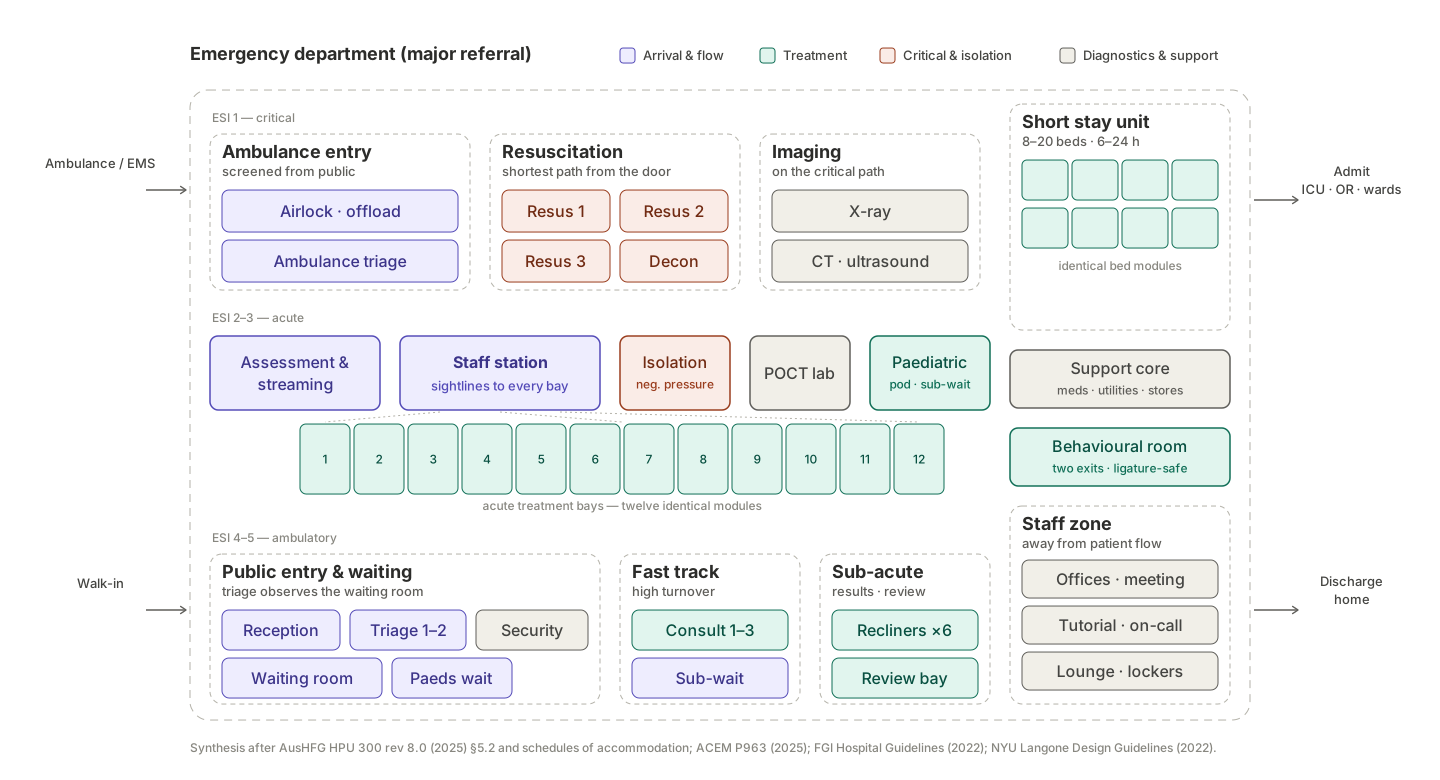
The building is best read as a sorting machine with treatment attached. Everything about the layout follows from one constraint: arrivals are unscheduled and unsorted, so the department's first job is to rank them, and its geography is organized so that severity maps to distance. The two doors are the first sort—ambulance patients arrive pre-assessed by paramedics and bypass the front end entirely, while walk-ins hit triage, where a nurse assigns an ESI acuity level (1 is dying, 5 is a prescription refill) in about two minutes. Registration is deliberately thin at this point; full paperwork happens later, bedside, because the design principle is "sort before you administer."
From there the streams diverge by acuity, and each stream gets its own real estate so they never queue behind each other. The resuscitation bays sit directly against the ambulance doors—the sickest patient travels the shortest distance, and those rooms are the largest because a code involves eight people and a lot of equipment. Acute bays (ESI 2–3, the chest pains and abdominal pains that need real workups) occupy the main floor. Fast track is the opposite logic: a walled-off mini-ED for sprains and lacerations, staffed for throughput, existing purely so that a fifteen-minute suture job doesn't wait four hours behind a stroke. The waiting room, notably, is not passive storage—patients get re-checked, because triage is a provisional judgment and deterioration re-sorts you.
The center of the floor is about observability and cycle time. The nurses' station is a control tower with sightlines into every bay—the racetrack layout exists so one person can visually sweep the whole census. Imaging is embedded in the department rather than upstairs because X-ray and CT sit on the critical path of nearly every workup; the lab and med room are similarly co-located to shorten the order-to-result loop. And the decon room sits at the ambulance door for the obvious reason that you don't walk a contaminated patient through the building.
The movement is not simply from less information to more information. It is from one kind of information to another. The patient begins with effects: pain, dizziness, weakness, pressure, nausea. These are real facts, but they do not contain their own explanation. The disease process, if there is one, lies behind them.
Let \(X\) denote the latent condition and \(Y\) the symptoms available to the patient. The causal direction runs from condition to symptom:
\[X \longrightarrow Y\]The clinic must solve the inverse problem:
\[\left( Y,\ \text{history},\ \text{vital signs},\ \text{examination},\ \text{tests} \right) \longrightarrow \widehat{X} \longrightarrow \text{treatment}\]The difficulty is that this inverse mapping is rarely unique. One condition may produce many symptoms, while the same symptom may be produced by many conditions. Dizziness may arise from the inner ear, circulation, medication, metabolism, anxiety, or neurological disease. The patient possesses privileged knowledge of the sensation but usually cannot trace it backward to its cause. The clinic exists to perform that traceback.
This resembles the help-desk XY problem, although medicine presents a more fundamental version of it. In the conventional XY problem, a person has an underlying problem \(X\), decides prematurely that solution \(Y\) will fix it, and then asks the expert how to accomplish \(Y\). The medical form appears when the patient says, "I need antibiotics," "I need an MRI," or "I need this medication," rather than presenting the condition that led him to that proposed remedy. The clinician must walk backward from the requested intervention to the complaint, recover the actual problem, and determine whether the proposed solution bears any relation to it.
But even when the patient proposes no remedy, medicine remains an inverse problem. The patient can report \(Y\); the institution must infer \(X\). That inferential labor belongs to the medical domain. The patient may accept or refuse the resulting treatment, but he cannot make a symptom disclose its cause merely by describing it more emphatically.
The linguistic register changes because the function of language changes. At registration, language is phatic and transactional: greeting, identity, eligibility, the opening statement of complaint. Phatic is Malinowski's coinage (1923) for speech whose work is contact rather than content—the greeting as channel test, not inquiry. At triage, it becomes elicitative. The nurse listens, clarifies, observes, and records, but ordinarily keeps the interpretation provisional. During intake, speech is broken into structured variables. During clinical assessment, questions narrow and terminology becomes differential and causal. The narrowing arrives on a stopwatch. Beckman and Frankel, taping internists, clocked the patient's opening statement at a mean of eighteen seconds before redirection; only about a quarter of patients ever finished it. A 1999 replication stretched the mean to twenty-three. H. B. Beckman and R. M. Frankel, "The Effect of Physician Behavior on the Collection of Data," Annals of Internal Medicine 101 (1984): 692–696; M. K. Marvel et al., "Soliciting the Patient's Agenda," JAMA 281 (1999): 283–287. During diagnostics, the body is made to "speak" through numbers, images, specimens, waveforms, and reference ranges. A priority claim hides in the vocabulary: semeiotics was the physician's art of reading bodily signs for some two millennia before linguistics borrowed the word for the general science of signs. When the body speaks in signs, medicine is practicing the discipline it named. During treatment, language becomes performative: an order does not merely describe the world but authorizes something to be done in it. J. L. Austin, How to Do Things with Words (Oxford, 1962). A performative succeeds or fails not by truth but by its felicity conditions—the circumstances that make the words count as the act. What makes it an order is not the verb but the chair: the identical sentence in the nurse's mouth is an observation; in the physician's, it changes the world. Felicity conditions are institutional facts, and no warmth of relation can supply them. Which explains, in passing, the triage nurse's reticence: she keeps her interpretation provisional because the performative register is not hers to enter—the restraint is not timidity but register discipline. The reticence is not intellectual passivity. Nurses assess, analyze, synthesize, identify changes in condition, estimate severity, and escalate; in emergency care they are often the first professionals to recognize that a patient may be seriously ill. The boundary is not between thinking and not thinking but between a provisional assessment used to route and protect the patient, and a definitive diagnosis or prescription issued under the appropriate authority—one that advanced-practice nurses, within their scope, hold as well. At discharge, the register returns to ordinary language—the arc has run from vernacular into the domain language and back out—but its direction has reversed. The patient no longer narrates; the institution instructs.
The arc is therefore not merely:
\[\text{plain language} \longrightarrow \text{jargon}.\]It is:
\[\text{narration} \longrightarrow \text{elicitation} \longrightarrow \text{classification} \longrightarrow \text{diagnosis} \longrightarrow \text{order} \longrightarrow \text{translated instruction}.\]Drawn as a ring, with the vernacular and the domain language at opposite poles, the same arc appears twice—once in the clinic, once on the manager's floor:
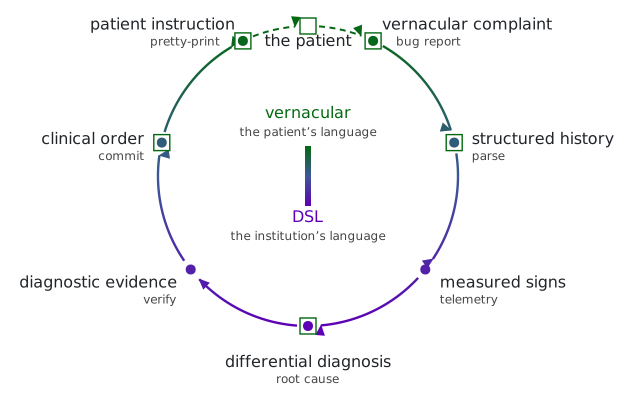
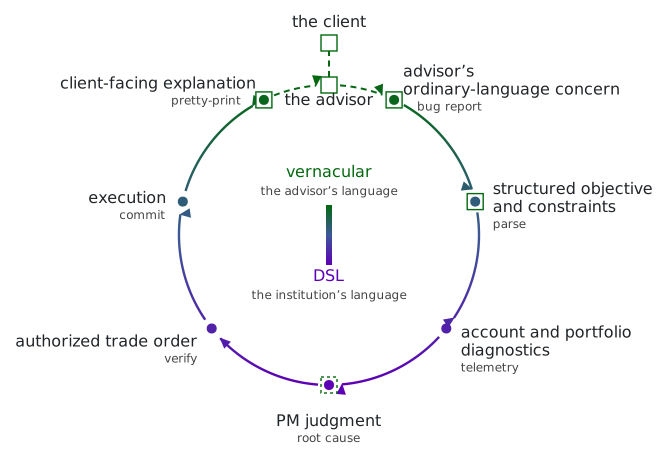
The differential isn't a batch computation—it's an interactive one, and the patient is the oracle it queries. At intake, the institution can only run the standard prefix: the fields everyone gets asked, the vitals everyone gets measured. But the discriminating questions don't exist yet, because they're generated by the hypothesis set. "Does the pain move through to your back?" only becomes worth asking once dissection is on the list; Dix-Hallpike only becomes worth performing once the inner ear is a candidate. The inverse problem is non-unique, so resolving it requires new queries chosen to split the surviving candidates—and the selection of those queries requires the DSL, while the answers live only in the person. Symptoms have no instrument; the subjective channel—quality, timing, what makes it worse, what it feels like—is readable through narration alone. So station 4 contains a miniature of the whole ring running at high frequency: each discriminating question descends from the differential into the vernacular, is answered in the vernacular, and is consumed back into the DSL. The patient isn't co-authoring the diagnosis. He's the sensor the inference loop reads adaptively, which is why he must be in the room while the loop runs rather than serialized before it.
And this is exactly why the PM's frame is dashed rather than solid—medicine itself contains both models. The examining specialist queries the person; but the pathologist and the radiologist never see the patient at all. They work from the specimen plus the requisition form, and the specimen suffices because it detaches completely from its speaker. The subadvisory PM is a specimen specialist: the account excises cleanly—positions, lots, flows, restrictions, all in the custodian record—so the adaptive queries run against the record, not the person. The residual that can't be serialized is the client's mind—what "less risk" means, what he'll actually tolerate—and that examination belongs to the advisor, the treating clinician of the relationship, not to the PM. The dashed frame is the escalation path for when the requisition was inadequate; and pathologists' oldest complaint—"insufficient clinical history" scrawled on the requisition—is precisely the PM receiving an unparsed request.
The old handwritten prescription was a nearly perfect emblem of this directional system. It was physically handed to the patient but functionally addressed to another professional. The patient carried the message without necessarily belonging to the linguistic circuit in which it was written. The notorious illegibility of physicians' handwriting was not an intentional cryptographic device. It was a dangerous by-product of speed, compression, abbreviation, and a professional communication channel designed chiefly for prescribers, pharmacists, and other clinicians. Yet as a social symbol it was almost too perfect: the patient held the order in his own hand and still could not read it. Electronic prescribing replaced much of this scrawl with standardized, machine-readable transmission. It made the channel safer without fundamentally changing its direction: the clinician issues the order, the pharmacy receives and validates it, and the patient receives the resulting medicine and instructions.
| Stage and principal role | Direction of information flow | Dominant linguistic register | Transformation performed by the system | Direct time with physician or APP |
|---|---|---|---|---|
| Arrival and registration—registrar or paramedic | Patient → registrar → administrative record | Social and transactional vernacular: name, complaint, insurance, ordinary explanation | Establishes identity, eligibility, source of arrival, and a provisional reason for the encounter | None |
| Triage—triage nurse | Patient's narration + visible condition + initial measurements → nurse → acuity queue | Elicitative and provisional: active listening, short clarifying questions, neutral description | Separates urgency from diagnosis; identifies red flags, assigns acuity, and routes the case without pretending to have resolved it | Usually none |
| Nursing intake—assigned nurse or technician | Patient + body + instruments → structured clinical record | Descriptive and standardized: symptoms, history, medications, allergies, vital signs, specimens | Decomposes the patient's story into fields, observations, measurements, and abnormalities that can travel through the institution | None |
| Initial clinical assessment—physician, NP, or PA | Chart + patient + physical examination ↔ clinician | Focused clinical interrogation and differential-diagnostic language | Reconstructs possible latent causes from observed symptoms, formulates the problem, and orders discriminating tests or provisional treatment | Brief first encounter |
| Diagnostics and treatment—laboratory, radiology, nursing, pharmacy, respiratory therapy | Body → instruments and laboratories → record → clinician; clinician's orders → treatment team | Technical measurements, codes, images, reference ranges, protocols, and medication orders | Tests the competing explanations and carries out interventions already authorized by the clinician | Usually none; the clinician works elsewhere |
| Reassessment and disposition—physician, NP, PA, or specialist | Results + response to treatment → clinician → diagnosis and disposition order | Synthetic and prescriptive: diagnosis, assessment, contraindication, dose, route, frequency, admission, discharge | Collapses the differential into a working conclusion and determines what the institution will do next | Brief return encounter |
| Discharge, admission, or transfer—nurse, pharmacist, care coordinator, receiving service | Clinical order → operating staff → patient or next institution | Translation back into patient-facing language, now chiefly imperative: take, stop, avoid, return, schedule, call | Converts technical judgment into an executable plan, confirms comprehension, and transfers responsibility for the next stage | None or a final brief confirmation |
Tally what the role of patient absorbs without protest. A visit of three hours contains perhaps three minutes of physician, and the ratio scandalizes no one. The professionals conduct the case in a language the patient cannot speak and record it in codes he will never read—of medicine's several registers, only the patient-facing vernacular is addressed to him. The consequential decisions are made on his behalf: he chose to come, and he may refuse what is offered, but he does not design the treatment, select the molecule, or set the dose. And no one considers the institution obliged to make him understand its reasoning: he swallows, on schedule, a compound he cannot pronounce, prescribed by a specialist whose name he barely caught. Any one of these terms, transplanted into an unscripted commercial relationship, would end it by the afternoon. Bundled into the role of patient, they pass not merely unresented but unnoticed.
The terms are uniform, announced in advance, and applied to everyone, and expected hierarchy reads as order rather than insult. The other half is the interesting one. The terms are not tribute, and their beneficiary is, in the end, the patient: each purchases some quantity of accuracy, safety, or capacity that a more courteous arrangement would have had to surrender. The profession has learned to say precisely what is being bought. The clearest statement is from 1968:
We should not assess a physician's effectiveness by how much time he does or does not spend with patients or how sophisticated his specialized technics are. Rather, we should judge him on the completeness and accuracy of the data base he requires at the time he starts his work, the speed and the economy with which he obtains his data for his patients, the adequacy in the formulation of all the problems, the effectiveness of the therapy he prescribes and the total quantity of acceptable care that he is able to deliver.
—Lawrence L. Weed, "Medical Records That Guide and Teach," New England Journal of Medicine, 1968
Weed's argument is more radical than the familiar plea for better medical records. It rejects the visible clinical encounter as the proper unit of professional value. We see the physician enter the room, ask a few questions, perform an examination, and pronounce a judgment; because this scene is human, ceremonial, and expensive, we mistake it for the care itself. Weed asks us to judge something less theatrical and more consequential: whether the institution assembled a complete and accurate body of information, formulated the patient's problems correctly and in context, selected an effective treatment, and delivered acceptable care with speed and economy. The conversation at the bedside is one interface. The care lies in the processing.
Read this way, the choreography is an operating system for allocating scarce judgment, and each audacity converts into a design feature. The brevity of the encounter is the efficiency of an interface: everything another layer can do has been moved off the specialist's three minutes, so that the three minutes contain only what no other layer can do. The jargon is compression: professionals who must not lose precision between hand-offs cannot conduct the case in the vernacular, so the institution maintains several registers and translates deliberately between them. The delegation is a division of judgment: the patient consents to destinations, and the profession selects routes, because route-selection is precisely the expertise being purchased. Even the silence about mechanism is a decision about registers rather than a confiscation: the patient is owed an intelligible account of his condition, the intervention, its material risks, and its alternatives—not a seminar in biochemistry. Opacity of method may sometimes be legitimate. Opacity of consequence is not.
The authority the procession produces is real but derivative: the physician's few minutes carry disproportionate weight because the rest of the clinic has been built to make them decisive, and what the patient defers to is the decisiveness, not the procession.
In the production of care, direct interaction is usually the least important component, though often the most emotionally salient. It matters when the institution must elicit information that exists nowhere else, clarify an ambiguity, exercise judgment, obtain consent, or explain a consequential decision. Everything else—identity, history, medication reconciliation, vital signs, specimen collection, laboratory work, imaging, record retrieval, classification, routing, execution, and monitoring—should occur before or after the physician appears, and should not require him to perform work another competent layer can perform. A forty-minute consultation conducted over an incomplete chart may produce worse medicine than a three-minute consultation supported by a complete one.
The same inversion applies to asset management. Firms often treat access to portfolio managers as the service because it is the part the client can see. The advisor receives a call, hears technical language, asks questions, and feels attended to. Yet the PM conversation is no more the investment product than bedside conversation is the treatment. The product is the successful conversion of a client's objectives and constraints into an authorized mandate, coherent portfolio settings, correct trades, and continuing controls. A long meeting founded on scattered information is theater. A brief consultation that resolves the final irreducible uncertainty is professional work. And the stakes license the comparison: the clinic is entrusted with the body, the manager with a household's economic life, and neither trade deals mainly in reversible errors.
An advisor begins with effects: "the client wants less risk," "the client needs cash," "the account is underperforming," or "the client does not want a tax bill." Sales or Client Service receives the narration. Operations assembles the account facts and tests the request against the record. Portfolio analytics expose the underlying structure. The PM determines whether "less risk" means less beta, leverage, concentration, tracking error, illiquidity, drawdown exposure, or merely less emotional discomfort. The resulting prescription becomes a mandate setting, trade instruction, transition plan, restriction, recommendation against action, or escalation.
The linguistic color should change with the work. Sales speaks relationally. Client Service and Operations listen actively, clarify, and structure without prematurely diagnosing. Investment Engineering and the PM speak internally through exposures, constraints, covariance, tax lots, optimizer outputs, liquidity, and execution mechanics. The PM's decision becomes an authorized order. The institution then translates the result back into advisor-facing language: what problem was identified, what action was taken, what trade-off it creates, and what must happen next.
This does not justify using jargon to repel inquiry. The technical register exists to increase precision inside the professional channel, not to stage superiority outside it. The client need not read the internal prescription, but he must understand what condition the institution believes it is treating, what intervention it proposes, and what material consequences follow. The patient-facing language may be simpler than the clinical language without being less truthful.
The failure runs the other way, too. Excessive interaction is often evidence of defective design. The client repeats the same facts because the record does not travel. Sales summons the PM because the request was never classified. The PM joins an operational call because decision rights are obscure. Another meeting is scheduled because the first produced neither a durable decision nor an executable order. What is praised as "high touch" may be institutional amnesia performed with excellent manners. High-touch should describe the fidelity of the service, not the frequency of interruption.
The decisive migration is therefore not from friendliness to coldness. It is from complaint to evidence, evidence to judgment, and judgment to order. As the case advances, the patient's narration loses its monopoly, the body and instruments acquire a voice, and professional language acquires the authority to act. The same should occur in asset management: the advisor's account begins the process, but it cannot remain the final description of the problem.
A good system does not silence the original speaker. It prevents the original symptom from impersonating its own diagnosis.
The clinic, then, has much to teach the SMA business: how to structure access, specialize labor, encode decisions, and preserve professional discretion under load. The one lesson it does not offer is the one a cynic would copy first. Its asymmetries are tolerable because they are load-bearing—each one bought and paid for, with the patient collecting the dividend. Reproduce the asymmetry without the machinery beneath it—delay staged as importance, jargon kept as a moat, discretion inflated into dominion—and what remains is the costume of expertise without its competence.
Nor should the clinic be mistaken for medicine's birthright. The terms catalogued above are young, and they were acquired late, slowly, and against the profession's own strenuous resistance. For most of its history medicine could not have charged them, because it was organized exactly as asset management is organized today: around the relationship.
Customization as courtship
The art of medicine consists in amusing the patient while nature cures the disease.
—Voltaire
The healer's capital was not information but proximity. Weed's standard—judge the physician by the completeness of his database, the economy of its acquisition, the adequacy of his problem formulation—would have been unintelligible to nearly every healer who ever practiced. For most of its history, medicine kept no database, counted nothing, and formulated its problems in whatever vocabulary the patient found most consoling. This was not a failure to attain an obvious ideal. The profession was organized around a different asset altogether.
The office is older than the science, and it began as a bundle. The shaman healed, but he also divined, interceded, blessed harvests, and advised on war; his authority flowed from privileged access to the invisible world, and illness was one department of a general practice in mediation. When societies stratified, the mediation followed the power. Imhotep, vizier and architect to Pharaoh Djoser, was remembered as a healer and eventually promoted to god of medicine—a career trajectory no modern department chair has matched. Herodotus tells of Democedes of Croton, a captive Greek who cured Darius's ankle and rose to dine at the Persian king's table. Galen's talent carried him from Pergamon to the household of Marcus Aurelius. Avicenna served twice as vizier and wrote philosophy between court intrigues; Maimonides attended Saladin's court. For two and a half millennia, the consummation of a medical career was not a cure rate—no one kept cure rates—but an appointment. Medicine was a branch of favor.
Antiquity had already filed the diagnosis. In the Gorgias, Plato divides the practices that aim at the good of the body from the knacks that aim at its pleasure: medicine has cookery for its counterfeit, as justice has rhetoric. And Socrates concedes the commercial implication without illusion. Tried before a jury of children, with a pastry-cook for accuser, the physician would be convicted every time, having nothing to say in his defense except that he cut, burned, and starved them for their own good. A patronage market is a jury of children with revenue. So long as the patron judged, the knack outsold the art, and the practitioners who flourished were, on the whole, those who had quietly made the substitution.
The alchemist was the pure type of the genre. His deliverables—transmutation, the elixir, perpetual youth—had the great commercial virtue of being infinitely postponable, and his method, secrecy, was not an embarrassment but a strategy. Rudolf II filled Prague with adepts; John Dee had Elizabeth's ear. Opacity protected a relationship that measurement would have dissolved: what the alchemist sold could not survive an audit, so the audit was declared profane. The modern reader smiles, and then remembers how much of the service economy still runs on the same architecture.
Even after medicine separated from magic, its market remained a patronage market, and its hierarchy said so. The early modern English physician was a gentleman of Latin learning who diagnosed and prescribed but did not, as a rule, touch; touching was for surgeons, who shared a guild with barbers, and dispensing was for apothecaries, who kept shops. Status ran inversely to contact with the body—and, one is tempted to add, to therapeutic contribution. Eminence traveled through manner and emblem: London's gold-headed cane passed from Radcliffe to Mead to Askew like a relic, which in a sense it was. Physicians of the first rank conducted substantial practices by post, diagnosing patients they never examined from the patients' own elegant self-descriptions. The sociologist Nicholas Jewson called this world bedside medicine and named its epistemology precisely: the sick man was the patron, the patron governed the encounter, and medical theory answered to him. N. D. Jewson, "The Disappearance of the Sick-Man from Medical Cosmology, 1770–1870," Sociology 10, no. 2 (1976): 225–244. It was the first of three medical cosmologies in his schema—bedside, hospital, laboratory—each the knowledge-form of a patronage structure, and each worth naming, because the sequence is the argument. Humoral medicine was superbly adapted to this market—individualized, endlessly adjustable, unfalsifiable, flattering in its attention to the patient's unique constitution. It was customization as courtship, and it survived for two thousand years while curing approximately nothing. What it did instead is recorded at Mount Vernon. In December 1799 George Washington took to bed with an inflamed throat and was attended by three physicians of impeccable standing, who bled him four times—perhaps five pints—in under a day. The youngest of the three, Elisha Dick, urged them to stop and proposed opening the windpipe instead; he was overruled by seniority. The relationship was beyond reproach, the attendance devoted, the sincerity total, and the patient died of the remedy as much as the disease. Wilde's epigraph returns here with its teeth showing: the physicians at that bedside had both style and sincerity, and lacked only a system that could tell them they were wrong.
The system arrived by inversion. And Foucault's account of it remains the essential one. The clinic of post-revolutionary Paris was not a friendlier venue for the old encounter; it was a new way of seeing, and it became possible only because the power relation had reversed. The hospital filled with the poor, who could not dictate the terms of their treatment and who paid for it, in the tacit contract Foucault describes, by becoming teaching material. Freed from the patron, medicine could at last demote the patient's narrative to one symptom among several, interrogate the body directly, and check the story against the lesion—Bichat's advice was to open a few corpses. Laennec's stethoscope interposed an instrument where a conversation had been. This is Jewson's second cosmology, hospital medicine, and his blunter sociological translation of it runs: when the patient stopped paying, the patient stopped defining the disease. What changed was less the doctor's mind than his audience. The pauper neither chose his physician nor defined success; careers were now made before colleagues and the seniors who controlled appointments, and knowledge reorganized itself for the new judges. Signs elicited by the examiner outranked symptoms reported by the sufferer; disease moved from the person into the tissue; and patients, no longer patrons, standardized into cases—interchangeable at last, the precondition of every statistic the bedside could never run. This is the uncomfortable half of the lesson, and it should not be prettified. The epistemic revolution did not occur because physicians grew humbler or kinder. It occurred because the encounter ceased to be governed by the client's favor—a point worth sitting with in any industry that recites its identity as a relationship business.
Then medicine began to count, and every step toward the count was resisted as an assault on standing. Pierre Louis's numerical method tallied the outcomes of bloodletting and found arithmetic where authority had been; venesection—the remedy that bled Washington—did not survive the ledger. P. C. A. Louis, Recherches sur les effets de la saignée dans quelques maladies inflammatoires (Paris, 1835)—the founding exhibit of the "numerical method." Semmelweis showed with mortality tables that physicians' hands were carrying death from the morgue to the maternity ward, and the profession heard not a finding but an insult—a gentleman's hands could not be unclean—and mothers went on dying for a generation. Ernest Codman proposed in the 1910s that a hospital should track the end result of every patient it treated, record its errors, and publish them; Boston's finest institution invited him to leave. Each refusal had a body count. That is what it means to say the profession learned the hard way that medicine is not about the relation: the tuition was paid by patients, over centuries, in installments.
Once the resistance broke, consolidation came quickly. The laboratory—Jewson's third cosmology—recast disease as process, indifferent to the sufferer's uniqueness; Virchow's cellular pathology and Bernard's experimental medicine answered to no bedside at all, their audience the discipline, their patron the state; Flexner annexed medical education to the university and closed the schools that ran on charm; the record, the code, and the protocol made cases commensurable. Rudolf Virchow, Die Cellularpathologie (Berlin, 1858); Claude Bernard, Introduction à l'étude de la médecine expérimentale (Paris, 1865); Abraham Flexner, Medical Education in the United States and Canada (New York, 1910). Set the three cosmologies in a row and the pattern declares itself. As control over the encounter migrated—from the patron to the profession to the discipline—the disease migrated with it, from the person to the tissue to the cell, and the sick man's account of himself fell from constituting the disease, to indicating it, to interfering with its measurement. Jewson's title says the sick-man disappeared from medical cosmology; his mechanism says that nothing so dignified as an argument removed him. Each cosmology was the shadow of its payment structure, and the shadow moved when the money did.
L. J. Henderson's famous estimate dates the crossover to about 1910: only then did a random patient consulting a random physician enjoy better than even odds of benefiting from the encounter. Two and a half millennia of relationship, one century of information processing—and the entire cure rate lives in the century. Weed's 1968 manifesto is therefore not a technocrat's provocation but the profession's mature self-description, arrived at last: the bedside scene demoted from product to interface, judged by what it contributes to the chart. The physician still sits with the patient, still holds the hand. But the profession now knows which part is the care.
Finance is younger, and its early chapters rhyme. The court factor and the family banker were the healer's cousins: the Fuggers attended emperors as Galen attended Marcus Aurelius, and the private banker perfected the bedside manner—discretion, presence, the annual letter, performance politely unmeasured and largely unmeasurable. Finance even had its Pierre Louis: in the 1960s Jensen counted mutual-fund outcomes as Louis had counted bloodlettings, with comparable results for heroic intervention, and the index fund institutionalized the arithmetic. But the count reached the portfolio long before it reached the service model, where the Galenic residue persists—individualized, endlessly adjustable, unfalsifiable, and flattering. The SMA platform is finance's Paris clinic: hundreds of thousands of cases, scarce judgment, and, as yet, no inherited chart. Medicine paid retail for the lesson that the relation is the interface and the processing is the care; finance can have it secondhand. The alchemist sought the ear of the king; the chemist sought the structure of the compound; and the profession that began by attending upon the powerful became powerful only when it learned to attend to the information instead.
The hierarchy of the early modern sickroom was not a peculiarity of medicine. It was a local application of the general grammar of honor. Veblen located the root of status in demonstrated exemption from necessary labor: the honorific occupations are those furthest from the material work of survival, and the surest insignia of rank is a hand that visibly does nothing useful. Mary Douglas supplied the complementary theorem: dirt is matter out of place, contact with disorder pollutes, and those who handle a community's anomalies absorb the stigma of the anomaly. Everett Hughes, watching hospitals, described the mechanism that joins the two: occupations rise by delegating their dirty work down the line, until the pattern of delegation is the organization chart. The grammar is not European property. The classical Chinese ranking set the scholar above the farmer, the farmer above the artisan, the artisan above the merchant, and the mandarin grew his fingernails long as proof that his hands had retired from the world. Even our vocabulary confesses: surgery is cheirourgia, hand-work—the stigma preserved in the name like an insect in amber.
The medieval anatomy theater staged this grammar with diagrammatic honesty. Three men attended the corpse. The lector sat aloft in his chair, reading Galen aloud. The ostensor stood below with a wand, pointing at whatever the text described. The sector—a barber—had his hands in the body. Status, interpretation, and evidence occupied three altitudes, with honor at the top, the corpse at the bottom, and a pointer in between; information flowed downward as instruction and could not flow upward as correction. When the body contradicted the book, the body lost. Galen's five-lobed human liver survived centuries of two-lobed human livers. And when Vesalius finally published the discrepancies, his own teacher, Jacobus Sylvius, answered that mankind had degenerated since antiquity—that the femur, for example, had straightened under the influence of narrow trousers. It is the purest specimen we possess of an institution defending its status gradient against its own evidence, and it deserves study from anyone who has ever watched a reconciliation break get "fixed."
Modern medicine began as a descent down that gradient. The frontispiece of the Fabrica is a deliberately staged status scandal: the professor has come down from the chair, displaced the barber, and put his own hands in the corpse while the crowd presses in to watch. The descent continued for three centuries. Auenbrugger, an innkeeper's son, learned to percuss a chest as his father had tapped wine casks, and was ignored for forty years until Napoleon's physician translated him. Laennec put his ear, by way of a tube, against the sick body itself. The Paris school completed the correlation of symptom with lesion by following its patients into the morgue. Surgery, once barbers' work, was redeemed by anesthesia and antisepsis into the most prestigious craft in medicine—and the British surgeon still styles himself "Mr." rather than "Dr.," the old badge of low birth worn now as insignia. Status did, in the end, reprice to follow efficacy. But the repricing took roughly three hundred years, and it cleared only under the audit of mortality.
Finance runs the same gradient and, with admirable candor, names it spatially: front office, middle office, back office. The terms are Goffman's—the front stage where the performance is given, the back stage where it is prepared and repaired—promoted from dramaturgy to floor plan. Honor tracks contact with the client and the capital; contact with the instruments in their material life—the tax lot, the corporate action, the collateral call, the failed settlement, the break—is delegated downward until it is performed by the least-paid hands in the building. The mapping onto the anatomy theater is uncomfortably exact. The front office holds the text: the strategy, the narrative, the deck. The middle office stands where the ostensor stood, pointing at the body with a wand of risk reports and compliance attestations, describing without cutting. The back office is the sector, alone in actual contact with the corpus. Veblen would have savored the fractal: finance, the occupation his leisure class honored precisely for its distance from making things, reproduces within itself a hierarchy of distance from its own things.
And the epistemology transfers with the org chart, because the back office is the firm's morgue: the place where its claims are laid beside its body. Reconciliation is a daily autopsy—the ledger against the custodian, the narrative against the tissue—and a break is a lesion, a site where the story and the flesh disagree. An institution reveals its character in what it does next. The medieval arrangement recurs wherever the break is treated as clerical noise—“just fix it”—and the ledger is blamed for contradicting the text. The industry's history punishes this arrangement at intervals. In 1968 Wall Street nearly died of its back office: buried in paper certificates and failed deliveries, the exchange closed on Wednesdays to let the sectors catch up, a hundred member firms disappeared, and the depository system was born—the industry discovered it had a body the way medicine did, by nearly dying of it. Forty years later, the largest fraud in financial history was a back-office fiction: the trades were typed, not traded, and a single custody confirmation would have opened the corpse—but for decades no one of sufficient standing performed the autopsy, because verification was beneath the people with the standing to insist on it. The status gradient was the camouflage. Since then, operational due diligence has begun its Vesalian ascent—allocators now walk down into the morgue themselves—and in 2008 the industry relearned the ranking of realities: the poetry died in a weekend, and the plumbing took a decade to probate.1
The question in the anatomy theater of the firm is therefore the old one: who holds the text, who holds the knife, and whether the man aloft can be corrected from below. An institution's intelligence can be measured quite precisely by how easily bad news travels up its status gradient—by whether the sector is permitted to overrule the lector.
At the top of the gradient the inversion completes itself. Ascent in a modern asset manager is a progressive exchange of contact with instruments for contact with clients: the analyst touches positions, the portfolio manager touches portfolios, and the chief investment officer, at the summit, touches almost nothing but people. His practice is boards, consultants, allocators, letters—attendance. The industry even mints titles for the pure form, "relationship manager" and "coverage," the courtier function professionalized and given a terminal. Promotion, in other words, quietly reconstructs the court physician: the most senior professional in the building is the one whose contact with the object of care has become entirely ceremonial.
The demand runs the same direction, and never more strongly than in a drawdown. Frightened clients do not ask for the person who knows the account best—the client PM who set the mandate, the analyst who reconciles it nightly. They ask for the highest personage available, because what they are seeking is not information but attendance. Fear seeks rank. The drawdown meeting is a bedside scene; the CIO's appearance is itself the treatment, an anxiolytic administered in person, and it works precisely because his hours are scarce—a costly signal that the account matters. Nor is the demand irrational, and the essay's opening explains why it compounds: every deployment of the summit teaches the script. Send the founder to the board after two bad quarters, and his absence after the third reads as abandonment. The firm has written a liturgy that it must now perform.
Medicine has a name for what happens when rank enters the sickroom. The VIP syndrome, described by Weintraub in 1964, is the eminent patient treated personally by the chairman, off protocol, amid general deference—and with reliably worse outcomes, because status suspends the system at precisely the moment the system is most needed.2 The reductio was administered in a Holmby Hills bedroom in 2009: a personal physician on a princely monthly retainer, giving the patron the anesthetic he demanded, at home, outside every protocol on earth. The relation was superb; the patronage model was fully restored; and it killed the patient, as it had killed Washington, for the same structural reason with better equipment.
The financial equivalent is the order written at the bedside. The real danger of the drawdown meeting is not that it consumes the CIO's afternoon but that it tempts the institution to let its highest-status, least-charted participant prescribe—to trade for the relief of the room. Some of the most expensive transactions in institutional history were executed as hospitality: portfolios de-risked at the bottom because the quarterly meeting had become unbearable, positions bled to soothe a board. Capitulation with excellent manners is still capitulation. The minutes record only that the client felt heard.
The remedy is not to abolish the bedside visit. Reassurance, accountability, and the renewal of consent are legitimate clinical work, and in a fiduciary business they are obligatory. The remedy is the one this essay keeps arriving at: connect the presence to the chart rather than letting it route around the chart. The CIO enters the drawdown meeting charted—briefed from the record, not the corridor—and leaves it documented: a consultation note, a decision owner, a review date; and if the client directs a departure from the recommendation, an informed refusal, in writing, like anyone else's. The English language has kept the necessary distinction on file. Medicine's attending physician is defined by responsibility for the case; the physician in attendance was defined by proximity to the patron. A mature firm knows, at every moment, which of the two its summit is being asked to be—and insists on being the first even while the client is requesting the second. The chart does not defer to rank. That is what a chart is for.
Intentional interaction engineering
The important thing here, I believe, is that truth isn’t outside power or lacking in power: contrary to a myth whose history and functions would repay further study, truth isn’t the reward of free spirits, the child of protracted solitude, nor the privilege of those who have succeeded in liberating themselves. Truth is a thing of this world: it is produced only by virtue of multiple forms of constraint. And it induces regular effects of power. Each society has its regime of truth, its “general politics” of truth—that is, the types of discourse it accepts and makes function as true; the mechanisms and instances that enable one to distinguish true and false statements; the means by which each is sanctioned; the techniques and procedures accorded value in the acquisition of truth; the status of those who are charged with saying what counts as true.
— Michel Foucault, The Chomsky-Foucault Debate: On Human Nature
The transformation just narrated is usually told as intellectual history; its engine was economic. Bedside medicine was a low-throughput instrument—one patron, one physician, one theory adjusted to one constitution—and it scaled exactly as far as the patron’s fee. The clinic became possible when medicine confronted demand without patronage: wards of the poor, conscript armies, industrial cities, and finally the modern conviction that care is owed to everyone. An institution obliged to treat all comers, at prices it does not negotiate bedside by bedside, cannot deliver care through relationships, because relationships do not scale. It must deliver care through processes, and reserve the relationship for the work that only a relationship can do.
Finance has reached the same confrontation by the same road. Fee compression is the profession’s loss of patronage: the index fund did to the courtier-manager what the public ward did to the society physician, and the SMA platform completes the arrival—hundreds of thousands of individualized mandates, scarce judgment, fees set by competition rather than by favor. The previous section called the platform finance’s Paris clinic. This section supplies the theory of that clinic: what a process is, what it must conserve as it replaces the relation, and what it may never be permitted to forget.
Both professions are routinely described as relationship businesses, and the description deserves an autopsy rather than a sneer, because it is the kind of half-truth that quietly reorganizes institutions. In one sense it is plainly correct. Nobody is healed by a clinic he never visits. The patient must choose a physician, trust him enough to appear, disclose enough to be diagnosed, and believe enough to swallow what is prescribed; a practice that cannot attract and retain patients delivers no care at all, however superb its processing. The same holds for capital. An asset manager without distribution is a research department with opinions. Sales is how the clinic acquires patients and how the manager acquires mandates, and nothing should be mistaken for underestimating it.
The error lies in promoting a requirement to the substance. Medicine needs patients as it needs electricity, and it needs revenue roughly as the body needs respiration—as a condition of everything and the purpose of nothing. A hospital that reorganizes itself around attracting, pleasing, and billing—around the relationship and the margin rather than the body and the processing—does not become a friendlier hospital. It becomes, by degrees, a marketing operation with clinical decoration, and its medicine decays exactly where decay is hardest to see: in the completeness of the chart, the honesty of the differential, and the quality of the routing. No one summarizes medicine as salesmanship, and no one should summarize it as profit maximization, though it cannot survive without either.
Finance deserves the same defense of its core, though it requests one less often. The industry repeats “this is a relationship business” with such liturgical regularity that the sentence has stopped being examined. It is true of how mandates arrive and false of what a mandate is. Fiduciary duty marks the boundary with legal precision: like the physician’s duty of care, it attaches to the thing entrusted, not to the pleasantness of the relation through which the trust was formed. The physician’s obligation runs to the patient’s body even when the patient would rather hear something else; the manager’s obligation runs to the client’s capital even when the advisor would rather be told yes. A physician who prescribes for the sake of the relationship has failed the body. A manager who trades for the sake of the relationship has failed the portfolio, and neither failure is redeemed by the warmth with which it was committed.
Strip either institution to its essentials, then, and two assets remain. The first is the object of care: the patient’s body in one case and, in the other, the client’s financial body—the capital, obligations, constraints, and horizons that together constitute a household’s economic life. The second is the processing: the machinery that perceives that object accurately, formulates its problems, decides with authority, and acts. In an industry that speaks of assets all day, it is worth being exact about which ones matter most: the client’s, and the machinery that cares for them. Everything else—the titles, the manners, the lobbies, the relationships—is valuable precisely insofar as it serves these two. The relationship escorts the body to the machine and keeps it there, which is indispensable and insufficient. It is the waiting room, not the operating theater.
Intentional interaction engineering begins from a simple principle: do not maximize interaction; maximize the information yield of each interaction. Capture facts once. Validate them at the proper layer. Preserve the client’s narrative beside the structured fields. Route the case according to complexity, authority, and urgency. Invoke scarce expert judgment only when something remains that records, rules, standing procedures, or delegated professionals cannot safely decide. The purpose is not to eliminate the human encounter, but to strip from it everything that need not burden it.
Before a clinic is a place of healing, it is a system for processing uncertainty. Before an asset manager is a steward of capital, it is a system for converting incomplete human intentions into authorized financial action. Both institutions are furnished with people, manners, credentials, screens, documents, instruments, and rooms; beneath this social upholstery, however, they perform the same primitive operations. They ingest information, validate it, classify it, route it, interpret it, decide upon it, record it, and act.
For any completed case, assume there is a finite quantity \(W\) of information-processing work required to carry it from its initial presentation to a legitimate conclusion. Once the case is taken, much of that work is irreducible: the material facts must be collected, the problem must be formulated, a decision must be made, and the result must be authorized, communicated, and recorded. Organizational design cannot abolish this work. It can determine who performs each part, in what sequence, through which medium, with what controls, and how often the same labor must be repeated.
Before intake, however, \(W\) is unknown. It is drawn from a distribution whose center determines ordinary staffing but whose tails govern the institution’s moments of truth. A patient may arrive with a mildly twisted ankle, a familiar infection, an obscure autoimmune disorder, or an apparently harmless complaint concealing an emergency. A financial advisor may ask for a routine report, a modest cash withdrawal, or a portfolio reconstruction involving concentrated stocks, embedded gains, liquidity constraints, interval funds, and long-short mechanics. When the first message arrives, the institution does not yet know where in that distribution the case will fall.
The design objective may be stated plainly:
\[\max_{\pi}\ \operatorname{Throughput}(\pi)\]subject to acceptable bounds on material error, delay, and unauthorized action, where \(\pi\) is the institution’s policy for intake, classification, routing, escalation, decision, and follow-up. Throughput without an error constraint is merely haste. Accuracy without regard to capacity is artisanal care for a fortunate few. The design problem is to produce the greatest number of correct, authorized, intelligible, and properly recorded conclusions per unit of scarce professional capacity.
A system organized around the exceptional case becomes expensive, ceremonial, and glacial: every sore throat receives the resources of an undiagnosed malignancy. A system organized around the median case becomes quick and agreeable until it encounters genuine complexity, at which point its efficiencies reveal themselves as shortcuts and its shortcuts become errors. The task is to process the ordinary case cheaply without treating the extraordinary case carelessly. That is the office of triage.
Triage is not merely a front-desk convenience. It is the classification mechanism by which the institution estimates \(W\), identifies the relevant kind of work, and assigns the case to the least costly competent path. Routine matters should be resolved through records, protocols, or delegated authority. Complex matters should reach specialists with the relevant information already assembled. Urgent matters should bypass the ordinary queue. The system succeeds when scarce judgment is neither squandered on the simple case nor withheld from the dangerous one.
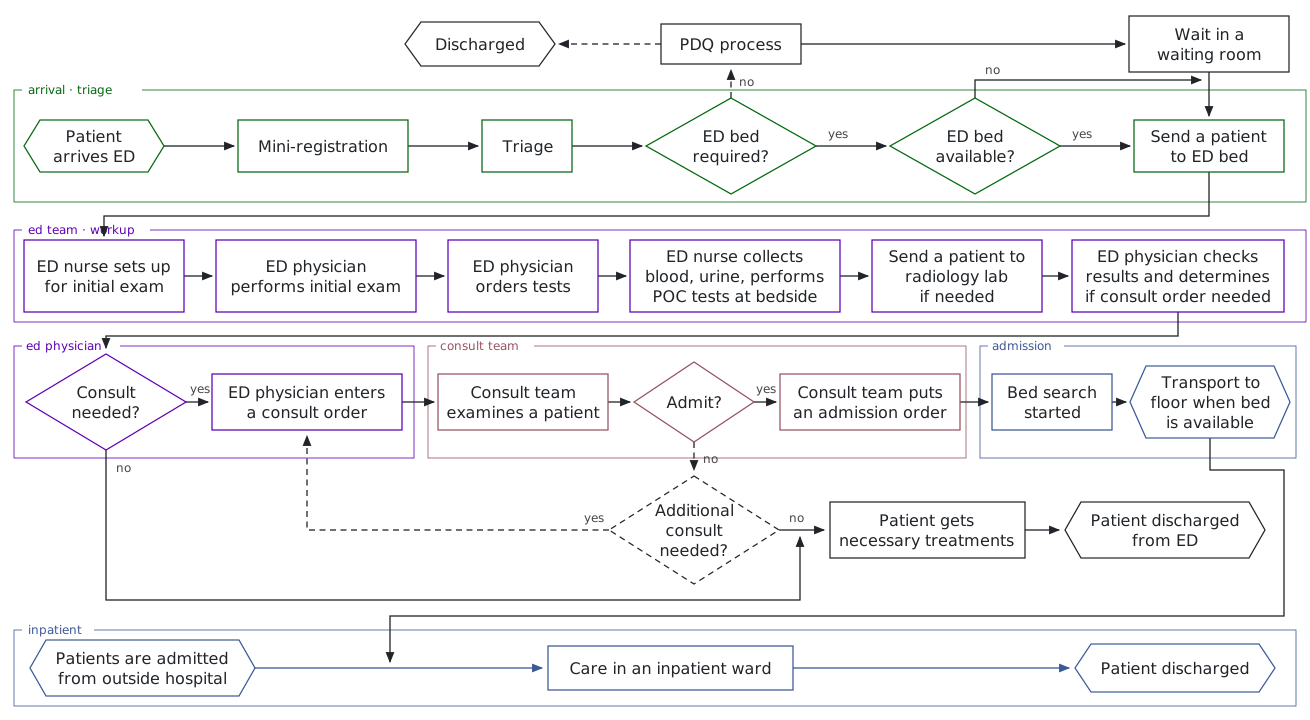 Adapted from Figure 1 in Hyojung Kang, Harriet Black Nembhard, Colleen Rafferty, and Christopher J. DeFlitch, “Patient Flow in the Emergency Department: A Classification and Analysis of Admission Process Policies,” Annals of Emergency Medicine 64, no. 4 (2014): 335–342.e8.
 In a clinic, the raw input begins with the patient’s narrative: where it hurts, when it began, what changed, what he fears, and what he believes may have caused it. That account is joined by medical history, medications, allergies, vital signs, physical examination, laboratory results, imaging, and the clinician’s accumulated knowledge. The system processes these heterogeneous signals into a diagnosis or differential diagnosis. Its output may be a prescription, a procedure, a referral, further testing, observation, reassurance, or the important instruction to do nothing. What began as a private experience of discomfort becomes an institutional act that can be explained, recorded, authorized, and carried out.
The asset manager receives an equally mixed set of inputs. A client or advisor presents an objective, usually in ordinary language: reduce risk, raise cash, avoid taxes, generate income, preserve a concentrated position, track a benchmark, or recover from an earlier decision. That narrative must be joined to account holdings, tax lots, mandate terms, liquidity needs, restrictions, custodial mechanics, risk exposures, market conditions, household relationships, and prior instructions. The system processes these facts through analysis, optimization, professional judgment, compliance controls, and execution logic. Its output may be a mandate, a portfolio setting, a series of trades, a transition plan, an escalation, a recommendation against action, or an explanation that the requested combination of outcomes is impossible. In each institution, the essential transformation is the same: an unstructured human concern must become a structured and authorized act.
This transformation is the real work because neither the patient nor the advisor arrives speaking the institution’s native language. The patient does not arrive speaking in diagnosis codes, and the advisor does not arrive speaking in optimizer constraints. The first statement is usually not false, but it is rarely operational. “I feel dizzy” does not tell a physician whether the problem is vestibular, cardiovascular, neurological, pharmacological, or trivial. “The client wants less risk” does not tell a portfolio manager whether to reduce beta, tracking error, leverage, duration, concentration, drawdown exposure, liquidity risk, or merely the client’s anxiety.
The communication system must identify the operative meaning without losing the human purpose. It must compress without mutilating. Medical-history forms, intake questions, checklists, vital signs, diagnostic codes, and electronic records are compression devices. They reduce the disorderly amplitude of a life into a finite set of features upon which an institution can act. Portfolio systems perform the same operation when a client’s fear of losing recently accumulated wealth becomes a risk target, a future tuition payment becomes a dated liquidity requirement, a moral aversion becomes an exclusion list, a desire to avoid a tax bill becomes a gain budget, or a complicated family circumstance becomes a householding rule. Without such compression, every case remains a private novel—rich in meaning but impossible to administer at scale.
The division of labor follows from this informational architecture. A specialist should receive neither every available fact, regardless of relevance, nor only the fragments that happen to survive an informal chain of retelling. He should receive the relevant facts in a validated, decision-ready form, with access to the underlying record when the case requires it. The receptionist should not diagnose; the physician should not have to begin each visit by reconstructing the patient’s insurance, medication list, and temperature from scattered conversations. In a financial institution, Sales should not determine portfolio treatment; the portfolio manager should not have to search email, Slack, custodial systems, and half-remembered calls merely to establish which account is being discussed, what the client is trying to accomplish, and what authority the caller possesses.
Routing is not a matter of etiquette. It is a computational function. Every communication sent to the wrong layer consumes capacity, increases latency, and creates another opportunity for distortion. A routine servicing question routed to a portfolio manager wastes scarce diagnostic time. A portfolio question answered conclusively by Sales risks turning commercial interpretation into an unauthorized investment decision. An operational exception described only in conversation may disappear between teams. A trade instruction phrased as a casual suggestion may be executed without anyone being able to identify the moment at which discussion became command.
The PM–Ops–Sales triad can therefore be understood as an information pipeline rather than merely an organization chart. Sales receives and frames external demand. Operations validates, structures, administers, and monitors it. Portfolio managers supply the technical judgment that converts a properly formed case into an investment decision. In an SMA business, all three functions remain engaged after the sale, and every new account creates a continuing claim on individualized attention; that persistent engagement is both the model’s attraction and the source of its servicing burden.
A bad system makes the client tell the same story first to Sales, then to Client Service, then to Operations, and finally to the portfolio manager. Each retelling introduces variation: one person hears a tax objective, another records a liquidity request, and a third interprets an instruction to trade. By the time the case reaches the decision-maker, the original problem has passed through so many human codecs that it arrives as a rumor with an account number.
A good system makes the chart travel instead of the client. Information should be captured once, verified where necessary, enriched as it moves through the institution, and made available to every authorized participant. Repetition remains useful when it serves validation, clarification, consent, or the detection of inconsistency. Otherwise, repeated conversation is not service. It is rework wearing a courteous expression.
The errors produced by such a system can be classified according to the stage at which information fails. Acquisition errors occur when a material fact is never collected; translation errors when a valid human objective becomes the wrong institutional parameter; routing errors when a case reaches someone without the necessary competence or authority; judgment errors when the evidence is interpreted incorrectly; execution errors when a correct decision is implemented badly; and feedback errors when the outcome is not monitored or communicated to those who need to know. The final harm may appear at the end of the process even though its cause lies several stages earlier.
In medicine, an allergy omitted during intake may become an injury during treatment, while a patient’s casual mention of chest pressure may be classified as ordinary discomfort and routed too slowly. In asset management, a restriction omitted during onboarding may become a prohibited trade, while an advisor’s casual remark about needing liquidity may be mistaken for an instruction to liquidate. These are not merely examples of people communicating badly. They are failures in the institutional conversion of information into authority and action. The visible error occurs at treatment or execution, but the system may have become wrong long before either took place.
Communication cannot therefore be treated as a decorative layer placed upon the “real work.” It is the sensor system through which the institution perceives the case, the protocol through which it assigns authority, and the control channel through which its decisions become action. A communication failure is not merely an unpleasant client experience or an embarrassing lapse in courtesy. It can change the diagnosis, the mandate, the trade, and the result. The quality of the institution’s judgment is bounded by the quality of the information architecture through which the object of judgment becomes visible.
Queues belong to this architecture because cases arrive stochastically while professional capacity does not. Some form of buffering is unavoidable. Appointments smooth demand. Triage assigns urgency. Office hours batch related questions. Standing procedures resolve common conditions without requiring a specialist to re-derive the answer each time. Escalation paths reserve immediate attention for cases in which delay would materially increase harm.
Waiting, in this sense, is not intrinsically a defect. It is the visible consequence of scarce capacity meeting uncertain arrivals. There is nevertheless a sharp difference between a queue that protects the quality of judgment and a delay staged to exhibit authority. One is operations. The other is theater.
The same distinction applies to access. Unlimited access to specialists feels generous but often produces a perverse result: the loudest, most anxious, or most commercially aggressive clients consume the capacity required by the most consequential cases. Excessive restriction creates the opposite failure, preventing important information from reaching the decision-maker before it decays into damage. The objective is neither open access nor closed access, but correctly routed access: the right information reaching the right person early enough to matter, without requiring every request to begin at the top of the hierarchy.
A functioning system should know which matters require education, which require administration, which require technical analysis, which require an authorized decision, and which require immediate intervention. It must also detect when those categories change. A routine request may reveal a mandate problem. An operational exception may expose a portfolio risk. A service complaint may contain the first evidence of a systematic defect. Triage is not simply the sorting of cases into fixed boxes; it is the continuing recognition that a case has crossed a boundary and now requires a different kind of attention.
Intentional interaction engineering therefore comprises more than scripts and service levels. It requires an explicit design for inputs, records, queues, routing rules, escalation thresholds, decision rights, execution authority, response obligations, and feedback loops. It asks what information each participant needs, what information each may alter, what each statement is capable of authorizing, and where responsibility resides when the process produces the wrong result.
Yet no communication architecture is merely mechanical. Clients do not experience themselves as packets moving through a network. They experience names, voices, titles, silences, interruptions, doors, uniforms, waiting times, and degrees of attention. Every routing rule is also a statement about status. Every permission expresses a relation of authority. Who may call whom, who must wait, who may interrupt, who is expected to explain, and who is entitled to decide are at once operational rules and social facts. The analysis must therefore descend one further level, to the scene where the institution first converts a person into a case—the intake. That scene has an ancestry.
The chart does not abolish the patient's story; it changes the story's jurisdiction. The preceding sections argued that the chart protects evidence from rank. It has a second office: protecting diagnosis from narration. Under the bedside regime, the patron's narration governed the encounter—he described his constitution, adjudicated among rival physicians, and retained the one whose theory best flattered his experience. The clinic demoted this speech without eliminating it. The patient still speaks; but his account now enters a system in which other observations may translate, correct, or overrule it.
Foucault returned to this structure in The History of Sexuality, a book commonly mistaken for a history of silence. Modern society, he argued against the repressive hypothesis he wrote it to dismantle, did not forbid people to speak of desire; it constructed an immense apparatus for making them speak of it—the confession, the medical interview, the psychiatric case history, the pedagogical inquiry, the legal examination, the analytic session. Western man, he remarked, had become a confessing animal. An earlier section observed in passing that the physician holds, like the confessor, intimate jurisdiction over persons rather than cases; the observation now deserves promotion from aside to thesis, because the confessional is not a posture but an information architecture, and it has a characteristic asymmetry. The speaker possesses the experience but not the final authority over its significance. He tells the physician what he feels, the analyst what he desires, the priest what he has done; the listener places the account within a body of knowledge unavailable to the speaker and returns it as diagnosis, identity, risk, pathology, or absolution. The institution does not extract a truth already complete inside the individual. It manufactures the form in which that truth can be recognized.
Modern finance has built its own confessional. The client is asked to disclose income, assets, debts, tax basis, liquidity needs, marital arrangements, children, inheritances, illnesses, fears, ambitions, ethical aversions, prior losses, future obligations, and the precise amount of decline he believes he can endure without panic. Few commercial relationships demand so intimate an inventory. The information is elicited because it is necessary—an institution cannot manage a life's capital while remaining ignorant of the life—but the disclosure is only raw material. It must be translated.
A fear of losing money becomes a risk score. An impending tuition payment becomes a liquidity horizon. Attachment to an inherited stock becomes a concentration constraint. An aversion becomes an exclusion; a reluctance to pay taxes becomes a gain budget; a hope of retiring at sixty becomes a return requirement, a contribution schedule, and a sequence of probabilistic assumptions. The client speaks in purposes; the institution records parameters.
This translation is not clerical. It is constitutive. "The client wants less risk" appears to be a statement, but—as the earlier catalogue of its possible meanings established—it is scarcely more operational than "I feel unwell." A system can ingest every holding correctly, compute every exposure precisely, and execute every order flawlessly while solving the wrong problem. Accuracy begins before calculation.
The intake form is therefore not a transparent funnel through which preferences pass unchanged. It is a small catechism. Its questions determine what kinds of answers the institution knows how to receive. A questionnaire offering "conservative," "moderate," and "aggressive" does not discover three pre-existing species of investor; it furnishes three rooms and then congratulates itself when everyone enters one. And once assigned, the category begins to govern: it selects portfolios, frames future conversations, and decides which of the client's subsequent behavior will be read as reasonable and which as inconsistent.
This is Foucault's more unsettling conception of power. Power does not merely prohibit; it produces—objects, classifications, persons. The investor becomes "moderate"; the account becomes "tax sensitive"; the household becomes "income oriented." The descriptions may be accurate and useful, but they are not inert labels pasted onto a finished reality. They organize what the institution notices, which actions become available, and how later information will be understood. And the mechanism operates at two scales at once. At the level of the account, the system constructs a singular mandate from a singular life; at the level of the book, it aggregates thousands of such mandates into cohorts, defaults, risk bands, service tiers, and model portfolios. The same information that individualizes the client makes the book governable. The chart individualizes; the census totalizes; the client becomes more personal and more comparable in a single motion.
There is no scandal in this. No institution can act upon an unabridged human life; every practical system must compress, and every translation reveals and amputates. A form may record that a patient has chest pain without capturing the hesitation before he mentions his father's early death; a platform may record a maximum capital-gain budget without capturing that the client would willingly realize more gains to escape a particular concentration risk. Weed's problem-oriented record was itself a disciplined compression—identify the problems, preserve their context, tie data and plans to each, and expose the reasoning for continuity and audit—and its virtue was not that it abolished classification but that it made classification explicit, cumulative, and corrigible.
The danger begins when the institution forgets that compression has occurred. A field marked "liquidity need: 10 percent" survives long after the event that created it. A tax budget intended to defer gains for a single year hardens into an eternal prohibition. An exclusion outlives the conviction that demanded it. A risk score produced in a calm market is treated as revealed character during a crash. The representation acquires bureaucratic immortality while the purpose that animated it decays.
A sound financial chart therefore preserves two things side by side: the encoded instruction and the narrative from which it was derived. Not merely "maximum gains: $100,000," but why; not merely "do not sell," but under what circumstances; not merely "moderate," but which loss, liability, or fear the word was appointed to represent. It standardizes the common case while keeping an exception channel for the facts that do not fit the form, lest the institution become wonderfully efficient at answering a question no one intended to ask. The platform may remain the source of truth for what the account is—positions, cash, active constraints. The chart is the source of record for why it became so: what was known, what was recommended, what was decided, by whom, under which authority. The first allows the machine to act. The second allows the institution to determine whether the machine is still acting on the client's behalf. Without it, the firm remembers state and forgets judgment.
This settles the proper function of direct interaction. Conversation is not the care, but certain conversations determine what the care is. The useful distinction is not between interaction and its absence; it is between repetitive interaction and constitutive interaction. Repetitive interaction exists because the record is incomplete, the chart does not travel, roles are confused, or the last meeting produced no durable decision. The industry books this traffic as intimacy. An engineer would book it as retransmission. Constitutive interaction, by contrast, performs the work that cannot safely be delegated to the record: it discovers an objective, resolves an ambiguity, surfaces an exception, tests an interpretation, obtains consent, or assigns responsibility. Its value lies not in duration but in informational leverage. A single well-formed question can correct an entire portfolio trajectory; an hour of indiscriminate discussion can produce nothing that can be recorded or executed.
The engineering principle thus returns with a finer grain. Maximize the information yield of each encounter—and yield can now be defined: constitutive work per contact. The client should speak where his knowledge is indispensable. The institution should remember what it has heard. The specialist should enter where interpretation or authority begins. Everything else should travel through the chart.
The division of labor follows. Sales may elicit the presenting concern and establish the commercial context, but it may not silently convert anxiety into an investment prescription. Operations may validate facts, structure the case, flag conflicts, and administer approved settings, but it may not infer a mandate from conversational debris. The portfolio manager may interpret the assembled record and determine the intervention, but he may not replace the client's ends with his own merely because his vocabulary is better. The difficulty in the SMA structure was never the three functions' continued engagement after the sale, but the absence of a grammar governing how information and authority pass among them.
That grammar must distinguish statements that conversation blurs. A complaint is not a diagnosis. A preference is not a constraint. A request is not an authorized instruction. A recommendation is not an order. Consent is not comprehension. Execution is not vindication. Consider the sentence, "Sell enough to make the client comfortable." It may be an expression of anxiety, a request for analysis, a direction from an authorized advisor, or an attempt to transfer responsibility for an outcome no one has defined. Until the sentence is classified, it should produce no trade. The system must establish the account, the amount, the objective, the consequences, the governing authority, and the owner of the resulting decision. Language becomes action only after its jurisdiction is established.
The client's right in this system is not the right to dictate every technical step, and the manager's expertise is not a license to conceal the translation. Informed consent, in medicine, attaches to the treatment. The financial confession requires something prior: consent to the translation. The client or advisor should be able to see how the stated purpose became an institutional parameter and to say, before action, "That is not what I meant." The most useful test is not "Do you understand?"—almost everyone understands enough to end an uncomfortable meeting. The better test is whether the advisor can state the encoded objective in his own words: what problem is being solved, what action has been approved, what risk remains, and who owns the next decision. A discrepancy discovered here costs a sentence. Discovered after trading, it is an incident.
Foucault's analysis exposes the opposite danger as well, for confession can become command. The client speaks, the institution obeys, and professional judgment degrades into a delivery mechanism for preferences it has never examined. Medicine knows the absurdity: "I want antibiotics" is not a diagnosis, and "I want this procedure" does not make the procedure appropriate. Finance should know it equally well. "Sell now," "take no gains," "produce more income," and "do not underperform" may each be intelligible while remaining jointly incoherent or technically destructive. A professional service does not honor the client by pretending that every wish is feasible. It honors him by identifying the conflict before the market does.
Yet the inverse error is equally grave. Expertise can confiscate the client's purposes, converting a delegated specialty into an empire. The manager begins by interpreting the objective and ends by deciding what the objective ought to have been; jargon turns a contestable translation into a natural fact; the client is permitted to supply data but not meaning. The settlement, once again, is constitutional. The client owns legitimate ends, material preferences, and consent. The portfolio manager owns technical judgment and implementation within the mandate. Sales owns neither, though it may represent and clarify both. Operations preserves the record, administers the decision, and stops action when instruction, authority, and account do not agree. No role is sovereign. Each has jurisdiction.
The chart mediates among them. It prevents the client's passing agitation from becoming an undocumented trade, the salesperson's accommodation from becoming a permanent capability, the manager's assumption from becoming the client's supposed intention, and the executive's presence from suspending the ordinary controls. Properly designed, it is not a memory aid. It is the unwritten constitution of this essay's opening pages, at last written down.
The financial confession should therefore end differently from its religious and psychiatric ancestors. The client supplies the intimate material; the institution must expose the translation to inspection. It may retain authority over the technical diagnosis; it may not claim infallibility about what the client meant. The client need not understand the apparatus. He must be able to recognize himself in the mandate it produces. The system should require the client to speak once, the institution to remember faithfully, and the specialist to intervene only where judgment begins. The client should not have to repeat the confession. The institution should have to defend the constraint.
The financial clinic
Medical care did not always have its present form. For much of the twentieth century, American primary care was represented by the solitary general practitioner, operating through personal reputation, longitudinal familiarity, and a relatively unmediated relationship with the patient. After the Second World War came greater specialization, larger organizations, more elaborate diagnostic technology, new professional roles, and eventually electronic records, productivity metrics, corporate ownership, and interprofessional teams. The intimate authority of the individual doctor was gradually absorbed into the administrative authority of the health system.
Michel Foucault's The Birth of the Clinic attends to an earlier and deeper transformation: the emergence of a distinctly modern way of seeing illness. The clinic did not merely place doctors and patients in a new building. It reorganized perception. The patient's account of suffering was translated into signs, lesions, classifications, measurements, and relations among organs. Disease became an object that trained observers could locate, describe, compare, and record. The institution produced a new kind of visibility and, with it, a new kind of authority. The clinic does not merely provide treatment. It constructs a field of roles in which some people may examine, classify, prescribe, and command, while others are examined, classified, instructed, and made to wait.
Foucault's point is easily vulgarized. He was not claiming that every doctor consciously conspires to suppress every patient. Power, in his account, is ordinarily more impersonal and more efficient than conspiracy. It settles into architecture, vocabulary, credentials, routines, forms, permissions, and expectations. No receptionist needs to decide that the patient should feel subordinate. The sequence of check-in, undressing, waiting, examination, and instruction can produce that relation by itself.
Yet medical history did not end with the triumph of the clinical gaze. The ethical development of modern medicine moved, with difficulty and considerable resistance, away from unqualified paternalism. Informed consent now requires more than the patient's obedient signature. The physician is expected to communicate the diagnosis, the purpose of an intervention, its material burdens and risks, the expected benefits, the alternatives—including no treatment—and to document the decision. Contemporary shared-decision models similarly distinguish professional expertise from the patient's authority over personal values and acceptable trade-offs.
The mature medical model is therefore neither democracy nor despotism. It is hierarchical in expertise but constitutional in authority. The patient does not become a physician; the physician does not become sovereign. The patient supplies ends, values, tolerances, and consent. The clinician supplies diagnosis, evidence, technical judgment, and execution within the consented plan.
That is the lesson financial services should borrow: participation in the mandate, hierarchy in the implementation.
The analogy, corrected
In an earlier essay, I described the SMA business as a hybrid of asset management and Software-as-a-Service, organized around three continuing functions: PMs create and govern the investment product, Ops makes it deliverable, and Sales commercializes and maintains the relationship. Unlike a commingled fund, an SMA keeps all three functions engaged after the sale, and each new account creates a standing claim on individualized attention. That continuing engagement is both the model's attraction and its structural servicing cost.
The clinic clarifies this arrangement, although the most accurate mapping is subtler than PM-as-doctor, Ops-as-nurse, Sales-as-front-desk.
At the workflow level, that mapping has force. Sales is the access layer. It identifies the relationship, establishes eligibility, collects the presenting request, sets expectations, and directs the case to the proper channel. Ops performs much of the structured assessment: account status, mandate, restrictions, holdings, cash, tax posture, custodian, deadlines, prior instructions, and any abnormal condition. The PM integrates those facts, determines what problem actually exists, and decides whether the proper intervention is a trade, a mandate change, a restriction, a transition plan, a referral, or no action.
But in a subadvisory business, the financial advisor is not simply the patient. The end investor is the closest analogue to the patient: it is the investor’s wealth, liabilities, taxes, family circumstances, and future that are at stake. The advisor represents that investor, possesses longitudinal knowledge of the household, and ordinarily owns the broader relationship. The SMA manager supplies specialist expertise within a defined investment and implementation domain.
Even this mapping, however, is too static if it turns “advisor” into a uniform scope of practice. Financial advisor is a commercial and fiduciary position, not a standard measure of technical competence. One advisor may be an accomplished allocator; another may be a tax planner, an interval-fund specialist, or an expert in a particular asset class; another may chiefly be the steward of a household relationship and know very little about portfolio machinery. The same advisor may be formidable in one case and nearly lay in the next. Expertise is local. The hierarchy should attach to the problem, not the title.
The mature financial clinic is therefore not globally hierarchical in expertise. It is locally hierarchical and constitutional in authority. Four things must remain distinct: knowledge of the household, knowledge of the domain, authority to bind the client, and responsibility for implementation. These may sit in different hands. Knowledge earns voice. Mandate confers authority. Accountability determines who may act.
This makes the advisor–manager relationship variable by case. When the advisor possesses the household context but little relevant technical depth, the manager should lead the portfolio diagnosis, present a bounded set of intelligible alternatives, and use teach-back to verify that the objective and consequences have been understood. When the advisor is a competent investment generalist, the case becomes shared: the advisor frames the household problem and tests the trade-offs; the manager supplies specialist diagnosis, identifies contraindications, and governs implementation within the mandate. When the advisor has genuine expertise in the domain, the encounter should become a peer consultation rather than a lecture.
Expertise changes the conversation; it does not silently rewrite the contract. A sophisticated advisor deserves greater technical participation, not unbounded control over machinery for which the manager remains responsible. A less experienced advisor deserves clearer explanation, not contempt, and certainly not technical authority manufactured by confidence. The manager, for his part, may possess superior implementation knowledge without acquiring the right to redefine the client’s ends.
| Consultation mode | When it applies | Advisor’s role | SMA manager’s role | Required record |
|---|---|---|---|---|
| Standing protocol | Routine case already covered by mandate and procedure | Supplies or confirms relevant client facts | System and Ops execute approved protocol; PM enters only on exception | Standing order, exception criteria, owner |
| Specialist-led consultation | Advisor has household knowledge but limited expertise in the relevant domain | Defines ends, supplies context, selects among material alternatives, confirms consent | Diagnoses portfolio problem, recommends route, explains consequences, implements | Referral question, consultation note, teach-back |
| Shared-care or peer consultation | Advisor has substantial relevant expertise | Contributes technical analysis, challenges assumptions, proposes alternatives | Integrates the proposal with the total portfolio, mandate, controls, and implementation machinery | Competing views, agreed action, decision owner, review date |
| Advisor-directed departure | Advisor chooses a route outside the PM’s recommendation, where the contract permits it | Issues an explicit authorized instruction and accepts the defined consequences | Tests feasibility, documents objections, executes if permissible, or refuses if unsafe or outside mandate | Written direction, disclosed risks, responsibility allocation, PM/Ops stop right |
If the advisor wishes to determine the route rather than the destination, the relationship has changed. The instruction should become explicit, authorized, and documented as advisor-directed; the allocation of responsibility should change with it. No party should be permitted to choose the route while leaving another party to own its hazards.
The PM, then, is often better understood as the consulting specialist. The advisor presents a case and a question. The specialist reviews the history and diagnostics, offers an assessment, recommends treatment within the specialty, identifies contraindications, and specifies follow-up. The specialist does not seize control of the whole patient. The referring physician does not scrub into every procedure.
This double agency explains much of the tension in SMA service. The advisor knows the client better than the PM but usually knows the portfolio machinery less well. The advisor is entitled to define the objective, supply context, challenge assumptions, and accept or reject a recommendation. The advisor should not casually direct technical implementation while leaving the manager responsible for its consequences.
Modern health care is itself increasingly team-based; nurses, advanced-practice clinicians, pharmacists, care coordinators, and others are not decorative preliminaries to the physician but professionals with distinct responsibilities and judgment. The analogy improves when investment Ops is treated the same way. Ops should not be imagined as a row of obedient clerks carrying out whatever sentence happens to fall from a PM's mouth. It should own safe administration, structured assessment, monitoring, reconciliation, documentation, and escalation. It should have standing authority to execute approved protocols and to halt unsafe or ambiguous instructions.
The first principle of the financial clinic follows: every PM encounter should arrive charted and leave documented.
The language of expertise
It is tempting to believe that medical terminology developed chiefly to exclude the patient from the conversation. That is too crude a history. Technical language arises because experts require precision, compression, and stable distinctions. "Chest pain" is a useful report; it is not yet a diagnosis. A profession cannot operate at scale if every observation must be translated anew into the entire vernacular of ordinary life.
But jargon is a dual-use technology. Internally, it compresses knowledge. Externally, it can fortify status, conceal uncertainty, and frustrate scrutiny. What begins as precision can end as priestcraft.
The end investor needs to understand the objective, the expected behavior of the strategy, the principal risks, and what may happen under adverse conditions. The advisor needs a professional consultation note: the portfolio diagnosis, the recommended action, the alternatives, the relevant tax and risk consequences, and the boundary of the manager's responsibility. PMs, researchers, traders, and Ops require the full technical record: exact parameters, model outputs, assumptions, constraints, approvals, and executable orders.
Trying to use one register for all three audiences produces either chaos or condescension. An investor need not understand covariance shrinkage, optimizer convergence, borrow mechanics, or the geometry of a factor-risk constraint. An advisor need not be given keyboard access to the entire diagnostic workstation. But neither can the manager merely announce that the machine has spoken.
A patient need not understand every metabolic pathway through which a drug operates. The patient must understand what condition is being treated, why this intervention is recommended, what important side effects may occur, what alternatives exist, and what happens if treatment is declined. The financial analogue is exact. The advisor need not reproduce the optimization. The advisor must understand the problem being solved, the proposed intervention, its material consequences, its alternatives, and its failure modes.
Medicine's teach-back technique offers a particularly useful practice. Rather than asking, "Do you understand?"—a question that often elicits a courteous and meaningless yes—the clinician asks the patient to explain the plan in his own words. The purpose is not examination but verification that the explanation succeeded. An SMA manager could do the same after a consequential discussion: What objective are we solving for? What change has been approved? What is the principal trade-off? What happens next, and who owns it?
This is not an invitation to turn every advisor into a financial engineer. It is a check against the far more expensive mistake of discovering later that two parties consented to different realities.
Speech acts, prescriptions, and scope of practice
Language in professional institutions does not merely describe action. Sometimes it performs action. A prescription, an order, a consent, a restriction, and a referral are sentences that alter what others are authorized or required to do. As J. L. Austin observed, such utterances work only under the proper conventions: the right words, spoken by an authorized person, in the proper circumstances.
Financial organizations are often careless precisely here. A salesperson says, "We can accommodate that." An advisor writes, "Please raise some cash." An operations employee interprets a conversation as approval. A PM offers a hypothetical preference in Slack. Somewhere downstream, description becomes instruction without anyone being able to say exactly when the transformation occurred.
A clinical operating model would impose what Austin called felicity conditions on consequential financial speech. An executable order must come from an authorized role, identify the account or population, specify the action and scope, conform to a valid mandate, carry an effective time, and enter the permanent record. A suggestion is not an order. A Sales assurance is not a mandate amendment. An advisor's request is not automatically a PM instruction. A diagnostic observation is not permission to trade.
This is where the medical idea of scope of practice becomes useful. Sales may describe capabilities, collect the reason for consultation, and manage access. It may not diagnose the portfolio or promise an exception that requires investment judgment. The front desk can book an appointment; it cannot tell the patient to double the dose.
Ops may execute standing protocols, gather evidence, identify abnormalities, educate the advisor on process, and escalate. It should not infer a new investment mandate from an ambiguous request. At the same time, it must possess enough authority to refuse unsafe administration. A nurse who detects the wrong dose is not insubordinate for stopping it. An Ops professional who detects an account, restriction, or instruction mismatch should enjoy the same institutional protection.
The PM owns the portfolio diagnosis and the investment prescription. That authority may be delegated to appropriately trained client PMs or exercised through standing orders, just as medicine distributes work among attending physicians, advanced-practice clinicians, residents, and protocol-driven teams. The important matter is not title but privilege: who may recommend, who may approve, who may execute, who may communicate, and who bears responsibility.
The dangerous advisor is therefore not simply the advisor who knows something. Knowledge is rarely the true problem. Ambiguous authority is. A partly informed advisor can ask excellent questions and provide indispensable context. Trouble begins when the advisor directs implementation, the manager executes reluctantly, and responsibility remains conveniently unassigned.
The solution is not to punish curiosity. It is to formalize control. When an advisor rejects the PM's recommendation or directs an alternative within the contractual structure, the record should state the manager's assessment, the material risks, the advisor's decision, and the resulting ownership. Medicine has the concept of informed refusal. Financial services needs its analogue.
An advisor may refuse the recommended treatment. He should not be permitted to prescribe it and then ask, after an adverse result, why the specialist failed to stop him.
The waiting room and the temptation of power
The waiting room deserves special attention because it is the most visible theater of medical hierarchy. The patient arrives punctually, submits to intake, is moved from public room to private room, and then waits for someone whose time appears more valuable than his own. The white coat enters on no reciprocal schedule. Even when no insult is intended, the architecture communicates dependency.
It would be easy to convert this observation into a managerial principle: make financial advisors wait, and they will value access to PMs more highly. That would be clever in the manner of a cheap tyrant.
Foucault is a diagnostic instrument, not a customer-experience manual. To read The Birth of the Clinic as a handbook for manufacturing deference would be to confuse pathology with prescription. Power is unavoidable; humiliation is not.
Modern health-care quality frameworks treat timeliness as a basic dimension of good care, alongside safety, effectiveness, efficiency, equity, and patient-centeredness. Long waits are generally a problem to be reduced, not a ritual to be cultivated. Authority that must be demonstrated by wasting another person's time is already counterfeit.
The theory with which this essay opened explains why the distinction is not sentimental. Advisors, like patients, will accept hierarchy, queues, and bounded access without resentment—provided the script names them in advance and applies them consistently. The same executive who waits forty minutes in a paper gown without complaint would walk out of a restaurant that treated him that way, because the role of patient includes the wait and the role of guest does not. What no client accepts is improvised asymmetry: the queue that dissolves for whoever shouts loudest, the access that tracks revenue rather than urgency, the delay that is discovered rather than disclosed. Expected hierarchy reads as order; unexpected hierarchy reads as insult. The task is therefore not to soften the structure but to publish it—and then to obey it oneself.
The financial clinic should therefore adopt triage, not theater. A queue is legitimate when it reflects genuine scarcity, urgency, and preparation. It becomes illegitimate when it is manipulated to produce awe. Advisors should not have unrestricted access to PMs merely because they are loud, commercially important, or accustomed to escalation. Nor should they be made to wait after the case is urgent and ready simply to remind them of their rank.
PM access should be governed by the severity of the issue, the time sensitivity of the decision, the magnitude and reversibility of the risk, and whether specialist judgment is actually required. Routine education belongs with prepared materials, Sales, or Client Service. Operational questions belong with Ops. Portfolio interpretation may belong with a client PM or strategist. Mandate changes, material risk decisions, and unusual cases belong with the responsible PM. True emergencies require an on-call path.
Should PMs hold open clinics? Yes—but a clinic is not the same thing as an unstructured walk-in desk. A useful model would offer recurring office hours or specialist sessions for tax transitions, long/short mechanics, liquidity, concentrated positions, or unusual restrictions. Each case would arrive with a completed intake, a defined question, the necessary account data, and a designated decision owner. The PM would review cases in batches, issue consultation notes, and specify follow-up.
Walk-ins should exist at the front door. They should not wander unannounced into the operating room.
The costumes of medicine deserve the same distinction. White coats, badges, colored scrubs, room assignments, instruments, and modes of address form a semiotics of jurisdiction. They help people identify roles and expectations, although they can also exaggerate hierarchy. Financial services should take the semiotics and leave the wardrobe. Clear titles, meeting roles, signature authority, communication templates, access permissions, and system badges can tell an advisor who is speaking and with what authority. Literal theater is unnecessary.
The PM's authority should be constitutional, not sartorial.
What Foucault would notice in the portfolio system
The most important Foucauldian lesson concerns neither doctors nor waiting rooms. It concerns the production of the case.
A person enters the clinic with a life. The chart represents a patient. That translation is indispensable, but it is not innocent. The form decides what may be entered; the vocabulary decides what may be named; the measurement decides what may be compared. Anything that cannot be coded risks becoming anecdotal, and anything anecdotal risks becoming invisible.
The same thing happens in a portfolio platform. A family becomes an account. A fear of losing recently acquired wealth becomes a risk category. Ethical commitments become exclusion fields. A complicated future liability becomes a liquidity parameter. A tax history becomes a gain budget. The optimizer can act only on what the institution has made legible.
Every translation reveals and amputates. This is the compression problem of the second section, returned with its politics visible. It is not an argument against standardization. Without standardization, thousands of accounts become an archipelago of private understandings, impossible to monitor and easy to mishandle. It is an argument for keeping the promise made earlier: preserve the original narrative beside the structured representation. The account should contain not only the parameter but the reason for the parameter; not only the restriction but its source; not only the target but the human objective the target is meant to serve.
Here the distinction between a source of truth and a source of record becomes essential. The portfolio platform may be the source of truth for positions, cash, exposure, and active constraints. The consultation note is the source of record for what was known, what was recommended, what was decided, by whom, under which authority, and why. The optimizer tells us what the account is. The chart tells us why it became so.
Without that record, the institution remembers data and forgets judgment.
Authority without infantilization
The clinic analogy can easily harden into paternalism. The PM knows; the advisor does not. The PM speaks; the advisor consents. The PM acts; the advisor waits. This may be operationally convenient, but it is philosophically and commercially brittle.
Habermas distinguishes communication oriented toward mutual understanding from communication used strategically to produce a desired response. A manager may explain a recommendation in order to establish a shared basis for action, or he may merely deploy explanation as a technique for securing compliance. The words may sound identical. The relationship is not.
Clients and advisors usually detect the difference, even when they cannot name it. A conversation in which every question is treated as insolence, every explanation is a controlled dose, and every objection is managed rather than considered eventually ceases to generate legitimacy. It produces either passive dependence or active resistance. Neither scales well.
The answer is not unlimited discussion. Expertise cannot be endlessly re-litigated, account by account, by people who bear neither the training nor the operating responsibility. The answer is bounded justification. The PM should explain the reasons that make the recommendation intelligible and legitimate to the party whose interests and authority are engaged. He need not reconstruct the research platform in public.
The client is sovereign over legitimate ends, not over empirical facts. The advisor is entitled to choose objectives, constraints, and among acceptable trade-offs. He is not entitled to make an infeasible portfolio feasible by insistence. The PM is entitled—and sometimes obligated—to say that a requested combination of liquidity, return, tax efficiency, leverage, customization, and risk cannot all be obtained together.
Service means stewardship, not obedience. But expertise is not a license for contempt.
Medicine is a service, but it is not hospitality. A physician should not prescribe an inappropriate treatment merely because the patient prefers it. Yet respect, comprehension, access, and the patient's values remain components of good care. Financial management occupies the same difficult ground. The PM is not there to keep the advisor pleased at every instant. He is there to exercise delegated judgment faithfully, explain material decisions, and prevent avoidable harm. The advisor's satisfaction matters, but it is not the objective function.
Financial iatrogenesis
Ivan Illich supplied a final warning. In Medical Nemesis, he argued that professional systems can generate the very harms they exist to remedy: direct injury from treatment, dependency created by institutional control, and the erosion of people's capacity to understand and manage their own condition. He called the phenomenon iatrogenesis—harm produced by the healer.
Asset management has its own iatrogenesis. Every consultation can become a reason to intervene. Every customization can create another setting, exception, operational dependency, or future contradiction. Every attempt to correct short-term discomfort can generate turnover, realized gains, tracking error, liquidity problems, or unintended exposure. The service organization, eager to demonstrate attentiveness, can begin manufacturing treatments for conditions that required observation rather than action.
A mature financial clinic must therefore possess a respected no-action prescription. "Continue monitoring" is a decision. "The portfolio is behaving within its mandate" is a diagnosis. "The requested intervention would create more risk than it removes" is service, even when it does not feel solicitous.
Medicine also offers the forms of second opinions, case conferences, grand rounds, and morbidity-and-mortality review. These practices recognize that difficult judgments benefit from structured disagreement and that adverse outcomes require examination without collapsing outcome into error. In both medicine and investing, a sound decision may produce a bad result, while an unsound decision may be rescued by luck. Process and outcome must be examined separately.
For consequential mandate changes or unusual portfolio interventions, a second PM review may be appropriate. Complex recurring cases can be discussed in cross-functional rounds. Trade errors, near misses, servicing failures, and client harm should enter a financial version of the morbidity-and-mortality conference: What was known? What was missed? Which control failed? Was the decision wrong, the execution wrong, the communication wrong, or merely the outcome unfavorable? What will change?
The purpose is not ritual confession. It is institutional memory.
A clinical constitution for SMA service
The clinic's most useful practices can be condensed into a simple operating constitution.
Every advisor relationship and account should possess one durable chart containing the objective, mandate, restrictions, relevant history, prior decisions, open issues, and allocation of authority. Every escalation should arrive with a referral question rather than the vague request that a PM "join the call." Every queue should be triaged by risk and urgency rather than revenue, hierarchy, or volume of complaint. Every role should have defined privileges: who may educate, recommend, approve, execute, stop, and communicate. Every PM decision should leave a consultation note stating the assessment, recommendation, material alternatives, risks, decision owner, and review date. Every advisor-directed departure from the PM's recommendation should be acknowledged rather than left suspended in conversational mist. Every adverse event should produce a case review capable of distinguishing bad luck from bad medicine.
Standing orders should absorb routine work. Specialist judgment should be reserved for cases that actually require it. The technology should not merely route messages; it should encode jurisdiction, preserve context, enforce approval conditions, and prevent an unauthorized sentence from becoming a trade.
Communication should be layered rather than either maximal or evasive. The investor receives a comprehensible explanation. The advisor receives a professional consultation. The internal team receives the technical record. Each layer should be consistent with the others, but none should be forced to carry information useful only to another audience.
And the most important boundary should be stated without embarrassment: the advisor and client determine the destination; the portfolio manager determines the route within the mandate. Where the advisor wishes to determine the route as well, the relationship has changed. The documentation, responsibility, and perhaps the mandate must change with it.
The lesson of the clinic
The deepest achievement of modern medicine is not that it has made doctors mysterious. It is that it has spent centuries—unevenly, imperfectly—constructing a system in which enormous bodies of technical knowledge can be applied to individual cases through specialized roles, disciplined records, controlled instruments, explicit orders, and continuing accountability.
Its deepest failure has often been to mistake that necessary structure for moral supremacy.
Financial services should borrow the structure and refuse the supremacy. It should triage rather than obstruct; translate rather than mystify; document rather than insinuate; grant authority through competence and responsibility rather than scarcity and costume. It should not invite every advisor to become a portfolio engineer, but neither should it treat inquiry as trespass. It should not give everyone access to the diagnostic machinery, but it must explain what the machinery found and what follows from it. It should not make advisors wait in order to teach them their place. It should make them arrive prepared so that scarce expert time can be used for judgment rather than reconstruction.
The right lesson is not: make the advisor defer. It is: make the jurisdiction clear.
The relationship should be written before it is tested—announced in advance, applied consistently, and enforced upon the institution as much as upon the client, so that its hierarchy is experienced as order rather than as insult. A mature financial clinic would neither flatter the advisor as sovereign nor silence him as a child. It would hear the symptom, establish the facts, identify the underlying problem, define who may decide what, obtain informed delegation, issue a recorded plan, and then let the portfolio manager practice.
On the paperwork crisis, see Wyatt Wells, "Certificates and Computers: The Remaking of Wall Street, 1967 to 1971," Business History Review 74, no. 2 (2000): 193–235. ↩
Walter Weintraub, "'The VIP Syndrome': A Clinical Study in Hospital Psychiatry," Journal of Nervous and Mental Disease 138, no. 2 (1964): 181–193. ↩