Good companies and good-looking companies: lost dimensions of work
May 9, 2026
Du mußt dein Leben ändern
In 2014, I went to CERN’s Winter School on Supergravity, Strings, and Gauge Theory at the Meyrin site outside Geneva. Meyrin is in the middle of nowhere. In February, it is windy and bleak. The campus looks like a Soviet commune stuck in the eighties — low concrete buildings, corrugated metal cladding, peeling signage, a canteen, bicycles. Inside, the corridors run for kilometers under fluorescent light. The offices are small and often shared, two desks pushed against each other under the window; the hallways have chalkboards of their own. The chalk stays up for weeks.
No Glass Cathedral. No suits. Nothing like the metropolitan business school I would return to in Hyde Park: glass, light, money, polish, ambition, and the quiet choreography by which everyone learns to look like someone worth investing in. Meyrin is its opposite, and the closest thing I have seen to the communist ideal as it was originally imagined — work as play, conducted in common, hierarchy present but strangely beside the point. You do not know who is tenure-track and who is not. You do not know who is famous and who is there only for the term. You do not know who will be remembered and who will vanish back into the machinery of science. It does not appear to matter. The problem matters. The detector matters. The equation matters. The argument at lunch matters. The Higgs boson had been discovered there two years before. The Large Hadron Collider runs underneath. Internet was invented in one of those buildings, to help the scientists share their papers more easily. The achievements are enormous; the place that produced them is practically a monastery, stripped of ornament and almost embarrassed by display.
At CERN I saw work stripped of almost everything that usually confuses it. There was little glamour. There was little money on display. There was no obvious social choreography of importance. The place did not flatter the people inside it. It did not need to. The work itself supplied the dignity.
The people who work there are, in a sense, in self-exile. They have removed themselves from the markets that would pay them better and the cities that would entertain them more. Walking through the corridors at Meyrin, I thought of Perelman in St. Petersburg, living with his mother in an apartment on the outskirts of the city, having declined prestigious American appointments and then refused the Clay Millennium Prize — a million dollars for proving the Poincaré conjecture — after already refusing the Fields Medal in 2006 because he did not want to be displayed like an animal in a zoo. I thought of Ramanujan in Madras a century earlier, working out his theorems in the margins of borrowed books while clerking at the Port Trust, until Hardy brought him to Cambridge. I thought of Yitang Zhang, who proved the bounded-gaps theorem on prime numbers at fifty-eight, after years on the margins of academic mathematics. I thought of Grothendieck, who would die later that year in a Pyrenean village he had not left in two decades, having walked out of the Institut des Hautes Études Scientifiques in 1970 over military funding, burned much of his own archive from the world, and spent the rest of his life writing thousands of pages of mathematical, mystical, and philosophical work he later asked the world not to publish,In 1991, Grothendieck burned twenty-five thousand pages of his own manuscripts in the garden of his then-partner’s house and moved to a hamlet in the Pyrenees foothills called Lasserre. Jean Malgoire, a former student, managed to rescue about twenty thousand pages before they went into the fire; the rest were lost. He lived in Lasserre for the next twenty-three years on dandelion soup and his own dreams. In January 2010 he wrote a letter to another former student, Luc Illusie, asking the libraries still holding his books to remove these books from those libraries. as if even recognition after disappearance had become another form of theft.
In each case, the work had become almost separable from the world that was supposed to recognize it. Recognition was a corruption, or an irrelevance, or a contingency that arrived late or not at all. The discipline made room for them when it had no choice. They did not need the discipline back.
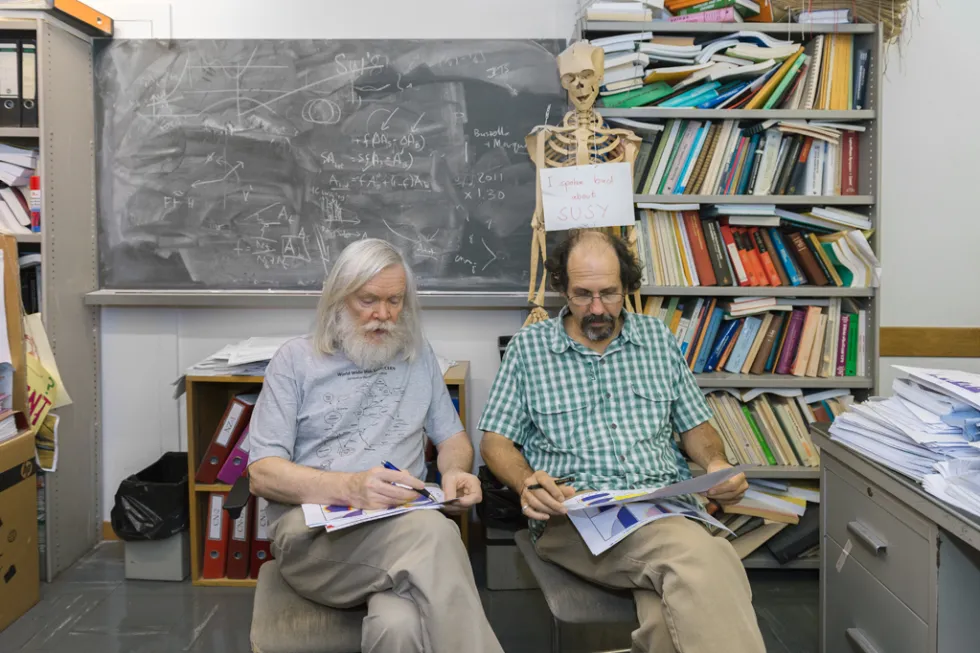

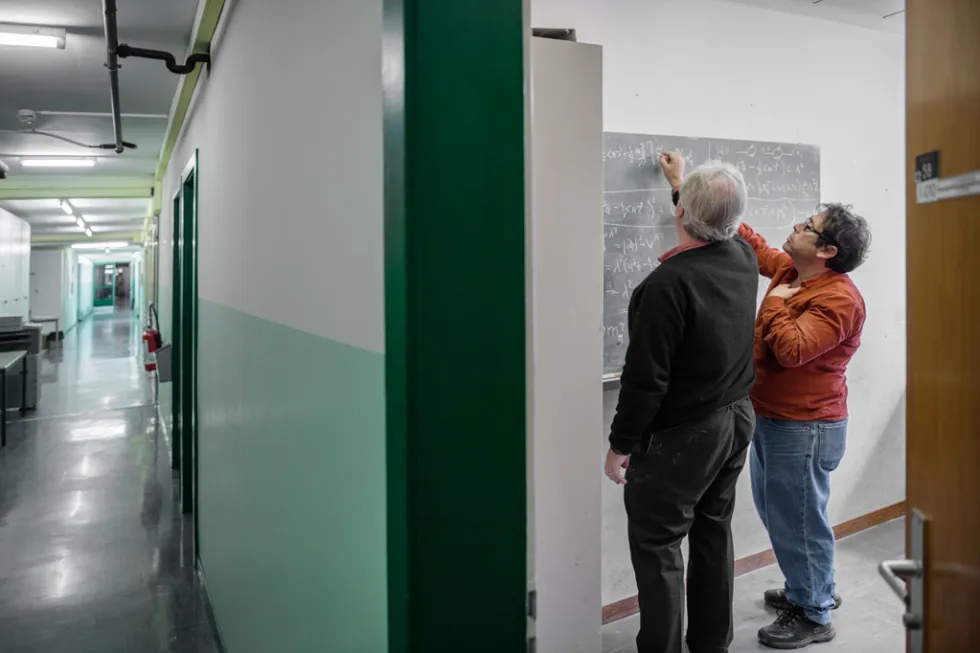 Andri Pol, Inside CERN.
I returned to Chicago that spring and the university looked different. The question hovering over my work was not whether I could do it but whether I belonged to the discipline that would judge it. I was a statistician working in quantum field theory and string theory. Interdisciplinary work was permitted but discouraged. The rule, spoken or unspoken, was that crossing fields was a privilege reserved for the tenured. First you served the discipline. Then, if you survived, you were allowed to leave it.
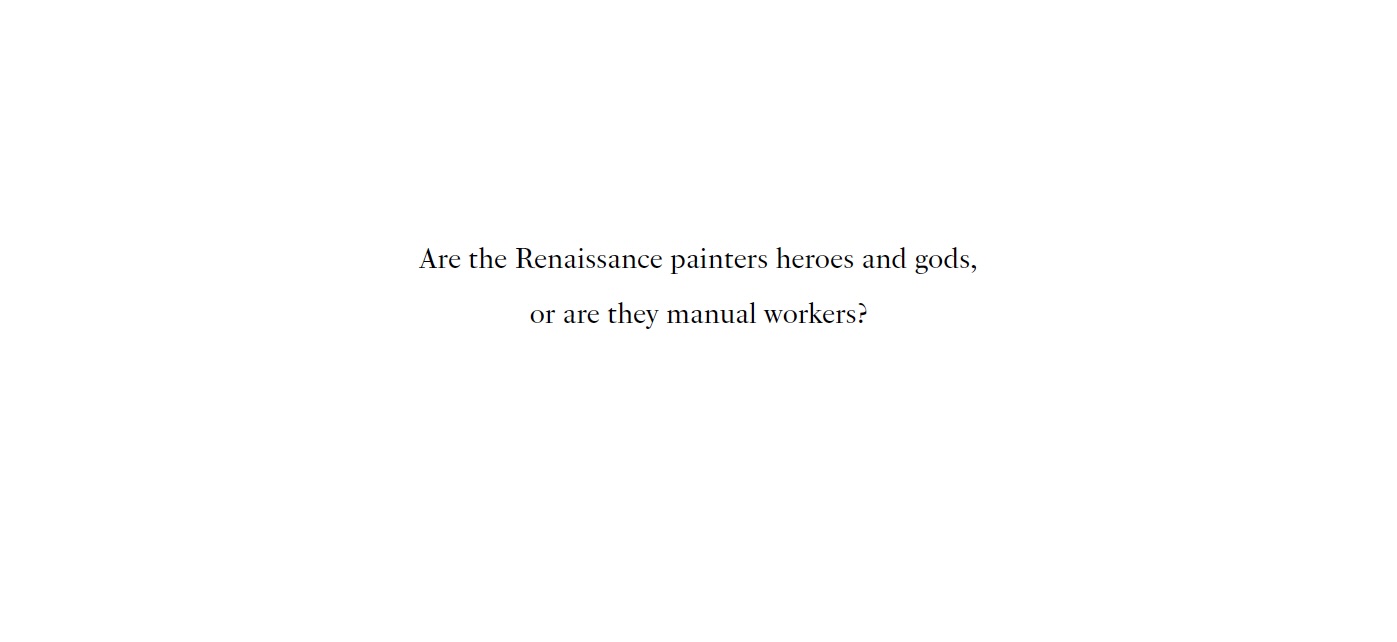 Epigraph of my doctoral dissertation, The University of Chicago, 2018.
A question began forming in my notebooks that I would later put in my dissertation: are the Renaissance painters heroes and gods, or are they manual workers?I probably got this from Sloterdijk? The question was not really about painters. It was about the meaning of work itself. Is work made noble by the institution that recognizes it, or by the thing it answers to? Is the scholar dignified because the university confers dignity on him, or because the act of inquiry already contains its own form of sovereignty? Was Perelman free because mathematics had crowned him, or because he had found something in mathematics that made the crown irrelevant?
The honest answer, for me, was that I was not Perelman. I was not brilliant enough, or pure enough, or indifferent enough for the pages alone to sustain me. Mathematics in and of itself would not have been enough. The work alone, with no audience but the work, would not have carried me through the years a serious life requires.
But there were other considerations too, less noble and more practical, though not therefore less real. By the time I was leaving academia, machine learning was already rising at the edges of everything I had been trained to value. The older university had justified itself as a place where knowledge was stored, transmitted, and authorized. But that function was already beginning to leak out of the institution. Who needed the lecture hall when YouTube could teach you the lecture? Who needed the seminar room when the best explanations were becoming searchable, replayable, and free? And now, with LLMs, even that question seems quaint. The university no longer has a monopoly on access to knowledge. Increasingly, it does not even have a monopoly on explanation.
Statistics, too, was changing under my feet. The discipline in which I had been trained still carried the prestige of inference, asymptotics, elegant parametric models, and the controlled humility of estimation. But the world was moving toward prediction, scale, computation, and engineering. The center of gravity was shifting from the statistician’s model to the machine’s performance. The old professional identity — the statistician as the person who specified the right model, proved its properties, interpreted its coefficients, and disciplined uncertainty into form — was losing authority. Not everywhere, and not all at once. But enough that I could feel the future receding from the thing I had been trained to become.
So leaving academia was not only a failure of purity. It was also a recognition that the institution I was leaving might not be the institution in which the next life of the mind would be fought. The hedge funds beginning to recruit my classmates were glass cathedrals of their own: monetized, confident, lit from above. But they would see me. They were also, in their vulgar way, closer to the new dispensation: computation, prediction, scale, feedback, judgment under uncertainty. I had not left China, learned the language of American meritocracy, and spent a decade inside its institutions in order to disappear into a noble obscurity. For every Chinese student enrolled at a private American university, there are thousands at least as able, and many more able, who never came close to the same door. They were not less gifted. They were less fortunate. Whatever I owed the work, I also owed something to the accident that had carried me to it.
To choose obscurity after such an improbable passage would not have felt like purity. It would have felt like ingratitude disguised as purity. I left academia after graduation and never looked back.The figures I have been describing embody a particular Western romance: the genius who withdraws, who refuses the world and is purified by the refusal. I did not grow up inside that romance. The tradition I inherited took a different view of what learning is for. 学而优则仕 — when one excels in study, one enters service. The scholar does not study in order to go on studying; he studies in order to act, to take office, to apply what he has learned in the world. Mencius makes the application an obligation: 达则兼济天下 — in adversity, perfect yourself alone; in success, better the world. To rise — 达 — is to acquire a position from which one is bound to benefit others; to rise and benefit only oneself is to fail the duty that rising imposes. And where the Western recluse answers the question of withdrawal by going to the mountains, the Chinese tradition answers it in reverse: 大隐隐于市 — the lesser hermit hides in the wilderness, the greater hermit hides in the marketplace. The mountains are the easy discipline. To keep one’s cultivation intact inside the noise and the money of the world is the harder one, and the higher. The cloister was never our ideal. The scholar who entered the world without losing himself was.
For years I told myself this was a story about leaving one kind of work for another. It was not. It was a story about discovering that work has two meanings, and that modern life is largely organized to confuse them. There is work as economic activity: the thing one is paid to do, measured by output, title, compensation, and rank. And there is work as vocation: the thing through which one’s powers are disciplined, enlarged, and finally judged. The first makes a living. The second makes a life. The tragedy is not that these two forms of work are different. The tragedy is that they sometimes resemble each other closely enough for a person to mistake one for the other for years.
The Chicago motto is crescat scientia; vita excolatu — let knowledge grow, and so let human life be enriched. The motto was chosen in 1894, and it rests on a confidence that the growth of knowledge enriches life. That confidence was reasonable when knowledge was hard to come by, when the act of growing it was itself a human achievement that conferred dignity on the grower. To know more than others, to discover what had not been known, to add something durable to the common store: these were not merely technical accomplishments. They were ways of becoming a certain kind of person.
In 2026 the premise has cracked. LLMs are the most extraordinary librarians the world has ever seen. If something has been written down, they have probably seen it. Knowledge is cheap now. No one wants to watch Usain Bolt race a motorcycle. We are now being asked to accept the same humiliation of the mind.
But perhaps it is not a humiliation. Perhaps it is a clarification. If knowledge itself is no longer scarce, then knowledge can no longer be the center of human dignity. The Chicago motto asked, in 1894, that knowledge grow so that life could be enriched. In the age of the librarians, the inverse question matters more: if knowledge is no longer worth growing for its own sake, can life still be enriched? The answer, if there is one, depends on what you do with the knowledge, and on whom you become while doing it.
This is why the question of work returns with more force, not less. The machine can summarize the paper. It can draft the memo. It can retrieve the precedent, imitate the style, generate the code, compose the email, and offer the plausible answer. What it cannot do is stand behind the answer. It cannot want the thing to be true. It cannot be corrupted by recognition or purified by obscurity. It cannot leave the cloister for the market and then ask whether it has betrayed itself. It cannot confuse a salary for a vocation, because it has neither hunger nor vocation. It does not work. It performs.
Human work begins where performance is insufficient. It begins where the person doing the work is changed by the doing of it. This is why the old examples still matter: Perelman, Ramanujan, Zhang, Grothendieck. They are not examples because they were geniuses, though they were. They are examples because their lives reveal the extremity of the question. What would you do if the world did not reward the thing you were made to do? What would you do if recognition came too late, or came wrongly, or came in a form that falsified the work itself? What part of the work would remain?
I do not ask these questions from a position of purity. I left. I chose the market. I chose visibility. I chose the glass cathedral over the concrete commune. And because I chose it, I do not have the luxury of romanticizing the cloister. Poverty is not dignity. Obscurity is not proof of depth. Institutions, for all their cowardice and vanity, can protect real work as well as distort it. Markets, for all their vulgarity, can reveal truths that monasteries hide. The question is not whether the cloister is better than the market. The question is whether either can be inhabited without surrendering the thing that made work meaningful in the first place.
What I have been looking for, in the years since I left Hyde Park, has a name. It is Hesse’s Siddhartha, not the Buddha — the Brahmin son who left his father for the ascetics, then left the ascetics for Kamaswami’s city, then left the city in despair for the river, and only at the end of his life understood that none of those leavings had been a betrayal. The cloister and the market were not opposites. They were stages. The river was what contained them both.
That is the meaning of work I want to recover. Not work as employment, not work as status, not work as productivity, not even work as knowledge production. Work as the river: the activity in which the divided parts of a life are gathered, disciplined, and made answerable to something beyond appetite and applause. Work is where the self stops merely expressing itself and begins to be formed. It is where freedom ceases to mean the absence of constraint and begins to mean obedience to the right constraint.
At CERN, beneath the concrete and the peeling signage, I saw one version of that obedience. In Chicago, under the glass and the institutional light, I saw another. In the market, I would see still another. The mistake was believing that one place possessed the meaning of work and the others had lost it. The harder truth is that work is not guaranteed by any setting. The monastery can become a career ladder. The market can become a discipline. The university can become a theater. The hedge fund can become a school. Everything depends on whether the work remains answerable to something real.
And so the question is not, finally, what kind of work should one do? The question is: what is your work making of you?
I can think. I can wait. I can fast.
We say we work to make a living. We say it because it is partly true, and because the partial truth lets us avoid the harder version of the question. The harder version is why the activity of work — the spending of one’s hours, attention, intelligence, body, and pride inside it — is bound up with what we take ourselves to be. A person can live, in principle, on very little. Most of what we do at work, and most of what we say about it, is not about staying alive. It is about something else. Status, perhaps. Usefulness. Recognition. Escape. Obedience. Mastery. The wish to become necessary. The wish to be seen doing something difficult. The wish to see oneself in the world and not merely pass through it.
Hegel, in the Phenomenology of Spirit, gave what is still the deepest answer. Two self-consciousnesses meet; one becomes master, the other slave. The master is recognized but recognizes nothing. He consumes without producing. The slave works on the world, transforms it, and through that transformation comes to recognize himself in what his labor has made. The slave, not the master, is the one who arrives at consciousness. Labor, for Hegel, is the path by which the human being becomes aware of himself as a self: by remaking the world, the worker finds his own image in it.
Marx took this and turned it against capitalism. Under capitalist relations, the slave does not receive the dialectical reward. The labor that should have produced self-recognition is alienated — sold as a commodity, its products taken away, its meaning emptied. The worker’s own power returns to him as something foreign: a wage, a commodity, a system, a boss, a market price. He does not see himself in his labor. He sees only what his labor can be exchanged for.
Lukács sharpened the diagnosis into reification. Under capitalism, human activity confronts the human being as a thing. The living motion of work becomes object, commodity, calculation. Time becomes billable. Talent becomes human capital. Attention becomes productivity. Education becomes credential. Personality becomes brand. The Hegelian dialectic, which should have ended in freedom, is short-circuited by the form of value.
Deleuze and Guattari pushed the diagnosis to its widest form. Capitalism, they argued, is the first social formation that has no inherent code. Older societies organized themselves around something untranslatable — a god, a king, a kinship, a craft — that could not be exchanged for anything else. Capitalism dissolves every such code and reterritorializes everything on the single axiom of money. Nothing is sacred in capitalism because everything is, in principle, priceable. This is not a moral complaint about consumerism. It is a structural observation. Inside the axiomatic of capital, there is no place from which work could be loved on its own terms, because the form of value has been extended to cover every register in which work could be valued.
He is opportunistic without seeming hungry. This is part of the style. Neediness would lower his price. He is chill. He does not overwork unless overworking produces visible return. He does not underwork in any crude or punishable way. He works exactly hard enough to remain optional, liked, plausible, and difficult to accuse. He understands effort as capital allocation. The question is never what the work requires. The question is what level of effort buys the greatest personal upside for the least personal exposure.
Remote work suits him, though not for the reasons he gives. He is not especially contemplative, independent, or capable of deep self-direction. Distance widens the gap between contribution and appearance. At home, he can manage surfaces more efficiently. He can be present without being implicated, responsive without being available, involved without being seen too closely. The screen is his natural habitat because the screen converts work into signals: green dots, quick replies, calendar blocks, polished snippets, performative busyness, the visible tokens of contribution detached from the slow embarrassment of actually being watched working.
He parades work because work, for him, is most useful when it can be seen. He works on planes, not because the work must be done there, but because the plane supplies the image: the overburdened man in transit, too necessary to be still. He sends Slack messages late at night, after having drifted through the day with remarkable ease. The timestamp becomes evidence of devotion. The content matters less than the hour. He has discovered that exhaustion, properly displayed, can substitute for contribution.
This gives him a moral language with which to accuse others. A colleague takes a trip, protects a weekend, refuses the late-night call, and he calls it selfish. The accusation is not that the work has suffered in any precise way. The accusation is that someone has broken the theater of sacrifice. He speaks often of fiduciary duty, compliance risk, optics, responsibility, the seriousness of the matter. These phrases are not constraints on his conduct. They are weapons for disciplining the conduct of others. He is usually the first to violate the obligation he has just named, and the first to explain why his violation is not really a violation at all.
No conflict survives contact with his self-interest. He rationalizes it away, reframes it, forgets it, converts it into an exception, or discovers that the true ethical risk lies elsewhere. Optics matter intensely when they can be used against someone else; they become vulgar and beneath consideration when applied to him. He does not care how he is judged by his peers because, in his private hierarchy, they are not really his peers. They are observers, obstacles, future subordinates, or people too small-minded to understand the scale at which he operates.
In public, he speaks the language of burden. He is losing sleep. The matter keeps him up at night. The stress, he says, is taking his hair with it, though genetics may have done most of the work. He performs depletion as proof of seriousness. But the exhaustion is curiously selective. It appears in the story about the work more reliably than in the work itself. What he wants credited is not sacrifice but the appearance of sacrifice; not responsibility but the visible strain of seeming responsible.
This is the figure I have been calling the value-extractor. He is not stupid. He is not, in any sense the law would recognize, unethical. He is the fully formed subject of late capitalism: the worker who has internalized reification and the axiomatic together so completely that he treats his own time as a commodity and optimizes the return on it without remainder. Every meeting is a transaction. Every relationship is a network position. Every year of his life is a portfolio decision.
He may even know this about himself. He may have read the books that diagnose him. He may describe the system with fluency, irony, and contempt. But the cynical distance is not a refuge from the ideology. It is the form the ideology now takes. Žižek’s analysis turns on exactly this point. Older ideologies required belief: the subject was supposed to think the official story was true. Contemporary capitalism requires only behavior. You do not need to believe the mission statement; you need only attend the off-site, repeat the framing, optimize the metric. The cynic who knows it is all theater is more reliable than the believer, because the cynic has already absorbed the inconsistency and turned it into a brand. The person who says, of course it is all about the money, I am not naive, is not seeing through the system. He is the system, articulating itself fluently in the first person.
The deeper problem with the value-extractor, though, is not that he is alienated from his labor in the Marxist sense. The deeper problem is that he has misunderstood what work is for. He thinks the work is an instrument and the return is the point. He has the equation backwards. The return is the byproduct, sometimes large and sometimes meager, of work being well done. The work itself is the point. The value-extractor cannot see this because the categories through which he sees have been emptied of any non-exchangeable content. He has eyes for what can be optimized and no eyes for anything else.
This is most visible in his relation to what Polanyi called the tacit dimension. Polanyi observed that we can know more than we can tell — that all serious work rests on embodied, unarticulated, judgment-laden skill that resists capture in rules and KPIs. The chess master, the radiologist, the welder, the trader who can feel a market shifting before he can explain it: each knows in the bones of his practice what no document records. The workshop is precisely the form of work that transmits this tacit dimension, through apprenticeship and through co-presence at the bench. The value-extractor cannot see the tacit dimension because the tacit cannot be optimized for. He sees only the documented surface — the deck, the dashboard, the deliverable. He confuses the documented surface with the work, and confuses optimizing the documented surface with doing the work. He is, in the strictest sense, missing the point.
What he does instead is optics. Perception, for him, is reality, because in his world perception is what gets priced. He cultivates appearances of competence, ascends through the management of impressions, takes credit for the tacit work of others while contributing none of it himself. He pontificates, chest-pounds, cries foul, discovers injuries useful to his position, and converts the common work into a theater of advantage. He makes his own development impossible because growth requires submission to the discipline of the work itself, and he has lost contact with that discipline. He makes the development of others impossible because apprenticeship requires trust, and he has converted trust into exposure. He does not believe one can see him. He believes everyone is doing what he is doing and is simply less skilled at hiding it.
Work has become so abstract to him that he has nothing left to reason with except relations. He no longer touches the thing. He is the architect of a skyscraper who has stopped going to the site. He dreams in floor counts and skyline silhouettes and does not know whether the concrete on the twentieth floor has cured. That is beneath him. That is for the people who work with their hands. What he forgets is that the skyscraper actually depends on whether the concrete has cured, and that no polish on the rendering will compensate for failure at the slab. When the building falls, it falls on the people who were doing the work. He will already be on his next project, presenting himself through the credentials of his last employer rather than the record of what he himself did there, because the record will not bear the weight he needs it to bear.
He is quick to act, and this looks, at first, like decisiveness. It is not. He acts quickly because he lives episodically, in flashes of opportunity, and because planning would commit him to a structure he intends to escape. Planning is against his method. So is the public sharing of plans: a public plan ties him to it, and his entire mode depends on not being tied. What he does instead is hoard information and release it selectively. Secrecy is his most reliable instrument because secrecy preserves optionality. To share is to surrender future moves.
This is also why he lives from crisis to crisis. Crisis is the mode in which everyone else’s planning has been shattered and his improvisation reads as leadership. He gravitates toward it, generates it when it is not at hand — by withholding information until the moment of maximum pressure, by promising and forgetting, by stacking deadlines against one another so that the chaos requires him to step in. The older he becomes, the more he leans on this. He thinks it is leadership. It is only the substitute he has left, because he has spent decades opting out of the kind of work that builds an actual mental model of what he is supposedly running.
His relationships are positions that open and close. He claims loyalties he does not cultivate. You are my guy is a sentence he produces frequently and inexpensively, addressed equally to those he intends to use now and those he intends to use later. When he is younger the corresponding sentence is I will follow you, addressed to whoever currently holds the keys. He does not follow. He does not lead. He attaches and detaches. The relationship is the unit of his work, but the relationship has no interior — no shared project, no accumulated trust, no inherited debt. Acquaintances eventually notice and stop returning his calls. He does not mind, not really. The acquaintances are not the target market anymore. The target market is the new people, who have not yet been on the receiving end of the closing of a position.
What he holds against the world he holds quietly. He does not confront the casual injury, the offhand remark, the honest correction. He buries it, and the burial becomes its own form of fuel. I will prove them wrong is the motor running underneath his ambition. The people he is proving wrong are mostly people who never had the chance to know him in the first place — coworkers in passing, acquaintances who said something honest at the wrong moment, observers who paid a cost they did not realize they were paying. The injury is asymmetric. They were doing the small work of saying what they saw. He is nursing decades of wounds whose authors do not remember inflicting them.
Even ordinary interactions are not easy for him. The transaction is always running. His mind is racing — what does he want from me, what can I get from him — and the other person can feel the calculation in the room even when he cannot name it. He will tell you Sam hates him. Sam does not know him. Sam crossed his line of sight once, gave a neutral expression, and went into the file tagged hostile, because in the absence of any actual relationship the calculation has nothing to read but the worst possible interpretation of silence. The grudge does not need a real injury. It needs only an other.
This is what comes of not understanding how relationships actually work. Real relationships move through a cycle of time, test, injury, and repair. The friendship that has not yet survived a quarrel is not yet a friendship; the colleague who has not yet disappointed you, and whom you have not disappointed, and with whom you have not yet found your way back, is not yet a colleague. He does not have access to this cycle. He has two categories: people who are useful and people who are enemies. The third category — the people you trust enough to be hurt by, and whom you trust enough to forgive — is missing from his vocabulary. So he does not trust. He uses. He interprets the absence of trust as clarity, when in fact it is the absence of a faculty.
He even takes pride in his choice of associates. He likes working with people who are visibly pliable, and he calls this his superpower: he can make do, he says, with the material at hand. What he does not say, because he does not know it, is that he has selected the material on purpose. Independent people see through him. People with standards make demands. People who know the work cannot be managed indefinitely by charm, urgency, and fog. The associates whose weakness embarrasses him to others are the same associates whose weakness protects him from being tested. Their incompetence is not a constraint he has heroically worked around. It is a moat.
What he does not see, and what he gets burned by repeatedly without learning, is that the pattern keeps producing the same result. Each time, he is briefly successful, then briefly tolerated, then quietly avoided. He attributes this to the malice of others. He becomes defensive. He stops communicating about the work and starts communicating about himself: corrections, vindications, war stories from prior firms, the credentials of his ex-employers held up against the suspicions of the present one. He suspects the colleagues he has not yet replaced of laughing at him behind his back and scheming against him. Often they are. Not because they are conspiring, but because they have all noticed the same thing he refuses to notice, and have agreed, without coordinating, that the only thing they want from him is for him either to do the work or to remove himself from the room.
This is one reason the administered workplace is more fragile than it looks.See §3 All the uncaring intricate rented world, Cognitive Resignation American workers are often docile in the first instance, especially across title lines. They will do what they are told, or appear to do it, because the organization has trained them to translate rank into temporary obedience. But obedience is not cooperation, and work is not a single encounter. Work is a repeated game. The first command gets compliance. The second gets clarification. The third gets public pushback, often in the language of process, risk, fairness, or scope. After that come the quieter forms of refusal: delay, omission, literalism, non-response, the email not answered, the task completed in the thinnest possible sense. Eventually the manager feels as if he is punching air. Nothing is openly disobeyed; nothing quite moves. A small organization can survive for a while on direct force, charisma, fear, or the exhaustion of an extractor-leader who personally pushes every loose object back into motion. But scale makes dictatorship impractical. No one has the energy to dictate at sufficient resolution. At a certain size, the company runs only on what cannot be ordered minute by minute: trust, standards, memory, pride, shame, loyalty, and the tacit desire of people to see the thing done well. Where those are missing, hierarchy still exists, but it increasingly speaks into a void.
Bauman traced the conditions that produced this figure. In liquid modernity, the older producer society — where identity was made by what one made, where a craft, firm, vocation, town, or institution could hold a person long enough to shape him — gives way to a consumer society in which the self is a brand, the job a temporary engagement, and durable commitment a failure of flexibility. The value-extractor is what becomes of a person whose long horizons have been dissolved. He is not a villain. He is a survival strategy.
Byung-Chul Han names the final form of this subject more sharply than anyone else writing now. We have moved past the disciplinary society of Foucault, in which the subject is constrained by external authority, into the achievement society, in which the subject exploits himself. The neoliberal worker is his own master and his own slave. The factory boss has been internalized, and the resulting subject is faster, more productive, more adaptive, and more thoroughly worked than any disciplinary regime could have produced. He is also exhausted in a new way: not tired from labor but depleted by the impossibility of ever being done. Burnout is not the worker breaking under an external demand. It is the worker breaking against an internal demand that has no ceiling. The command is no longer simply work. It is become more employable, more efficient, more legible, more networked, more resilient, more optimized, more yourself. Under such conditions, even self-expression becomes labor. Even rest becomes recovery for future output. Even freedom becomes a technique of management.
None of this means a serious company should have no value-extractors. A community is not healthy because every member is pure. It is healthy because it knows which impurities it can metabolize, where to place them, and when to retire them. A company is an ecosystem before it is an org chart. It needs different temperaments, different speeds, different tolerances for ambiguity, different ways of meeting the world. You are not raising a herd of sheep, each animal docile in the same direction. You are trying to grow an ecosphere dense enough to sustain life: predators and pollinators, scavengers and builders, roots and canopy, organisms that compete, correct, fertilize, and restrain one another. Purity is not health. Monoculture is not order.Peter Thiel’s defense of cult-like startup culture is the hard case: early companies may need fanatical alignment around a secret outsiders have missed. But that is alignment around an object, not sameness of temperament. The shared obsession binds different functions to one dangerous belief; it does not abolish functional diversity. It is fragility disguised as cleanliness.
There are uses for people optimized for strangers. They can be excellent salesmen, negotiators, recruiters, rainmakers, marketers, fundraisers, and border-crossers. The same disposition that extracts value internally can, when bounded by a real workshop, be turned outward. It can extract attention from a market, concessions from a counterparty, confidence from an investor, commitment from a client who has not yet committed. Such people warm quickly. They impress quickly. They cross thresholds before the specialists have found the door.
Their element is the liquid encounter: low memory, low structure, high upside. The first meeting. The conference hallway. The investor pitch. The sales dinner. The recruiting call. The negotiation before either side has a past. They are good before history begins. They find the unspoken desire in the room and move toward it before the domain person has finished defining terms. They are not merely agreeable. They reduce friction. Their social intelligence has been tuned like a language model: predict the next token most likely to keep the sequence going. Not the truest token, not the most responsible token, not the token that will survive contact with delivery six months later. The warm token. The plausible token. The token that keeps the room open.
This is why speaking with the value-extractor can be a delight. It feels like a click. He knows what you want to hear, where the resistance is, when to flatter, when to concede, when to laugh, when to offer the larger frame. He makes the room feel more possible than it was before he entered. In the right dose, this is not corruption. It is social liquidity. It lets a firm meet strangers without frightening them, negotiate without freezing, sell without sounding like a spec sheet, and move across departmental dialects without every sentence being translated by a priest of the domain.
Most serious people are bound, properly, to a domain. The frontend engineer sees buttons, flows, breakpoints, and user irritation. The backend engineer sees tables, queues, ETL, platforms, and failure modes. The systems engineer sees cloud, access, latency, permissions, Ansible, and hidden fragility. Sales sees accounts, champions, procurement, and the mood of the buyer. Finance sees cash, burn, receivables, control, and the small leak before it becomes a wound. Each attachment is a dignity because it gives the person something real to answer to. But attachment also creates boundaries. A young company needs some people who are not devout in this way: people who can move between domains, translate loosely, sense where a conversation wants to go, and keep the relation alive long enough for the specialists to do their work.
In the beginning, a company may need more of them than seems morally comfortable. A young company is not yet a workshop. It is a rumor trying to become a machine. It has no accumulated proof, no durable habits, no old customers whose experience can speak on its behalf. It survives by courtship: the pitch, the demo, the narrative, the first hire, the first customer, the investor meeting, the strategic partnership, the charm by which strangers are persuaded to treat a possibility as if it were already partly real. In that phase the extractor is not merely a parasite. He is scaffolding.
Venture capital makes this both necessary and dangerous because it prices the future before the institution exists to bear it. It rewards speed, story, option value, market capture, growth curves, and the capacity to make strangers believe before operating reality has caught up. This does not mean investors are stupid. Early-stage value really is partly composed of belief. The seed-stage company is not yet a company in the mature sense; it is a compressed claim about a future company. The extractor is useful because he knows how to make that claim feel present.
The danger is that the scaffolding begins to mistake itself for the building. The courtship class becomes the founding aristocracy. The people useful because they could sell the unrealized future remain in power after the problem has changed from winning belief to keeping promises. What was once necessary theater becomes governance. What was once a bridge to the workshop becomes a caste that stands between the workshop and the world.
Companies do not remain liquid. Growth produces memory. The first customer becomes the old customer. The first promise becomes the renewal term, the support ticket, the product gap, the roadmap item, the integration mentioned casually and then, months later, returned as an obligation. Old promises begin to haunt the company. They gather in inboxes, contracts, Slack threads, customer-success notes, half-remembered demos, and the minds of clients who listened more carefully than the extractor realized. What was once warm ambiguity becomes an audit trail.
At that point people-pleasing stops working. Mature colleagues and mature clients do not want someone who says yes to everything. They want a thinking partner. They want someone who can say, clearly and early, that the request is wrong, the timeline impossible, the dependency misunderstood, the product not yet capable of doing what has been asked. The value-extractor experiences this as negativity because he has confused warmth with service. But in a repeated game, refusal is often the deepest form of service. It is the moment when the company protects the client from the company’s own appetite.
Complexity accumulates faster than surface memory can manage. The little yeses have consequences. The quick concessions interact. The undocumented exception becomes precedent. The hand-waved dependency becomes someone else’s weekend. The friendly ambiguity of the sale becomes the operational cruelty of delivery. The client charmed in January is angry in June because the organization has no structure capable of remembering what its charm implied. The extractor, fluent in the encounter that created the obligation, is much less fluent in the slow system required to satisfy it.
So he begins extracting himself from the mess. He was present for the win and absent for the residue. He helped sell the thing but is suddenly not the owner of delivery. He remembers the promise as exploratory; the client remembers it as commitment; the operators inherit the difference. The organization is helpless because the structure was never built. There is no clean handoff, no operating cadence, no source of truth, no responsible domain owner, no shared discipline of saying what is and is not true. The company was built to generate belief, not to metabolize consequences.
This is the over-oiled firm. Nothing catches. Nothing grates. Nothing is allowed the friction by which a thing becomes true. Every disagreement becomes a vibe to be softened, every defect a narrative to be managed, every boundary a relationship problem, every standard an obstacle to momentum. The gears glide with exquisite smoothness, but they no longer transmit force. The machine is not broken. It is worse than broken: it is perfectly lubricated against its own purpose.
There are planning meetings, of course. There is always planning. People gather, nod, discuss dependencies, debate minor sequencing questions, and perform the gestures by which an organization reassures itself that direction exists. The conversation becomes very precise around things that do not matter, because precision around trivialities is safer than conflict over first principles. Everyone leaves with the feeling that planning has occurred. But no real plan has been made. A real plan binds. It assigns priority, creates exclusion, exposes scarcity, disappoints someone. The over-oiled firm prefers the feeling of alignment to the violence of choice.
Resources are distributed accordingly: not by priority, but by vibe, prior relationship, confidence, charisma, proximity to the last complaint, and the warmth of the room. Nothing is quite corrupt. Nothing is quite clean. Nobody says openly that the favored project is favored because its owner is liked, or because its narrative flatters the people who control the meeting, or because some old promise has to be protected from daylight. The allocation simply happens, as weather happens. Later, when the consequences appear, everyone will remember the decision as having been obvious at the time.
Accountability also exists, but mostly as atmosphere. Nobody wants to be seen as unsupportive. To press too hard is unbecoming. To ask who owns the failure is negative. To insist that someone said a thing, promised a thing, blocked a thing, or failed to do a thing is to violate the communal fiction that everyone is rowing in the same direction.“Mutual absolution of malfeasance,” as an old friend so precisely puts it. So people support each other in public and diagnose each other in private. The truth circulates, but never at the level where it could become form.
Ask such a company for its top three priorities and the value-extractor can produce them immediately. He will make them sound plausible. They will have the right nouns: growth, retention, platform, enterprise, efficiency, trust. They will be shaped like strategy. But nothing in progress will support them. No calendar will reveal them. No staffing decision will have been made against them. No project will have been killed because of them. No engineer will know what stopped mattering. No operator will know what changed. The priorities exist as speech before they exist as constraint, and therefore they do not exist.
Promotion follows the same logic. In a workshop, advancement is imperfect but at least answerable to the work: who can see farther, carry more, teach others, remember the system, prevent failure, make the thing better. In the over-oiled firm, where no one wants to say publicly what is true, promotion becomes a function of relations, age, marketable angles, and whatever story the company currently needs to tell about itself. If it looks good to have a Chief AI Officer, the company promotes the closest available resemblance to one. If the word “science” has become valuable, a firm that does no science discovers a Chief Scientist. If operations are visibly broken, someone becomes Head of Operational Excellence, though he hardly touches the operations and rarely speaks to the people who do. The title does not describe responsibility. It describes aspiration, theater, or defense. It is a sign hung over a vacancy. Once titles become theatrical, they multiply and inflate. Presidents, chairmen, boards, councils, offices, chiefs, heads of increasingly abstract nouns. The names grow more exotic as the accountability beneath them grows thinner. Everyone is senior; no one is responsible. The organization becomes baroque at the surface and hollow at the core. It develops an aristocracy of titles because it lacks a republic of work.
Compensation follows. If there are no real standards, there can be no real metrics. The first tier goes to the extractors, because they control the perception of value. The second tier goes to those they can use: the loyal, the pliable, the people willing to turn fog into decks, promises into activity, and confusion into the appearance of motion. The lowest tier goes to the people who refuse to vibe, who expose the gap between the title and the work, who insist on asking what has been built, what has been promised, what is true.
This is not always corruption in the crude sense. No envelope changes hands. No one announces that compensation will be distributed according to loyalty to unreality. The thing happens more softly. The person who makes the room feel good is called strategic. The person who remembers the broken promise is called negative. The person who flatters the current narrative is called senior. The person who tests it against the work is called difficult. Over time, the pay table becomes an epistemology. It tells the company what kinds of knowledge it values and what kinds it intends to punish.
The front office stays busy because anger supplies its own structure. Angry clients, urgent calls, broken expectations, implementation problems, renewal risks, executive escalations — these create motion even where no plan exists. Ops is busy for the same reason: reality keeps arriving. The people closest to consequence always have work, because consequence does not wait for alignment. They patch, soothe, explain, reroute, absorb, apologize, and carry forward whatever the courtship class has promised.
Elsewhere, the emptiness is quieter. Engineers come in for lunch and coffee. They attend the meeting. They hear the vague urgency. They wait for the thing to build. But there is no thing, not really. There are themes, asks, relationships, possibilities, one-off exceptions, promises made in demos, and screenshots of futures that have not been disciplined into requirements. There is activity around the work and very little contact with the work. The company has learned how to produce the social signs of building without submitting itself to the brutality of building something.
This is also why the administered workplace is more fragile than it looks. Workers are often docile in the first instance, especially across title lines. They will do what they are told, or appear to do it, because the organization has trained them to translate rank into temporary obedience. But obedience is not cooperation, and work is not a single encounter. Work is a repeated game. The first command gets compliance. The second gets clarification. The third gets public pushback, often in the language of process, risk, fairness, or scope. After that come the quieter forms of refusal: delay, omission, literalism, non-response, the email not answered, the task completed in the thinnest possible sense. Eventually the manager feels as if he is punching air. Nothing is openly disobeyed; nothing quite moves.
A small organization can survive for a while on direct force, charisma, fear, or the exhaustion of an extractor-leader who personally pushes every loose object back into motion. But scale makes dictatorship impractical. No one has the energy to dictate at sufficient resolution. At a certain size, the company runs only on what cannot be ordered minute by minute: trust, standards, memory, pride, shame, loyalty, and the tacit desire of people to see the thing done well. Where those are missing, hierarchy still exists, but it increasingly speaks into a void.
The value-extractor also changes the population around him. Extractors attract other extractors, not because they trust one another but because each recognizes in the other a familiar grammar: tactical warmth, optional loyalty, flexible memory, surface competence, and the language of principle used as leverage. Soon his world is filled with people who behave as he behaves, and this feels to him like confirmation. See, he thinks, everyone is like this. But this is not anthropology. It is adverse selection. The better people leave first because they are disappointed. They expected work, loyalty, standards, or friendship, and found only use. The other extractors remain only while the spread is attractive. When a higher-value field appears elsewhere, they detach with the same fluency with which they attached. The world he has built therefore confirms him only by emptying itself of anyone who could have disproved him.
Then come the ruptures: the missed implementation, the client whose patience ends, the launch sold before it was built, the contract whose obligations no one inside the company can actually meet. The extractor-led company waits for reality to wound it from the outside. A client complaint lights up the whole structure because nothing inside the company had enough bite to do so first. The problem was visible, but domesticated: softened in meetings, neutralized in documents, buried under the next optimistic update. The company had not lacked information; it had lacked the internal permission to make information dangerous. It becomes exquisitely sensitive to perception and nearly anesthetized to reality — able to feel the market’s face before it can feel its own broken limb.
This is how extractors build extracting companies. They build organizations optimized for courtship: pitch, charm, access, responsiveness, polish, the warm room, the rapid follow-up, the narrative in which everything is already becoming what the client hopes it will become. Because these gifts are real, the danger is not that such companies fail immediately. The danger is that they succeed. They win the heart too easily.
At the edge of the firm, the value-extractor can be useful. He is an organism adapted to unstable contact with the outside world: fast-moving, socially porous, able to carry pollen between rooms that would otherwise never touch. But when his kind multiplies past its niche, the ecology changes. What was once diversity becomes invasion. The traits that helped the company meet the world begin to crowd out the traits by which it could keep faith with the world: memory, craft, patience, refusal, repair. The fast-growing species blocks the light. The slower-rooted forms die first.
This is why the Casanova image matters. The extractor-led company can woo and win, but it has no intention, or no capacity, to marry. It collects commitments that require a structure no one has built.
Casanovas are not marriage material. They can make the first dinner feel like destiny, but a company eventually has to marry the world it has seduced. Clients come back. Contracts renew. Systems break. Employees compare promises with practice. Customers learn the difference between the deck and the delivery. As the company matures, the way it really operates gradually overtakes the way it appears to operate. Appearances still matter; they almost always do. But they matter less. Repeated games replace first impressions. Charisma becomes service, maintenance, support, product quality, documentation, follow-through, and the difficult boredom of doing what was promised after the room is no longer warm.
At maturity, extractive talent has to be specialized and constrained. It belongs at the edges: marketing, content, sales, business development, fundraising, maybe recruiting — domains where the firm legitimately meets strangers and must translate itself before it can be known. But the operating core cannot be organized around that temperament. Engineering, finance, legal, product, customer success, implementation, and management require people bound to the thing, not merely to the effect the thing produces in others. The mature company needs fewer Casanovas and more spouses: people capable of memory, obligation, repetition, repair, and the stubborn loyalty of showing up after the initial enchantment has expired.
Only here does Martin Fowler’s phrase from software become useful: sacrificial architecture.Fowler’s point is not that temporary systems should be shoddy. It is that the architecture suitable for discovery and early growth may need to be replaced once the system succeeds at another order of magnitude. In the early life of a system, the right architecture may be one you build knowing it will later be replaced, because the architecture that lets a young system learn and grow is not the architecture that can carry it at mature scale. A startup may need an analogous social architecture: a temporary overrepresentation of charmers, generalists, fundraisers, narrators, and deal-makers who pull the future toward the present. But the analogy has teeth only if the architecture is actually sacrificial. The mistake is not to build the temporary thing. The mistake is to forget that it was temporary.
This does not mean treating people as disposable, and it does not mean celebrating shoddy work. Sacrificing internal quality usually bites faster than the planned replacement; the early system must still have enough internal discipline to teach the builders what replacement will require. The same is true socially. The bootstrapping layer must leave behind knowledge, customers, capital, trust, and commitments that the workshop can inhabit. If it leaves behind only vibes, promises, exceptions, and bruised operators, it was not sacrificial architecture. It was technical debt with a smile.
The test comes when the mob of clients knocks on the door. Then perception is no longer enough. The question is whether the organization has enough rigidity to deliver what its fluidity has sold: enough standards to disappoint politely, enough memory to keep promises straight, enough domain attachment to solve what cannot be charmed, enough friction to stop itself before the outside world stops it. The good system therefore does not expel the value-extractor. It binds him. It gives him an outward-facing role, an internal limit, and a workshop behind him strong enough to make his promises true.
O tempora! O mores!
Let those who are to preside over the state obey two precepts of Plato, — one, that they so watch for the well-being of their fellow-citizens that they have reference to it in whatever they do, forgetting their own private interests; the other, that they care for the whole body politic, and not, while they watch over a portion of it, neglect other portions. For, as the guardianship of a minor, so the administration of the state is to be conducted for the benefit, not of those to whom it is intrusted, but of those who are intrusted to their care.Cicero, De Officiis 1.85, paraphrased/translated in the Loeb tradition.
And, to prove the truth of this to you, I declare that even if I may not be grateful without seeming ungrateful, even if I am able to return a benefit only by an act which resembles an injury; even so, I shall strive in the utmost calmness of spirit toward the purpose which honour demands, in the very midst of disgrace. No one, I think, rates virtue higher or is more consecrated to virtue than he who has lost his reputation for being a good man in order to keep from losing the approval of his conscience. […] My master Attalus used to say: “Evil herself drinks the largest portion of her own poison.” The poison which serpents carry for the destruction of others, and secrete without harm to themselves, is not like this poison; for this sort is ruinous to the possessor. The ungrateful man tortures and torments himself; he hates the gifts which he has accepted, because he must make a return for them, and he tries to belittle their value, but he really enlarges and exaggerates the injuries which he has received. And what is more wretched than a man who forgets his benefits and clings to his injuries?Seneca, Moral Letters to Lucilius, Letter 8.
The man in a flutter for after-fame fails to picture to himself that each of those who remember him will himself also very shortly die, then again the man who succeeded him, until the whole remembrance is extinguished as it runs along a line of men who are kindled and then put out. And put the case that those who will remember never die, and the remembrance never dies, what is that to you? And I do not say that it is nothing to the dead; what is praise to the living, except perhaps for some practical purpose? For now you are putting off unseasonably the gift of Nature, which does not depend on the testimony of some one else.Marcus Aurelius, Meditations, Book 4.19.
Is the value-extractor a new figure? He is not. The type is ancient. Cicero complained about him constantly in his letters from Rome: politicians who advanced themselves by managing appearances while contributing little of substance to the Republic. Machiavelli wrote a manual for the disposition. Sinclair Lewis gave us Babbitt in 1922. American sociology had the figure as William Whyte’s Organization Man and David Riesman’s other-directed personality by the 1950s. The Soviet apparatchik and the corporate yes-man were the same character in different institutional clothing. The value-extractor is one of the oldest stable types in social life.Confucius had a precise term for this figure: 乡愿 — the “village worthy” or “village honest man.” He is the locally respected person who has mastered the appearance of goodness: polite, moderate, agreeable, careful, and never out of step with his community. But that is exactly the problem. His virtue is not rooted in truth, courage, or judgment; it is rooted in approval. He has perfected social conformity to the point of ethical emptiness. Confucius’s verdict is severe: 乡愿,德之贼也 — The village worthy is the thief of virtue. He is a thief because he wears virtue’s clothing while avoiding virtue’s demands. He makes cowardice look like prudence, silence look like humility, and agreeableness look like moral seriousness. He does not attack virtue directly; he imitates it so well that the community forgets what real virtue looks like.
What is new is the institutional condition in which he now operates without consequence. The honor code that older American professional life referred to was not a code in any abstract sense. It was an enforcement structure made of shared spaces and shared time. You stayed at a firm for thirty years. Your reputation was held by people who watched you work. The partners’ lunchroom, the country club, the church, your daughter’s school, the local newspaper — all were occupied by overlapping publics, by people who knew who you were across several dimensions of life. Religion was thicker. Family was three generations. The professional partnership had real partners. Pensions vested over decades. The reputational graph was small, dense, and slow. A breach in one role traveled to the others.
An acquaintance of mine wants to spend a year traveling abroad. His firm wants to keep him. They offer him part-time. His father — a well-educated PhD and executive at a conglomerate — tells him to counter with full-time remote, because part-time has to report hours and nobody keeps track of full-timers. The father is not corrupt. He is doing what fathers do: transmitting practical wisdom to a son he loves. The practical wisdom he has accumulated over a long career is this: take the form of engagement that imposes the least accountability, because accountability is now a self-inflicted wound.
A first-year analyst, Ivy by legacy and aristocratic by self-description, once came to me with great excitement. His father was a self-made bulge-bracket banker, a man who had come from nothing and turned that ascent into a theory of human beings. The son was well-mannered, delicate, almost courtly in presentation, trained — or so it was said — at some Southern etiquette school, though the family’s manners had the faintly anxious quality of people trying to become WASPs after the fact. My dad thinks you’re an animal, he said. Seeing my surprise, he hurried to explain that this was praise. No, that’s the highest compliment from my dad. There are weak people, and then there are crazy motherf—ing animals.They were soon disappointed to find out that I am not. The crudeness was clarifying precisely because it came through so much polish. Here was the moral education beneath the etiquette: the world divided not into honorable and dishonorable, serious and unserious, generous and mean, but into weak people and animals. The point of cultivation was not to become more human. It was to become a more effective beast.
A chief executive of a startup — a PhD from the Ivies — quits, giving the firm one day’s notice. Under New York’s at-will employment law, he says he is not obligated to give more.At-will employment is the default in most of the U.S.; Montana is the major exception after probation. The point here is not legal liability but courtesy. Notice is a courtesy precisely because it is not compelled: it acknowledges that the relationship was thicker than the minimum enforceable term. The weight of his office, the optics of decency, the older shorthand of don’t burn the bridge — none of it is sufficient to extend a courtesy that was not legally compelled. He has read the contract and noticed that nothing forces him to behave as if he intends to encounter these people again. The firm has to pay him extra just to keep him for another two weeks — purchasing, at a premium, the decency that the office itself no longer commands.
Another Ivy League-educated second-year programmer receives comments from a colleague about the design of his work and turns them into an institutional crisis. The comments were made in public, in a group meeting: not abusive, not intimate, not even especially personal. They were the kind of criticism by which work becomes better. He says he is hurt and no longer wants to come to work. In the current culture of the office, that is already enough. Hurt becomes exposure; exposure becomes leverage; leverage becomes compensation. The grievance itself does not matter and was probably never the point. What matters is that he understood the conversion rate. The timing tells the story. He had almost certainly secured another job offer before making the scene. The firm has to choose between losing him and accommodating him. They offer him a retention bonus. He accepts. He leaves the day the bonus clears.
The detail that matters in all four cases is not deprivation. These are not desperate people clawing at the edge of subsistence. They come from well-off families, good schools, the full apparatus of cultivated advantage. I used to think the small brutalities of economic life came mostly from pressure: property, debt, hunger, children, the wolf-rules by which people forced by necessity do what they must. Or else from uncultivated minds, people who had never been taught to reason clearly through moral questions and so mistook appetite, resentment, or advantage for judgment. There is truth in both explanations. But these examples belong to a different register. They are not the crimes of scarcity, and not the confusions of the unformed. They are the manners of abundance: cultivated people, trained at the highest levels, using their intelligence to reason around decency rather than toward it. If the best education available to a society cannot install basic human decency in its winners, then it has not formed them. It has merely made their appetites articulate.
The father’s advice is the most diagnostic of the four because it is the least theatrical. No crisis, no scandal, no dramatic exit, no invented injury. Only ordinary prudence, transmitted as love. He is the figure one would have expected to be the source of the honor code: the educated executive at a conglomerate, the older generation, the man who came up under the older rules. Instead he offers the inversion. This is not the failure of one father to enforce a norm. It is the older generation telling the younger that the game has changed and instructing them in how to play it. That transmission is the moment to register. The honor code did not die when extractors began evading it. It died when the people who used to enforce it began advising their children to evade it too.
The visibility geometry has flipped. Work used to happen in physical proximity, under shared observation. The extractor’s pattern — taking credit, evading delivery, dressing up the documented surface — was easier to read when people saw one another working through the day. Remote work and the abstraction of knowledge work have widened the gap between contribution and appearance precisely in the way the extractor needs. The father understood this exactly. The part-time worker is monitored because his time is itemized. The full-time remote worker is not, because nobody knows whether his time means anything at all.
The aspirational templates have changed. The figures admired in mid-century American professional life — the people one encountered in The Fountainhead, Atlas Shrugged, The Man in the Gray Flannel Suit, The Organization Man, The West Wing, and the older American novels and films about working life — were figures whose dignity came from being embedded in something that mattered to them more than they mattered to themselves.
The current cultural inheritance is different: Silicon Valley as satire, the LinkedIn aesthetic of self-curation, the founder-mythos as personal brand, the podcast entrepreneur, the portfolio operator, the person whose real product is the story of his own optionality. The White Lotus belongs here because it understands the manners of abundance: people with money, education, therapy-language, political opinions, exquisite taste, and almost no stable account of what they owe one another.The show is so exact about America that it should almost be required viewing for anyone entering the country to settle, not as entertainment but as orientation. Here is the country you are entering when aspiration succeeds and obligation fails. Its characters are not barbarians. They are cultivated, verbal, therapized, aesthetically literate, and often very rich. Their brutality is not the brutality of scarcity. It is the brutality of people who have learned to narrate appetite as injury, preference as principle, and self-interest as self-care. They do not lack language. They lack obligation.
The Ratliff family makes this especially plain. Timothy arrives in Thailand as the patriarch of a Southern financial family, only to learn that the world he has built may be collapsing under a fraud and money-laundering scandal. The plot is not merely that a rich man has legal trouble. It is that an entire family has been organized around insulation from consequence, and then consequence arrives in the one form wealth cannot immediately metabolize: exposure. Timothy’s terror is not only prison or poverty. It is being seen without the envelope of solvency that made his authority appear natural.
His darkest thought is therefore not incidental to the plot. Timothy comes to believe keeping his family alive may be less merciful than taking them with him. This is the darkest joke of the Ratliff story. The patriarch who has insulated his children from necessity discovers, at the moment of his own collapse, that insulation has worked too well. They have no craft, no code, no discipline, no religion, no durable relation to the world that could survive the disappearance of money. He looks at them and sees not heirs but dependents of an atmosphere he can no longer maintain.
His murderous thought is provision turned inside out. He has confused protection with formation for so long that, when protection becomes impossible, annihilation begins to resemble care. This is the final paternal vanity: having built a family that cannot live without him, he mistakes dependence for love. The horror is that he is not entirely wrong about what he has made. He is wrong about what follows from it. His children are not useless by nature. They have been rendered useless by the success of the envelope around them. Wealth has protected them from the frictions by which people become real: obligation, work, shame, refusal, dependence, repair, consequence. Timothy’s crime is not only financial. It is formative. He has raised people for a world in which nothing would ever press hard enough to give them shape, and when pressure finally arrives, he calls shapelessness destiny rather than recognizing it as the result of his own regime.
Victoria is the voice of class preservation after the moral content of class has disappeared. Her horror is not sin but downward mobility, not corruption but embarrassment, not spiritual failure but the possibility that her children might become ordinary. She understands collapse chiefly as loss of surface: the wrong hotel, the wrong people, the wrong future, the indignity of needing what had once been beneath notice. Her morality is social weather. She can detect status with perfect sensitivity and guilt hardly at all.
Saxon is appetite without inwardness: gym body, finance speech, sexual aggression, entitlement as personality. He is what remains when masculine formation is replaced by market confidence and bodily display.The older snob, whatever his sins, at least risked appearing as himself. He carried his arrogance in public, and therefore submitted it to the ordinary disciplines of visibility: mockery, hatred, answer, overthrow. Saxon 2.0 is more evasive. He has learned manners, sensitivity, therapeutic fluency, and the tactical use of tears — an enfant riche déprimé, enchanted by the melancholy of his own beautiful life, having discovered that fragility can perform the social work once done by swagger. His snobbery is hidden even from himself, and therefore never has to prove itself, defend itself, or suffer the consequences of appearing under its true name. Appetite protected by inheritance, now laundered through vulnerability rather than pride. Piper wants renunciation, but even her renunciation arrives as an elite itinerary, a spiritual option consumed at a resort. She wants to exit the family’s world without quite losing the protections that made the desire for exit possible. Lochlan is the youngest and most porous, still looking for a form, absorbing whatever desire happens to be nearest. He is less corrupt than unmade.
The family is not held together by duty. It is held together by money, mimicry, and the terror of losing the surface that made them legible to themselves. That is why the Ratliffs are more useful than a simple satire of rich people. They are not outside American moral life. They are its logical endpoint when cultivation detaches from obligation. Everyone has a vocabulary. No one has a code. The father has money without honor. The mother has manners without mercy. The eldest son has confidence without discipline. The daughter has conscience without sacrifice. The youngest has sensitivity without form. What looks, from a distance, like a family is closer to a portfolio of self-concepts traveling together under one surname.
This is the value-extractor’s household form. The same pattern that appears in the firm appears in the family: roles without binding content, language without truth, crisis without confession, spirituality without submission, privilege without stewardship. The Ratliffs can explain themselves endlessly, but explanation is not repentance. They can move, consume, perform, recover, rebrand. What they cannot do, at least not until catastrophe forces the question, is answer the older demand: what do we owe, and to whom, when the money stops answering for us?
The people once admired for reliability inside an institution are now admired for the skill with which they detach themselves from any institution and become portable. The ideal is no longer the man who can be trusted with a role. It is the man who can convert every role, relationship, wound, preference, and identity into leverage for the next one.
The internet did not invent this. It accelerated and consolidated it. It atomized the audience. The local community whose judgment once policed behavior has been replaced by a fragmented platform audience that knows you only through what you choose to post. The embodied feedback that enforced norms — the look across the table, the silence after a remark, the colleague who would not meet your eye in the elevator — has been weakened by asynchronous, mediated communication. Brand-presentation, which is the form of self-presentation that comes most naturally to the value-extractor, is now the form that comes most naturally to everyone.
The deeper question is what Americans owe to one another once those rooms disappear. Older civilizations can be cruel, suffocating, hierarchical, and false, but they often possess a communal code thickened by time: village, clan, church, lineage, guild, neighborhood, ancestral shame, the remembered face of the neighbor. Rome and China could imagine civic or familial obligation against the background of long historical continuity. The code might be oppressive, hypocritical, or brutal, but it was not invented yesterday.
America is different. It is young, mobile, and made of immigrants, many of whom arrived precisely by escaping harsher realities at home. The ancestral memory is often not of neighbors held in common, but of hunger, persecution, humiliation, boredom, caste, bureaucracy, violence, or blocked possibility. The old country is not always the source of obligation. Sometimes it is the thing one escaped. The immigrant inheritance is therefore double: gratitude for freedom, and suspicion of the bonds that once made life unfree.
This gives American life its astonishing energy and its moral thinness. There is no spontaneous communal code rooted deeply enough to govern everyone by inheritance. What binds strangers is aspiration: money, mobility, reinvention, the hope of a better future, the promise that intelligence, aggression, speed, and nerve might move one ahead of the next person in line. These are powerful bonds, but they are not tender ones. They do not easily answer the question of what one owes to people who can no longer help one rise.
For a long time, American institutions supplied the missing thickness. The church, town, profession, union, firm, school, army, club, and civic association taught people how to remain bound after immediate advantage had passed. They did not abolish ambition; they gave ambition a form. They made the immigrant republic more than a market of escapees. But when those institutions weaken, the older American substratum reappears: mobility without memory, freedom without obligation, competition without neighborliness, and the private suspicion that everyone else is also trying to get out before the bill arrives.
The historical precedent for the current condition is not Eisenhower’s America. It is the Gilded Age. The late nineteenth century was marked by ruthless individualism, weak institutional checks, high-prestige value-extraction conducted with social cover. The robber barons were value-extractors at scale. The Progressive Era and then the New Deal built the architecture that constrained them: corporate codes of conduct, professional licensing, labor unions, regulatory bodies, the social compact of mid-century America. That architecture has been eroded steadily since roughly 1980. The world of Roark, Rearden, and Bartlet was not the baseline. It was an interlude. The current condition is a return to an older American baseline, before the Progressive settlement, intensified by digital infrastructure the Gilded Age never had.
Weber called the older process the disenchantment of the world: the loss of religious and metaphysical meaning under bureaucratic rationalization. Bureaucracy itself became a partial replacement. The institution had a purpose. You were bound to it. Your work participated in something larger than yourself. The institution gave bureaucratic life its meaning even as it stripped the world of religious meaning.
What has happened in the last half-century is a second disenchantment. The institutions themselves have thinned to the point that they no longer confer meaning on the work conducted inside them. The office building is still there. The firm still has a name. The Slack channels still light up. The rituals continue. But the institution has lost its capacity to bind anyone to anything. Once the binding is gone, the worker is left alone with his own optimization function, and the value-extractor is the form of life that optimization function produces.
American individualism is what Tocqueville already saw in 1835, but it was always counter-pressured by family, church, town, club, firm, profession, and civic association. Those counter-pressures have thinned to the point of being decorative. What remains is individualism without enclosure, ambition without formation, mobility without shame. The chief executive who quits with one day’s notice is not a moral monster. He is the natural product of conditions one generation watched being slowly dismantled. The executive father who tells his son to take full-time remote because nobody keeps track is the same product, one generation up, doing the dismantling himself without knowing he is doing it.
The value-extractor is old. What is new is that there is no longer anything in the room that can see him.
The workshop
Pressfield gives the same problem a more practical and therefore more embarrassing name: Resistance. In The War of Art, Resistance is the force that appears whenever a person approaches the work he is actually meant to do. It does not always appear as laziness. Often it appears as planning, networking, research, resentment, explanation, self-dramatization, the need to be ready, the need to be recognized, the need to arrange the conditions under which work will finally become possible. Resistance is cunning because it borrows the language of seriousness while preventing the serious thing from beginning.
This matters because the value-extractor and the exhausted achiever are mirror images. The extractor avoids the work by converting it into advantage. The achiever avoids the work by converting himself into a project. One hides behind opportunism, the other behind self-optimization. But both evade the same humiliation: sitting down before the thing itself and discovering that the thing does not care about one’s story. The page does not care about one’s career. The code does not care about one’s title. The market does not care about one’s anxiety. The patient does not care about one’s brand. The work asks only whether one can meet it.
Pressfield’s distinction between the amateur and the professional is useful here because it cuts beneath status. The amateur is not someone unpaid. The amateur is someone still bargaining with the work: waiting for mood, audience, permission, romance, certainty, applause. The professional shows up before those things arrive. He accepts the boredom, repetition, embarrassment, and daily resistance through which the work becomes real. This is not the neoliberal command to optimize oneself. It is almost the opposite. It is the refusal to let the self’s weather decide whether the work will be done.
So we have the diagnosis. The question is what the alternative is.
It is not the cloister. The cloister is the lesser hermit’s choice — admirable but incomplete, refusing the harder discipline of staying inside the world. Nor is the alternative the market as we usually defend it: the cheerful brutality by which every human power is translated into exchange value and every life is invited to become an investment thesis. The tradition keeps trying to name a third thing.
Hegel called it labor as the path to self-recognition. The worker does not become conscious by contemplating himself. He becomes conscious by working on something that resists him. The object is altered, but so is the worker. This is obvious when the material is wood, stone, metal, or soil. It is less obvious, but no less true, when the material is intellectual: a proof, a sentence, a model, a legal argument, a trading system, a diagnosis, a design. Thought does not become real while it remains intention. It becomes real when it leaves the mind, enters a form, encounters resistance, and returns to the thinker as something he can judge. The bad paragraph teaches the writer what his thought was not. The broken proof teaches the mathematician where his intuition lied. The failed model teaches the statistician what the data refused to become. The work makes the mind visible to itself.
Marx kept Hegel’s insight but placed it under the sign of alienation. Labor should be the activity in which human powers become objective, social, and recognizable. Under capitalist relations, that power returns to the worker as something foreign: commodity, wage, command, capital. This is not limited to factory labor. Intellectual labor can be alienated just as completely. The analyst writes the memo that becomes someone else’s authority. The researcher produces knowledge that returns as citation count, grant pressure, institutional prestige, or proprietary asset. The engineer builds the system but sees only tickets, sprints, performance reviews, and equity refreshes. The academic’s curiosity becomes a publication strategy. The consultant’s judgment becomes a slide in a deck whose conclusion was already sold. The mind has worked, but the form in which the work returns no longer bears the worker’s relation to truth. It bears the relation to value.
This is why intellectual alienation can be more difficult to recognize than physical alienation. The intellectual worker is often flattered by the very system that extracts him. He is called creative, strategic, expert, high-agency. He is given autonomy in the small and dispossession in the large. He may choose the language, structure the argument, refine the model, polish the deck, or optimize the code, while the purpose of the work has already been set elsewhere. He experiences discretion at the level of means and powerlessness at the level of ends. His intelligence is active, but not sovereign. His powers are engaged, but not his judgment. The work uses his mind without letting the mind fully belong to the work.
Arendt gives the distinction another form. Labor answers necessity and is consumed as soon as it is performed. Work builds a world. The table, house, road, book, institution, law, codebase, theorem, and discipline are not merely outputs. They stabilize a common world in which human beings can appear to one another and continue what others began. Intellectual work belongs here when it produces something durable enough to be returned to: an argument that clarifies a field, a model that disciplines uncertainty, a theory that makes scattered facts intelligible, a system others can build on, a standard that outlives the meeting in which it was proposed.
This matters because much of what now passes for intellectual work has the temporality of labor rather than work. Emails are consumed by the next email. Decks are consumed by the meeting. Summaries are consumed by the executive who needed to feel briefed. Content is consumed by the feed. Even strategy is often consumed by the next strategy cycle. The mind is active all day and leaves almost nothing durable behind. It produces language, but not world. It produces motion, but not form. It produces the signs of intelligence without necessarily building anything that can stand outside the moment of its use.
The workshop is the form that resists this reduction. It is Hegelian because the mind meets itself through an object that pushes back. It is Marxian because the worker’s powers remain connected, however imperfectly, to the thing made and to the purpose for which it is made. It is Arendtian because it aims at a world, not merely at throughput: something durable, shareable, revisable, and common. In intellectual work, the workshop is not a romantic room of tools. It is the community in which thought is made answerable to reality and to other minds before it is converted into status, price, or institutional theater.The mechanical watch is the workshop in miniature. By every functional metric, it should have disappeared. A cheap quartz movement keeps better time than the finest mechanical chronometer; a phone synchronized to the network is better still. The watch survived only after ceasing to be merely a device for telling time. What survived was the work: the hand-polished inner angle no machine can easily reach, the perlage no one sees without removing the case back, the black-polished steel that turns dark only when the surface has been made flat enough to refuse light at a certain angle, the gold or platinum case chosen not for efficiency but because the labor deserves a material that cannot lie about its own density. None of this improves the watch as a clock. That is the point. The value has migrated from function to formation. The buyer is not paying for time. He is paying for the visible residue of disciplined attention — hundreds or thousands of hours by people who have submitted themselves to a practice long enough for the practice to leave a trace in metal. The same principle survives wherever industrial adequacy has not killed judgment: hand-built furniture beside IKEA, the neighborhood bakery beside the supermarket loaf, the old shokunin cutting fish beside the conveyor belt, the surgeon who reads her own films beside the hospital chain, the lawyer who has read the file herself beside the legal-tech platform. The substitute may be cheaper, faster, and functionally sufficient. It may even be better by the ordinary metric. But the workshop object carries another kind of evidence: that a human being stayed with the thing past the point of utility, until skill became visible as care. The Polanyian tacit dimension is not mystical here. It is right there under the loupe. The work is hidden only from people who do not know how to see.
This is not (entirely) a fetishism of work. Fetishism begins when labor is honored merely because it is labor — because it took time, because it hurt, because a human hand touched it, because difficulty itself has been mistaken for value. The workshop does not make that mistake. It does not sanctify effort. It tests effort. Bad handwork is still bad. Fifteen hundred hours can be wasted as completely as fifteen minutes. The dignity of the work lies not in exertion but in formed judgment: in the point where attention, resistance, correction, and standard have passed through a person and become visible in the thing. What matters is not that the worker suffered, but that the worker was changed by submitting to a reality that would not flatter him.
The intellectual workshop has its own material constraints. The proof must close. The sentence must say what it means. The model must survive the data. The system must run. The diagnosis must meet the patient. The legal argument must survive opposition. The investment thesis must survive the market. The historical claim must survive the archive. These are not mere deliverables. They are the resistances through which intelligence becomes judgment. Without them, thought remains atmospheric: plausible, fluent, impressive, and untested.
This is why intellectual work cannot be reduced to having ideas. Ideas are cheap in the same way intentions are cheap. The work begins when the idea is forced into a form that can fail. A serious intellectual community is therefore not one in which everyone is brilliant in private. It is one in which people submit their brilliance to shared tests: criticism, revision, use, contradiction, memory, consequence. The workshop does not worship intelligence. It disciplines intelligence into form.
The value-extractor cannot understand this because he mistakes the social signs of intellect for intellectual work itself. He sees the deck, the vocabulary, the confidence, the framework, the title, the white paper, the “point of view.” He does not see the slow contact with the object that makes judgment possible. He can imitate the surface of thought because the surface is portable. What he cannot imitate for long is the accumulated relation between a mind and a thing it has had to understand under pressure.
That is the third thing. Not the cloister, where thought protects itself from the world. Not the market, where thought is priced before it is understood. Not the career ladder, where thought becomes credential. The workshop: a community disciplined by a resistant object, where intellectual work produces not only arguments, models, systems, and institutions, but the kind of person capable of judging them.
Jockeys over horses
The exchange that SBF had started to build, FTX, was Goldilocks-perfect. There was no concerted effort to skirt the law, no Zuckerbergian diktat demanding that things be broken… SBF himself seemed to be bred for the role of crypto exchange founder and CEO. Not only had he been a top trader at a top firm — and, thus, the ideal customer — but both his parents were lawyers. ‘And, so, he is committed to making the right chess moves for FTX to eventually be able to legally do everything they want to do in the U.S.,’ Bailhe says — ‘not by asking forgiveness, but by asking permission. […]
SBF is a Peter Singer–inspired utilitarian in a sea of Robert Nozick–inspired libertarians. He’s an ethical maximalist in an industry that’s overwhelmingly populated with ethical minimalists. I’m a Nozick man myself, but I know who I’d rather trust my money with: SBF, hands-down. And if he does end up saving the world as a side effect of being my banker, all the better. […]
But within the inner circle at Apartment V — a community of family and friends united by a philosophy that’s almost Pythagorean in its rule — there’s no unit of account. Love is the currency. Love is infinite. And infinity is a problem… infinity is also the solution, because it provides a shield from the spartan logic of utilitarianism. There’s no way to do an expected value calculation when one of the terms is infinite. The very incalculability of the love that exists in Apartment V makes it the one refuge from the whip that drives him. […]
After my interview with SBF, I was convinced: I was talking to a future trillionaire. Whatever mojo he worked on the partners at Sequoia — who fell for him after one Zoom — had worked on me, too. For me, it was simply a gut feeling… I don’t know how I know, I just do. SBF is a winner.Adam Fisher, Sequoia, Sam Bankman-Fried Has a Savior Complex—And Maybe You Should Too.
I was charmed by his nerdy affect as SBF, unkempt in a T-shirt and bushy hair, as he twirled a fidget spinner and rattled off tidbits about everything from M&A strategy to the macroeconomy to the importance of trust in business deals. It was all bullshit, of course, and I didn’t see through it… The answer is that, like any good con man, SBF told us a story we wanted to hear and were eager to believe. In hindsight, there were red flags aplenty—FTX using cutesy numbers like 69 and 420 in its funding announcements, the lack of a board or any other oversight, a CEO who played League of Legends instead of working—but we ignored them.
Sure, a handful of people saw through him, and they will come to receive the same accolades as those who foresaw and bet against the subprime mortgage boom in 2007. And in the coming days, many others will join Elon Musk and Mark Cuban in claiming they knew SBF was a fraud all along—even though they didn’t say a peep until last week.
The lesson here for me and others is the old adage “trust but verify.” I should have pushed SBF and his company harder to show me documents proving FTX was what he said it was, and not assumed that the likes of Sequoia would never back a house of cards. Finally, in business as in life, beware of messiah figures. This caution extends to the crypto community that, time and time again, rushes to build cults around leaders rather than to stay true to blockchain’s core ideal of decentralization.Jeff John Roberts, How SBF Fooled Everyone—Including Me.
There are good companies, and there are companies that look good. The two don’t always overlap. A good company can be ugly: slow to explain itself, awkward in a pitch, indifferent to the rituals of decks, demo days, founder mythology, and market maps. A good-looking company can be superficial: fluent in the precise idiom that unlocks meetings, memoranda, and term sheets, but with little behind the fluency.
This distinction matters because venture capital is not ordinary finance. It is finance conducted in the absence of most of the facts that later make a company legible. The public-market investor can inspect revenue history, margins, audited statements, comparable companies, and years of market behavior. The venture investor mostly confronts fragments: a founder, a prototype, a market claim, a few customers, a theory of adoption, and a story about a future that has not yet become measurable. This is why venture financing is surrounded by elaborate contracts, governance rights, liquidation preferences, board control, and staged rounds.
Where facts are scarce, signs become powerful. The founder biography, the enemy, the TAM slide, the crisp insight, the named secret, the demo that appears to compress the future into five minutes — these are not decorative features of venture culture. They are substitutes for evidence. This is why looking good has become a discipline of its own. The early-stage company must produce not only a product but a theory of itself persuasive enough to travel through a partnership meeting.
Venture capitalists themselves have long tried to simplify this into doctrine. Don Valentine’s Sequoia emphasized the size and force of the market — the problem being solved, not merely the polish of the person solving it. Marc Andreessen, borrowing from Andy Rachleff, gave the industry one of its most durable tests: product-market fit, the moment when a good market meets a product that can satisfy it. In Andreessen’s formulation, you can feel the absence of it: customers are not getting enough value, word of mouth is weak, usage is not growing, sales cycles drag, and deals fail to close. You can also feel its arrival: the market begins to pull the product out of the company faster than the company can push it. Paul Graham’s simpler command — make something people want — points toward the same discipline: the company must eventually be judged by desire outside the room, not eloquence inside it.
But before the market speaks, the room speaks. And the room has a grammar.
Peter Thiel codified one piece of this grammar in his book Zero to One: the contrarian truth, the secret the world has not yet noticed, the monopoly disguised as a startup. Andreessen Horowitz institutionalized another: the founder as protagonist, the firm as patron, software as the medium through which history is now written. The grammar works. It attracts attention, organizes belief, and moves capital. It can help a real company become legible before its evidence has fully arrived. But by itself, it is indifferent to whether anything beneath the language is true.
The failures make this easiest to see. Theranos looked impeccable: the board of statesmen, the black turtleneck, the aura of inevitability, the pitch that opened doors at the highest levels of American capital. But the machine on the bench did not work. The SEC later alleged that Theranos misled investors about its portable blood analyzer, which could perform only a small number of tests while the company relied heavily on modified or standard commercial analyzers. FTX looked like maturity arriving in a feral asset class: effective altruism, regulatory fluency, Washington tours, and a CEO who seemed to have read the right books. The SEC later charged Sam Bankman-Fried with defrauding FTX investors and concealing the diversion of customer funds to Alameda Research. Neither was a failure of looking good. Both were triumphs of it. What collapsed was the distance between the surface and the thing the surface claimed to represent.
So the question is not how a company learns to look good. That game has been mapped, taught, and absorbed. Most ambitious founders learn it whether they intend to or not. The harder question is the reverse: under what conditions does a good-looking company become good? When does the grammar stop functioning as costume and begin to discipline the reality beneath it?
| Company | Country | Inception / founding date | Scandal year | Age | Perceived value before scandal (USD mm) | Salvage / true value proxy after scandal (USD mm) | Value lost (USD mm) | Recovery % | Scandal trigger / event | Salvage proxy basis | Equity / investor outcome |
|---|---|---|---|---|---|---|---|---|---|---|---|
| Tingo Group | Nigeria | 2001 | 2023 | 23 | 3,000 | 0 | 3,000 | 0.00% | Hindenburg report and SEC fraud charges alleging fabricated financials and assets. | Equity value effectively collapsed/delisted; no meaningful salvage value identified. | Default judgment and monetary relief exceeded $250M, but that is enforcement relief, not investor salvage value. |
| FTX | Bahamas | 2019 | 2022 | 4 | 32,000 | 16,500 | 15,500 | 51.60% | Liquidity crisis, bankruptcy, and criminal/civil fraud proceedings after customer-asset shortfall became public. | Bankruptcy estate plan / creditor-customer repayment pool, not equity value. | Private equity value wiped out; customer/creditor recovery unusually high because assets were recovered and crypto values later rose. |
| Lordstown Motors | United States | 2018 | 2021 | 4 | 5,000 | 10 | 4,990 | 0.20% | Hindenburg report alleged misleading preorder and production claims; SEC action and bankruptcy followed. | Bankruptcy-court-approved asset sale price to former CEO entity. | Operating EV business collapsed; old equity value largely destroyed. |
| Wirecard | Germany | 1999 | 2020 | 22 | 28,000 | 715 | 27,285 | 2.60% | €1.9B supposed trustee cash could not be verified; insolvency followed. | Remaining insolvency assets converted from €650M to USD at assumed 1.10 EUR/USD. | Shareholders likely receive nothing; creditor claims vastly exceeded remaining estate assets. |
| Nikola | United States | 2014 | 2020 | 7 | 30,000 | 30 | 29,970 | 0.10% | Hindenburg report and subsequent regulatory/criminal scrutiny of founder statements and product claims. | Bankruptcy auction / Lucid asset acquisition consideration. | Equity value collapsed; selected assets and employees transferred through asset sale. |
| Luckin Coffee | China | 2017 | 2020 | 4 | 12,000 | 1,100 | 10,900 | 9.20% | Company disclosed fabricated sales; SEC alleged more than $300M of fabricated retail sales. | Post-disclosure market-cap proxy before Nasdaq delisting/halt period. | Equity crashed but company survived, restructured, and later recovered operationally. |
| WeWork | United States | 2010 | 2019 | 10 | 47,000 | 750 | 46,250 | 1.60% | IPO filing exposed governance, losses, and related-party issues; Chapter 11 followed in 2023. | Post-bankruptcy equity value estimate after debt elimination. | SoftBank and other old investors were heavily diluted/wiped down; business continued after restructuring. |
| Theranos | United States | 2003 | 2015 | 13 | 9,500 | 5 | 9,495 | 0.10% | WSJ reporting and regulatory scrutiny challenged blood-testing claims; SEC fraud charges followed in 2018. | Remaining cash available to unsecured creditors after failed sale process. | Equity and preferred-stock value effectively wiped out; company dissolved. |
| Satyam Computer Services | India | 1987 | 2009 | 23 | 3,200 | 1,100 | 2,100 | 34.40% | Founder/chairman confessed to falsifying cash, assets, and profits. | Tech Mahindra acquisition price for 31% stake implying roughly $1.1B equity value. | Company survived under Tech Mahindra; prior shareholders suffered a major markdown. |
| Madoff / BLMIS | United States | 1960 | 2008 | 49 | 64,800 | 15,411 | 49,389 | 23.80% | Ponzi scheme collapsed; Bernard Madoff arrested December 2008. | Trustee recoveries/settlements; not enterprise value. | Fake customer-statement balances were vastly above recovered cash; recovery distributed to eligible victims/customers. |
| Nortel | Canada | 1895 | 2004 | 110 | 266,660 | 7,300 | 259,360 | 2.70% | Accounting restatements, executive firings, and later regulatory actions; liquidation followed 2009 bankruptcy. | Global asset sale proceeds allocated through insolvency proceedings. | Equity was effectively wiped out; assets and patents were sold in pieces. |
| Parmalat | Italy | 1961 | 2003 | 43 | 12,000 | 6,000 | 6,000 | 50.00% | A reported €4B bank account was revealed not to exist; company entered extraordinary administration. | Relisting equity value converted from about €5B at assumed 1.20 EUR/USD. | Food operations survived; pre-collapse capital structure was rewritten. |
| HealthSouth | United States | 1984 | 2003 | 20 | 1,546 | 44 | 1,502 | 2.80% | SEC charged accounting fraud after years of allegedly inflated earnings and assets. | Trough market-cap proxy using $3.91 last pre-halt price and $0.11 OTC price with ~396M shares. | Equity collapsed but operating business survived and later became Encompass Health. |
| WorldCom / MCI | United States | 1983 | 2002 | 20 | 186,000 | 7,600 | 178,400 | 4.10% | Capitalized-line-cost accounting fraud disclosed; bankruptcy followed in July 2002. | Verizon acquisition price for reorganized MCI assets/business. | Old equity was canceled; viable telecom assets survived under MCI/Verizon. |
| Adelphia Communications | United States | 1952 | 2002 | 51 | 24,400 | 17,600 | 6,800 | 72.10% | Undisclosed debt, family self-dealing, and accounting/governance scandal led to bankruptcy. | Sale of cable operations to Comcast and Time Warner. | Old equity was destroyed, but cable assets had substantial strategic value. |
| Tyco International | United States | 1960 | 2002 | 43 | 120,000 | 40,000 | 80,000 | 33.30% | Executive-looting and governance scandal involving Dennis Kozlowski and other senior executives. | Implied market-cap proxy after more than $80B of market value was lost. | Company survived and restructured; not a liquidation. |
| Enron | United States | 1985 | 2001 | 17 | 74,000 | 0 | 74,000 | 0.00% | Accounting fraud and off-balance-sheet debt exposure; Chapter 11 filed December 2001. | Shareholder/equity salvage value; creditor recoveries are shown in notes. | Common equity was essentially wiped out. Separate creditor recoveries were substantial, estimated around $21.8B in prior source set. |
| Bre-X Minerals | Canada | 1988 | 1997 | 10 | 4,380 | 0 | 4,380 | 0.00% | Busang gold-deposit samples were found to be salted; stock delisted and company collapsed. | Equity salvage value after delisting/bankruptcy, approximated as zero. | Shareholders were effectively wiped out because the core asset was fake. |
One answer is that reputation has to become a resource rather than a mask. David Hsu’s study of competing VC offers found that entrepreneurs were much more likely to accept offers from high-reputation venture capitalists, even when those investors received equity at a 10 to 14 percent discount. This suggests that elite venture capital is not merely money; it is certification. A famous firm on the cap table can make a company easier to hire for, sell to, raise for, and believe in. Hochberg, Ljungqvist, and Lu similarly found that better-networked VC firms had better fund performance, and that their portfolio companies were more likely to survive to later financing and exit. In the best case, the company’s good-lookingness becomes infrastructure. The signal attracts the people, customers, partners, and investors who help turn the signal into fact.
But certification is double-edged. It can accelerate reality, or it can replace it. A prestigious investor can help a young company recruit the executive it could not otherwise hire; it can also make outsiders stop asking whether the product works. A board seat can impose discipline; it can also become theatrical oversight. A brand-name round can buy time to learn; it can also buy time to continue a fiction.
The difference is whether the surface creates obligations. Good-looking companies become good when the story they tell begins to make demands on the company telling it. The enemy in the deck has to become an actual enemy in the market. The secret has to become an operational advantage. The monopoly slide has to resolve into distribution, switching costs, proprietary data, regulatory position, network effects, or some other stubborn fact that survives contact with competition. The founder biography has to stop being symbolic capital and become temperament under pressure.
The research on venture capital’s “value add” is useful here. Hellmann and Puri found that venture-backed startups professionalize faster: they adopt human-resource policies, stock-option plans, marketing leadership, and other internal structures associated with mature firms. Bernstein, Giroud, and Townsend found evidence that VC monitoring can increase innovation and the likelihood of successful exit, using the introduction of new airline routes as a shock that reduced investors’ travel time to portfolio companies. In other words, venture capital can sometimes do more than select companies that already look promising. It can help install the internal machinery that makes promise harder to fake.
Still, the founder myth needs qualification. VCs say they invest in people, and early investors often behave as if the founder is the best proxy for the company. But Kaplan, Sensoy, and Strömberg complicate the familiar “jockey versus horse” debate. Studying venture-backed companies from early business plan to IPO and beyond, they found that business lines remained remarkably stable while management turnover was substantial. Their conclusion: at the margin, investors should place more weight on the business — the horse — than on the management team — the jockey. That result cuts against the most theatrical version of founder culture. A company becomes real not when the founder’s myth survives unchanged, but when the business can survive revision of the myth.
This is why time is so clarifying. In the beginning, almost everything can be performed. Urgency can be performed. Insight can be performed. Technical depth can be borrowed from the one impressive engineer in the room. Customer love can be simulated by curated anecdotes. Even traction can be arranged to look cleaner than it is. But duration is hostile to mere appearance. Customers renew or they do not. The product compounds or it does not. The best employees stay or quietly update their LinkedIn profiles. The market either begins to pull the company forward, or the company must keep dragging its own story behind it.
The recent history of venture financing has made this both easier and more dangerous. Ewens, Nanda, and Rhodes-Kropf argue that falling startup costs — especially after cloud computing reduced the cost of early experimentation — changed the venture model. Investors could fund more initial experiments with less capital, abandon more after the first round, and reserve deeper commitment for the few that generated positive information. Nanda and Rhodes-Kropf also find that hot venture markets fund riskier and more innovative startups: more of them fail, but those that succeed can be more valuable and more inventive. Capital abundance, then, does not merely fund worse companies. It funds more experiments. But it also creates more opportunities for companies to confuse experimental possibility with demonstrated truth.
A good-looking company becomes good when it allows itself to be corrected by the world. That is the threshold. As long as the narrative governs every fact, the company remains primarily an artifact of persuasion. But when the facts begin to push back — when customers use the product in ways the deck did not anticipate, when the best market turns out not to be the one the founder announced, when the true moat is less glamorous than the slide, when the board insists on evidence, when the company abandons a beautiful claim because the business has discovered something truer — then the company has begun to live.
The surface is not the enemy. A company needs language before it has proof; otherwise no one would join, invest, buy, or believe early enough for the proof to arrive. The danger is when language becomes a substitute for contact with reality. The discipline is to make every polished sentence answerable to something outside itself.
A real company is not one whose story was right from the beginning. It is one whose story can be revised by customers, constrained by governance, strengthened by reputation, disciplined by capital, and humbled by time. A good-looking company becomes good when the performance stops being a costume and becomes a promise the company is forced to keep.