Resistance as tremor, the murdered thing, and why AI cannot emerge from LLMs
Jun 14, 2026
The word is the murder of the thing
The mind commands the body and it obeys. The mind orders itself and meets resistance.
— Augustine, Confessions , Book VIII
The scandal in Augustine’s sentence is not that the body sometimes refuses — bodies are dumb and obedient, the hand lifts when told. The scandal is the second clause: that the one thing the mind cannot reliably command is itself. We are not at home in the world; worse, we are not at home in ourselves. Lacan gave this homelessness a structure. The subject who says “I” is not the subject the sentence is about; the moment we enter language we are split — barred, written $ — divided between the I that speaks and the I that is spoken, never able to coincide with ourselves because the very medium of self-relation is on loan. Augustine felt the division as sin; Lacan located it in the signifier. Either way it is the precarious relation the essay begins from, and everything that follows is an attempt to say why the precariousness is not a defect to be cured but the very signature of having a mind at all.
Why can the mind never quite settle? Because the only frame it is handed was never built to picture the world. Language is not a window; it is a virus. Its evolutionary pressure is not fidelity but fecundity — a good-enough, lossy reduction optimized for its own transmission. Nietzsche said it first: truth is a mobile army of metaphors we have forgotten are metaphors. The memeticists, Dawkins and Blackmore, only formalized the mechanism. Korzybski compressed it to a slogan: the map is not the territory. Lacan drew the same line through the heart of the sign — a bar between signifier and signified, with the signified sliding endlessly beneath a signifier that answers only to other signifiers and never to the world. What survives in a language is not what is true but what is catching. We inherit our concepts the way we inherit a cold.
And often it is this way because the truth, in its raw state, is socially unusable. It has edges. It cuts through the membranes that allow people to live together, sleep beside one another, sign contracts, raise children, attend funerals, and say “I’m fine” without causing a scene. What it cuts toward is what Lacan called the Real — not reality, which is already tamed and furnished with words, but the Real: the kernel that resists symbolization absolutely, the thing in experience for which there is no adequate word and never will be. So language performs its ancient cosmetic labor against it. It softens, rounds, perfumes, and tucks away. It takes the unbearable and makes it conversational. Death becomes “passing.” Failure becomes “a learning experience.” Exploitation becomes “opportunity.” Obedience becomes “professionalism.” Cowardice becomes “prudence.” Despair becomes “burnout.” The wound is still there, but grammar places a napkin over it.
This is not always deception in the crude sense. It is often mercy. A species that saw everything exactly as it is — that stood unscreened before the Real and the scalding charge Lacan called jouissance, the enjoyment that is too much to bear — might not endure itself for very long. Every culture is therefore a system of sanctioned evasions, a repertoire of agreed-upon blurrings, a collective fantasy stretched like a sheet across the void to hold the void at a livable distance. We do not merely speak to reveal; we speak to remain bearable to one another. The sentence is a social cushion. The concept is a padded room. The cliché is not just laziness; it is sedation by repetition. It allows the mind to encounter the intolerable without having to encounter it all at once.
But the cost of this softening is restlessness. Something in the mind knows when the word has not touched the thing. It senses the gap between the official name and the lived pressure underneath it. It hears the hollow ring inside inherited terms. Love, success, freedom, sanity, maturity, virtue — these arrive as polished coins passed through millions of hands, their original faces worn smooth. They are drawn from what Lacan called the Other, the great treasury of signifiers we did not mint and cannot redeem, and they ring hollow for a structural reason: the treasury itself is missing its guarantee. There is no final coin that backs the rest, no master-word anchoring all the others to the world. We spend our lives trying to buy reality with counterfeit currency, then wonder why nothing quite purchases peace.
Language promises settlement, but it manufactures displacement. To name a thing is already to move away from it. Here Lacan was at his most exact, taking the figure from Hegel and Blanchot: the word is the murder of the thing.” By “the thing” I do not mean an object. An object is already a domesticated thing, a thing admitted into the house of language, assigned a name, function, price, use, position, and grammar. A chair, a lover, a country, a wound, a father, a childhood — once named, each becomes manageable enough to circulate. The Thing is what remains before and after that operation: the unassimilable kernel in experience that no predicate exhausts. Freud had already found the structure in the Project for a Scientific Psychology, where judgment divides the perceptual complex into a knowable portion — attributes, activities, predicates — and an “unassimilable portion,” the thing itself. Lacan seizes on that residue and radicalizes it into das Ding: not the object in the world, but the impossible center around which desire and language arrange themselves. This is why the phrase must be heard with a capital letter. The Thing is not merely what language fails to describe; it is what language produces as lost by trying to describe it. Before the word, the thing burns too near; after the word, it is bearable but absent. Language does not simply miss the Thing. It kills it in order to preserve it, replacing its living pressure with a sign that can travel, be repeated, be inherited, be traded. The child learns “mother” and thereby loses the mother as immediate world; the mourner says “dead” and thereby begins the long social work of surviving what has no adequate name; the lover says “love” and feels, almost instantly, the poverty of the word beside the violence of the state it names. So the Thing is not the Kantian thing-in-itself exactly, though Lacan deliberately lets the shadow fall there. Kant’s thing-in-itself names the limit of knowledge; Lacan’s Thing names the limit of symbolization and the wound of desire. It is not simply unknowable. It is unbearable. It is the place where knowledge, pleasure, terror, memory, and forbidden enjoyment converge too intensely for the subject to inhabit directly. That is why Lacan places das Ding near ethics rather than mere epistemology: the problem is not only “Can I know the thing?” but “Can I survive wanting it?” The ordinary object is what society gives us in place of the Thing. Career instead of vocation. Marriage instead of eros. Identity instead of soul. Wellness instead of despair. Brand instead of creation. Opinion instead of judgment. The object is the Thing with its teeth removed. It lets us live; it also keeps us asleep. Every civilization survives by manufacturing such substitutes, and every serious mind feels the fraud. To think is to feel, beneath the object, the pressure of the Thing it has replaced. This also saves the argument from a cheap anti-language position. Language is not merely a lie. It is the murder that makes human life possible. Without the symbol, there is no memory, no mourning, no promise, no law, no history, no return. But the price of entering the symbolic is exile from immediacy. We gain a world and lose the Thing. We become human at the cost of never again coinciding with what happens to us. The symbol does not carry the thing across to us; it replaces the thing’s bristling presence with the cool permanence of its absence, so that we can hold the concept fire without being burned. The instant experience becomes description, it has been edited for transport. The blood has been drained so the body can travel. What can be communicated is what has survived compression; what mattered most may be precisely what could not be carried over — the corpse arrives, the warmth does not. That is why the deepest experiences often produce either silence or metaphor. The mind reaches for speech and finds only tools designed for trade, command, flirtation, prayer, excuse, and inheritance — blunt instruments for a world that arrives as flame.
So the mind circles. It revises. It suspects. It pushes against its own vocabulary as against the walls of a room whose dimensions were decided before it was born — the symbolic order, Lacan’s name for the lattice of language and law already in place, already speaking, when the infant arrives only to be spoken by it. It keeps asking whether its thoughts are thoughts or infections, whether its desires are desires or advertisements — and on this last point Lacan is merciless: man’s desire is the desire of the Other; we desire, from the very start, through and for someone else, so that the suspicion that the want is not one’s own is not paranoia but accuracy. It asks whether its moral convictions are insights or old tribal passwords wearing clean clothes. To think seriously is to become ill at ease with the language that made thinking possible.
The tragedy is that we cannot step outside the infection to inspect it from nowhere. There is no metalanguage — Lacan said it flatly, il n’y a pas de métalangage — no pure speech waiting beyond metaphor, no Other of the Other to guarantee the first, no sterile chamber where the world presents itself unmediated. Even the sentence “language is a virus” is another carrier, another vivid lie trying to outrun duller lies; even this indictment is read out in the contaminated tongue it indicts. The mind cannot settle because its shelter is also its distortion. It must live inside the very medium that estranges it, with no exit that is not built of the same material as the cell.
Perhaps this is why art matters. Not because it escapes language — there is no escape — but because it makes language confess. It bends the inherited frame until its seams show. It works the level Lacan late in his life called lalangue: the babble and music and bodily charge running underneath sense, where the signifier stops behaving like a coin and becomes again a sound with weight, a place where the murdered thing leaves a stain of its jouissance on the very word that killed it. Kristeva named the same eruption the semiotic — the rhythm of the drives breaking up the orderly surface of the symbolic — which is why it surfaces first in poetry. Art lets the softened truth sharpen again, not into doctrine, but into sensation. A poem does not give us the territory; it reminds us that the map is burning. A great sentence does not abolish the illusion; it makes the illusion visible enough to tremble — and in that tremor, for an instant, the Real shows through the tear that the naming makes in itself.
So a consciousness lives always between two pressures: the conformative force of a tongue it did not author, and the assertion of a private interior that exists — in flashes — outside any tongue at all. No one feels this seam like the transplant. To cross a language in adulthood is to discover that language is a tyranny: Wittgenstein’s limits of my world made flesh, the Whorfian cage with the door visible from inside. The old émigrés have a bitter proverb — that those who know only Americans do not even know America. They have felt the tension the natives are spared, the gap between the self and the words it has been issued to think with.
Out of that seam comes a sinister revolt. It is the same pressure that drove Heidegger to make a virtue of Verschwiegenheit, reticence, the dignity of keeping silent — a reticence continuous, it must be said, with the coldness that lets us judge, without unfairness, that he was not finally a man. It is the same pressure that broke Nietzsche in the street at Turin. And it is the condition of the only freedom the mind really has: the transcendental instant, the occasional flight, when between the fabrics of language you catch a snapshot of the real before the words close over it again.
From which the central claim follows, and I want to state it without softening. The world offers no third option between solitude on one side and vulgarity on the other. What is absolutely true is first true privately — 道可道,非常道, the Tao that can be spoken is not the eternal Tao — because to make a thing public is already to have reduced it to fit the channel. Publicity is a tax on truth, paid in fidelity; the crowd, as Kierkegaard had it, is untruth. Whatever you have managed to say to others is, by that very fact, no longer the thing you knew alone.
This is why solitude is not merely a temperament. It is a capacity. Winnicott’s phrase should be read with full severity: “the capacity of the individual to be alone” is among the deepest signs of maturity. Not the wish to be alone, not withdrawal, not resentment, not the cramped privacy of the wounded ego, but the capacity to be alone without falling apart. The child who cannot be alone must constantly recruit the world to hold himself together. The adult who cannot be alone does the same thing with friends, spouses, institutions, parties, screens, followers, causes, children. He calls the resulting dependency “life.”
The mirror and the factory
I must Create a System, or be enslav’d by another Man’s
I will not Reason & Compare: my business is to Create.— William Blake, Jerusalem, Plate 10 (1804–1820)
The mirror stage is often summarized too cheaply: the infant sees itself and forms an ego. That is not wrong, but it misses the violence of the operation. Lacan’s point is not simply developmental. It is structural. The ego is born from an identification with an image that is both enabling and false.
The child, roughly between six and eighteen months, is still marked by what Freud called Hilflosigkeit — helplessness — and what Lacan describes as motor insufficiency: a body not yet mastered from within, a body felt in fragments, a corps morcelé, a body-in-pieces. Then the mirror supplies a Gestalt: an image of bodily unity, contour, uprightness, completion. The image is not merely seen; it is assumed. The child jubilantly identifies with a form that is more coherent than its lived body. This is why Lacan calls the mirror image “orthopaedic”: it braces the infant ahead of itself, lending it an anticipatory wholeness it does not yet possess.
So the ego begins as a promise: you are one. But the promise is also a misrecognition — méconnaissance. The child recognizes itself in what is not itself. The reflected body is outside, reversed, flat, visually whole, and dependent on a frame. Yet this exterior object becomes the nucleus of the “me,” the moi. The ego is therefore not the sovereign center of the person. It is an object, an image-object, a formation outside the subject with which the subject becomes fascinated. Lacan’s polemic against ego psychology follows from this: strengthening the ego may only strengthen the subject’s alienation, because the ego is already a defensive fiction of unity.
This is the technical distinction we should keep sharp: Lacan separates the ego, or moi, from the subject, or sujet. The ego is the imaginary unity, the visible “me,” the self I can describe, defend, beautify, narrate, and present. The subject is not that image. The subject is split, barred, written $, divided by language and unconscious desire. It appears in slips, symptoms, jokes, repetitions, failed intentions, and the places where speech says more than the speaker meant. The ego says, “I know who I am.” The subject appears where that sentence breaks.
This also means that the mirror stage is not purely visual. The mirror is already social. In Lacan’s later revisions, the child’s identification with the image is ratified by the caregiver: “That is you.” The adult’s gesture, smile, naming, and approval install the image as the child’s own. The infant does not simply see itself; it is told how to see itself. The Imaginary is therefore already touched by the Symbolic. The mirror gives the image, but the Other gives the image authority.
That is why the mirror stage leads directly to the big Other. The big Other is not merely another person. It is the symbolic field: language, law, kinship, convention, grammar, social intelligibility, the treasury of signifiers into which the subject is born. The child’s “I” is not minted privately; it is issued by the Other. The name arrives before self-knowledge. Family fantasy arrives before choice. Gender, class, expectation, prohibition, praise, shame, and promise all gather around the image before the child can answer them. The ego is therefore extimate — intimate and exterior at once. It is lodged inside me, but made from outside materials.
This gives a more technical form to the essay’s claim that we are not at home in ourselves. The “I” is born at the crossing of three registers. In the Imaginary, I encounter myself as an image: whole, rivalrous, seductive, alienating. In the Symbolic, I am named, positioned, prohibited, and made intelligible by language and law. In the Real, something remains that cannot be imaged or symbolized: trauma, bodily intensity, death, the Thing, the impossible pressure that will not enter the frame. Ordinary “reality” is not the Real. Reality is the compromise produced when the Imaginary and Symbolic hold together well enough to let us live. The Real is what breaks that compromise.
This triad matters for the mirror. The mirror image belongs to the Imaginary, but it is ratified by the Symbolic and haunted by the Real. The infant sees a whole body, but the lived body remains unstable. The adult says “that is you,” but the subject never fully coincides with the name. The image promises mastery, but the body will age, desire, fail, sicken, and die. The mirror stage is thus the first treaty between chaos and form. The treaty is necessary. It is also false.
From here Lacan’s account of desire follows. Biological need becomes human desire only by passing through the Other. The infant needs milk, warmth, sleep, touch. But because these needs must be addressed to another person, they become demand: not merely “feed me,” but “love me, recognize me, answer me.” Something remains after the need is satisfied. Milk can answer hunger; it cannot answer the demand to be the object of the Other’s desire. That leftover is desire. Desire is not appetite. Desire is the remainder produced when need has passed through language and recognition.
This is the meaning of Lacan’s famous formula: desire is the desire of the Other. It does not only mean that I desire what others desire, though that is often true and links Lacan to Girard. It means something deeper: I desire from the place of the Other, through the signifiers of the Other, and toward the riddle of what the Other wants from me. The child’s deepest question is not “What do I want?” but “What am I for the Other?” “What does the mother want?” “What image of me secures love?” The ego forms as an answer to that question.
The Name-of-the-Father enters here as a symbolic function, not necessarily a literal father. It is the principle that interrupts the closed dyad between child and maternal desire. It says no, but its no is also an entrance ticket into the symbolic world. The child cannot be the Thing that completes the mother. It must accept loss, substitution, law, language, and deferred satisfaction. This is what Lacan calls castration in the structural senseNot mutilation, though one feels obliged to add, because he is still Freudian, that the metaphor did not wander in innocently. but the subject’s entry into lack, prohibition, mediation, and symbolic exchange.
This is why Lacanian “castration” belongs to our theory of freedom. The subject becomes human by accepting a wound in immediacy. It cannot have the Thing. It cannot be whole. It cannot directly possess what would settle desire. But the prohibition also creates desire’s fantasy: perhaps there is some lost object, some missing signifier, some person, success, country, love, office, audience, or God that would finally make the subject coincide with itself. This lost object is objet petit a — not the object desired, but the object-cause of desire, the little remainder around which desire turns.
The object a is crucial because it explains why public life is so adhesive. The subject does not chase objects because they are enough. It chases them because each object seems to contain the missing remainder: the look, the voice, the body, the applause, the promotion, the lover, the nation, the role, the child, the recognition. But once attained, the object disappoints. It was never the Thing. It was only the screen on which the lack became visible. Desire moves again. The subject says, “Not this,” and begins the next pursuit.
This is also where Lacan’s gaze must be distinguished from ordinary seeing. The gaze is not simply my looking at the world. It is the point from which the world seems to look back at me. In Lacan’s reading of Holbein’s The Ambassadors, the distorted skull is not just an object in the painting; it is the stain that reveals the viewer’s own implicated position. The gaze is the blind spot in visibility, the reminder that I am not a transparent spectator standing outside the scene. I am caught in the scene I think I am mastering.
This lets us connect Lacan more tightly to Foucault. Foucault’s panopticon disciplines the subject through possible visibility. Lacan’s gaze wounds the subject at a deeper level: visibility itself is never neutral, because to be seen is to be placed in the field of the Other. The platform fuses both mechanisms. It gives the subject an image to curate and a gaze to fear. It says: appear, but appear correctly. Be free, but be seen being free.
A related Lacanian object is the voice. The voice is not reducible to semantic content. It is the excess in speech: command, seduction, timbre, accusation, intimacy, authority. This matters for your “voice in the skull” argument. The internal command is not merely a proposition. It has force. It says no before reasons arrive. It is heard as authority before it is understood as meaning. Lacan’s object-voice helps explain why conscience, notification, command, and divine speech can belong to the same deep family: they are all voices detached from ordinary dialogue and installed as imperative objects.
The fantasy then organizes the whole field. Lacan formalizes fantasy as $ ◊ a: the barred subject in relation to object a. Fantasy is not just a daydream. It is the frame that teaches desire where to look. It tells the subject what it is missing, who took it, where it might be recovered, and what scene would finally make life whole. The fantasy protects the subject from the more unbearable truth: there is no final object that would complete the subject, and the big Other itself lacks a guarantee.
This gives technical weight to the essay’s anti-vulgarity claim. The vulgar person is not simply shallow. He is someone entirely captured by fantasy and image: by the imaginary ego, by the object a offered by the market, by the symbolic promises of institution and status, by the gaze of the crowd. He does not desire; he is desired through. He does not speak; he is spoken through. He does not choose; he selects from fantasies already staged by the Other.
The mature subject, by contrast, does not escape fantasy entirely. There is no clean outside. But analysis aims at what Lacan calls traversing the fantasy: not satisfying the fantasy, not repressing it, but seeing how one has been arranged by it. The subject stops accusing the Other of withholding the lost object and begins to see its own implication in the scene. In our language: the subject begins to see the mirror as mirror, the panopticon as panopticon, the language-game as language-game.
This is also why Lacan’s claim that there is no Other of the Other matters. There is no final guarantor behind the symbolic order, no ultimate authority that ensures the words are backed by reality. The big Other is necessary, but it is lacking. God, law, science, nation, market, family, institution, public opinion — each may function as if it guarantees meaning, but none finally does. The subject wants a master-signifier that would stop the sliding of meaning. Lacan’s answer is brutal: the guarantee is missing.
Late Lacan makes the picture even stranger with lalangue and the sinthome. Lalangue is language before it behaves politely as communication: pun, sound, rhythm, bodily residue, maternal babble, the enjoyment stuck in syllables. It is where language still touches the body. The sinthome is not merely a symptom to be cured, but a singular knot by which a subject holds together the Real, Symbolic, and Imaginary. Art does not escape language; it knots the registers differently. It makes the signifier stop pretending to be transparent and lets the body of language show. Your current draft already moves in this direction when it turns from the “murder of the thing” toward lalangue, art, and the tremor through which the Real shows through the tear in naming.
So the mirror stage should not be treated as a cute infant scene. It is the founding grammar of alienation. First the body is unified from outside. Then language divides the speaker from itself. Then desire is routed through the Other. Then fantasy supplies an object to cover the lack. Then the gaze makes visibility dangerous. Then the subject mistakes this entire apparatus for its own private life.
The mirror gives us the first lie by which we become human: I am one. Language gives us the second: I am the one who speaks. Desire gives us the third: I know what I want. The Other gives us the fourth: someone guarantees this.
Lacan’s whole work can be read as the slow dismantling of these four lies — not so the subject can return to some pure pre-mirror innocence, because no such return exists, but so it can stop mistaking alienation for sovereignty.
But here Deleuze and Guattari enter, not to rescue the ego, but to accuse Lacan of leaving desire too long before the mirror.
Their objection is not that Lacan is naïve. Quite the opposite. Lacan has already destroyed the bourgeois fiction of the sovereign self. He has shown that the ego is an alien image, that the subject is split by the signifier, that desire passes through the Other, that every “I” arrives already contaminated by recognition, language, fantasy, and lack. But Deleuze and Guattari think Lacan stops too late. He dismantles the ego, then leaves desire trapped inside a theater of absence. The subject is barred. The object is missing. The Other speaks first. The mirror lies. The signifier slides. The Thing is lost.
Deleuze and Guattari ask: why must desire begin as mourning?
Why should the first serious scene be a child staring into an image and discovering lack? Why should desire be forced to pass through mirror, father, law, prohibition, castration, and the missing object before it is allowed to exist? What if the mirror stage is not the origin of desire, but one of the first police operations performed upon it? What if the mirror does not reveal the structure of desire, but captures desire into a structure it then mistakes for destiny?
Against the mirror, they place the machine. A mouth connects with milk, thumb, air, cry, breast, word, kiss, cigarette. A hand connects with tool, skin, lever, weapon, brush, keyboard, money. An eye connects with light, mirror, screen, face, graph, wound, horizon. A child connects with rooms, animals, machines, noises, excrement, colors, fantasies, cities, gods, trains, games, punishments, parents, insects, screens, money, weather, war. These are not symbols waiting politely for interpretation. They are couplings. They cut flows and release other flows. The breast produces milk; the mouth interrupts the flow; the interruption itself produces another circuit. Desire is not hidden behind the coupling. Desire is the coupling.
This is the meaning of the desiring-machine. It is not a metaphor for a little engine inside the soul. It is Deleuze and Guattari’s attack on the whole representational habit of psychoanalysis. The unconscious is not primarily a theater where father, mother, child, law, and forbidden object perform the same old drama in different costumes. The unconscious is a factory. It does not ask first, “What does this mean?” It asks, “How does this work?” What does it connect to? What does it interrupt? What does it produce? What social machine does it enter? What flow does it block? What circuit does it open?
Here their revolt against Lacan becomes exact. Lacan listens for the signifier. Deleuze and Guattari listen for the machine beneath the signifier. Lacan asks how the subject is spoken by the Other. Deleuze and Guattari ask what productive arrangements were reduced to speech in the first place. Lacan hears lack beneath desire. Deleuze and Guattari hear capture beneath lack. Lack, for them, is not desire’s essence. It is what desire looks like after it has been blocked, privatized, moralized, familialized, and made to confess.
This is why they hate Oedipus. Not because the family is irrelevant, but because psychoanalysis makes the family too central, too theatrical, too sovereign. The child’s desire does not begin and end with daddy-mommy-me. It runs through the whole social field. The father is not merely father; he is agent of a machine — work, law, class, discipline, money, language, punishment, permission. The mother is not merely mother; she too is a relay in larger systems of care, gender, exhaustion, economy, nourishment, prohibition, tenderness, and debt. The family is real, but it is not the whole stage. It is one apparatus through which a much larger field of desire is coded.
So Deleuze and Guattari do not say: there is no capture. They say: capture is larger than psychoanalysis admits. Desire is not born privately and then socialized afterward. Desire is social from the beginning. It invests schools, armies, markets, churches, dormitories, fraternities, offices, platforms, nations, rituals, technologies, styles, drugs, slogans, and futures. It does not need to be sublimated into society, because it was already there. The social field is not outside desire. It is one of desire’s machines.
This clarifies the mirror. Lacan is right that the ego begins as an alien image. But Deleuze and Guattari force us to ask what the image does. The mirror does not merely deceive. It arrests. It takes a swarm of connections and organizes them around a face. It says: be this. It takes the moving multiplicity of a life and gives it an outline, a name, a profile, a posture, a family story, a wound, a type. The ego is not only a misrecognition; it is a reterritorialization. It gathers molecular flows into a molar form. It takes the machine and hands back a portrait.
That is why the mirror stage is both true and insufficient. True, because the ego really is born through alienating identification. Insufficient, because the ego is not the deepest truth of desire. It is one of desire’s captures. Beneath the mirror, before the portrait, there are flows. There are couplings. There are intensities, habits, repetitions, hungers, circuits, rhythms, bodily investments, social investments. The infant is not only asking, “Is that me?” It is already plugged into worlds.
The mirror says: become an image.
The machine says: make a connection.
The mirror says: seek recognition.
The machine says: produce a circuit.
The mirror says: you are this visible form.
The machine says: you are what passes through you and what you transform.
The mirror says: desire wants the missing object.
The machine says: desire does not lack its object; desire produces objects, worlds, attachments, territories, exits.
But the essay cannot simply become Deleuzian here. That would be too easy, and finally too American. America already speaks a vulgar Deleuzian language. It loves flows, disruption, reinvention, mobility, networks, innovation, acceleration, exits, pivots, experiments, deterritorialization. Leave your hometown. Break the rules. Build the future. Move fast. Scale yourself. Optimize your life. Become fluid. Become visible. Become new. On the surface, America looks like the land of the line of flight.
But this is exactly the trap. Capitalism does not oppose every line of flight. It harvests them. It waits for desire to escape one enclosure and then gives it a new market, identity, diagnosis, lifestyle, platform, aesthetic, or price. The rebel becomes a brand. The outsider becomes a founder story. The wound becomes content. The spiritual crisis becomes wellness. The refusal becomes merchandise. The line of flight becomes a subscription.
This is where Lacan must return against Deleuze and Guattari. Desire may be productive, but productive desire is not innocent. It is still routed through images, fantasies, signifiers, audiences, and the Other. The man who thinks he has escaped the mirror may only have chosen a more flattering mirror. The anti-conformist can become addicted to the image of himself as anti-conformist. The founder can call his compulsion vision. The artist can call his vanity necessity. The revolutionary can call his resentment justice. The nomad can become a tourist of his own instability.
Deleuze and Guattari know this danger better than their vulgar readers do. A line of flight can become a line of death. Deterritorialization can become addiction, psychosis, cult, fascism, sterile negation, private mythology, pure abolition. To flee the social is not yet to be free. Sometimes flight is only collapse with better metaphors. The mirror is a prison, but not every escape from the mirror is liberation. Some escapes only shatter the glass into sharper surfaces.
So the correction cuts both ways. Against Lacan, Deleuze and Guattari are right: desire cannot be reduced to lack, representation, family romance, or the subject’s endless appeal to the Other. There is a productive force beneath the mirror, a machinic life that connects before it explains, produces before it confesses, and assembles worlds before it asks to be recognized.
Against Deleuze and Guattari, Lacan is right: the subject does not ride flows into innocence. The mirror returns. The signifier returns. The Other returns. Fantasy returns. Capture returns. The very desire that flees the institution can become the institution’s next raw material. The machine can become a brand. The line of flight can become a profile. Production can become performance. The factory can become another theater.
The point, then, is not to choose the mirror or the machine. The point is to understand their war. The mirror is the apparatus by which life becomes an image of itself. The machine is the force by which life exceeds the image. The mirror gives unity, but as alienation. The machine gives movement, but without guarantee. The mirror makes the ego possible, and therefore makes human social life possible. The machine breaks the ego open, and therefore makes creation possible. The mirror domesticates. The machine deterritorializes. The mirror says: be someone. The machine says: become otherwise.
A serious theory of freedom needs both. Lacan without Deleuze and Guattari becomes priestly: law, lack, castration, melancholy, interpretation, and no creation. Deleuze and Guattari without Lacan become adolescent: flow, intensity, experiment, flight, and no account of fantasy, repetition, capture, or the mirror hiding inside revolt. One gives us the tragedy of subjectivity. The other gives us the violence of production. The essay needs the wound and the engine.
This is especially true for the leader. The maker can afford more flight. The leader cannot. He must build forms for people who would otherwise drown in flux. Children need names. Institutions need procedures. Families need rituals. Companies need roles. Democracies need publics. A civilization cannot live as pure desiring-production. Unmediated flow is not freedom; it is flood. And yet every form the leader builds will try to become a mirror. The role will try to become the person. The institution will try to become truth. The procedure will try to replace judgment. The public image will try to consume the private source.
So the existential leader must hold Lacan and Deleuze-Guattari in one chest. From Lacan, he learns suspicion: every image lies, every recognition captures, every public identity reduces, every desire has passed through the Other. From Deleuze and Guattari, he learns not to confuse suspicion with paralysis: desire produces, machines connect, new assemblages are possible, lines of flight can open real worlds rather than merely mourn lost ones.
He must give people mirrors without letting them worship the reflection. He must build machines without letting them become meat-grinders. He must create institutions porous enough for desire to move through them, but strong enough that desire does not dissolve into flood. He must know that the ego is a fiction, yet not sneer at the human need for form. He must know that desire exceeds the family, yet not romanticize the person who cannot honor a bond. He must know that the public image is false, yet still appear before the public. He must know that language murders the thing, yet still speak in a way that lets the murdered thing tremble under the word.
The mature position is therefore neither Lacanian resignation nor Deleuzian intoxication. It is disciplined flight. Not flight from form, but flight through form. Not destruction of the mirror, but refusal to kneel before it. Not worship of desire, but the patient construction of conditions in which desire can produce without immediately being captured.
This returns us to solitude. Solitude is where one can tell whether the machine is still producing or merely performing. It is where one can feel whether the line of flight is opening a world or only fleeing a wound. It is where one can see whether the mirror has gone dark, or whether one has secretly carried a pocket mirror into the desert.
The person incapable of solitude cannot distinguish production from reflection. He thinks he is creating when he is only arranging a better image of himself. He thinks he is free because he has changed scenes, partners, jobs, cities, identities, platforms. But the same mirror follows him. The same Other speaks through a new accent. The same desire attaches to new objects and calls the repetition growth.
The serious maker must therefore pass through both tests. Lacan’s test: can you see the mirror as mirror? Deleuze and Guattari’s test: once you see it, can you still produce? Many pass the first and become sterile. Many pass the second and become captured. Few can look at the image without obeying it, then turn from the image and make something real. That is the narrow path. The ego begins as a mirror. Desire begins as a machine. Society converts machines into mirrors. Creation converts mirrors back into machines. Leadership builds houses where this conversion can happen without destroying everyone inside. So the dialogue does not end with victory.
Lacan says: you cannot escape the mirror, the signifier, the Other.
Deleuze and Guattari answer: perhaps not, but you can make them stutter.
Lacan says: desire is marked by lack.
Deleuze and Guattari answer: lack is what desire looks like after capture.
Lacan says: the subject is barred.
Deleuze and Guattari answer: then let the bar become a switch.
Lacan says: there is no outside of language.
Deleuze and Guattari answer: there are lines of flight inside it.
And the essay’s answer is that both are true. The mind is captured by image and signifier, but it is not exhausted by them. The self is fabricated, but fabrication is not the end of creation. The word murders the thing, but the murdered thing keeps moving. Desire is captured by the Other, but it also builds machines under the floorboards of the Other’s house.
That movement — not pure escape, not reconciliation, but production under capture — is creativity. And the task of leadership is to keep the machine from becoming either a prison or a fire.
Don’t ask David about his weekends
Bought a bunch of makeup, tryna cover up my face
I started to skip lunch, stopped eating cake on birthdays
Bought a new prescription to try and stay calm
‘Cause there’s always something missing
There’s always something in the mirror that I think looks wrongWhen pretty isn’t pretty enough, what do you do?
And everybody’s keeping it up, so you think it’s you
I could change up my body and change up my face
I could try every lipstick in every shade
But I’d always feel the same
‘Cause pretty isn’t pretty enough anyway— Olivia Rodrigo, pretty isn’t pretty
America terrifies me here, not because it lacks freedom in the ordinary sense, but because it is so efficient at substituting choice for freedom. It gives a man options before he has a self capable of choosing. It gives him speech before he has silence. It gives him society before he has solitude.
From the beginning he is pushed into organized sociality: kindergarten birthday parties, classroom Valentine cards, high-school sweethearts, promposals, team photographs, dormitories, fraternities, clubs, internships, networks, romances, marriages, mortgages, children, management tracks, school districts, family photographs — the whole cheerful procession by which people reproduce the tragedies of their parents and call the repetition maturity. The drumbeat is not always coercive. That is why it works. It arrives as opportunity, belonging, normal development, the next step.
The child learns early that to be uninvited is not merely to miss cake but to suffer ontological demotion. The empty chair becomes judgment. The lunch table becomes tribunal. The hallway becomes market. Childhood is socialized before it is inwardly formed, and adolescence only intensifies the regime: first crush, first date, first public humiliation, first photograph with the correct people, first ritual proving one is not alone. Hollywood understood this before sociology did. The American coming-of-age story rarely asks whether the child has become capable of solitude. It asks whether the child has been chosen.
That is the hidden theology of the high-school film: salvation by selection. The outcast must be recognized, the ugly duckling must be seen, the lonely girl must be asked to dance, the boy must win the girl, the loser must acquire a group. Almost no one is permitted to remain alone and complete. Solitude appears as wound, punishment, villain origin, or temporary plot device before reintegration. To be alone is not a form of strength. It is a problem the narrative must solve.
HBO gives the prestige version of the same apparatus. Euphoria turns adolescence into a neon panopticon: drugs, sex, identity, trauma, friendship, love, social media, self-harm, performance — no protected interior, every wound stylized before it has been understood. The Sex Lives of College Girls makes the dormitory explicit: four suitemates arrive at a prestigious college, and “freedom” immediately appears as exposure, sexuality, roommate drama, status, comparison, and performance. The title is already the thesis. College is sold as liberation; the dorm makes liberation communal, surveilled, narrated, and available for consumption.
Olivia Rodrigo gives the same regime its lyric nervous system. Her songs are not merely about teenage heartbreak. They are about adolescence after the mirror has become total: jealousy, beauty, comparison, public rejection, the humiliation of wanting, the nausea of being young while already watched. “all-american bitch,” “ballad of a homeschooled girl,” “love is embarrassing,” “pretty isn’t pretty” — the titles read like a phenomenology of American girlhood under social evaluation. The girl in the car is alone, but the solitude is already socialized by comparison. Desire is never simply desire. It is desire under observation.
So the dormitory is not the beginning. It is the consolidation. The child has already been trained to fear the empty chair. The teenager has already been trained to understand desire as public selection. The college student has already been trained to confuse freedom with exposure. The dormitory is the first soft adult enclosure; the fraternity is the rehearsal for public vulgarity: hierarchy disguised as brotherhood, appetite disguised as freedom, conformity disguised as loyalty. Then comes the couple-form, the public proof that one is not alone; then the family script, the moral excuse of repetition.
People who have never learned to be alone are invited to bind themselves permanently to others, and then to create children who inherit not wisdom but unresolved rhythm — the same hunger, the same fear, the same unconscious debts, transferred forward under the name of love. The tragedy is not that they marry. The tragedy is that they marry before solitude has done its work.
This is why one hardly sees anyone alone in America. Or rather: one sees people physically alone, but almost never socially alone. The phone is the portable alibi. Earbuds, laptop, coffee, dog, calendar, errand, “waiting for someone” — each provides cover against the scandal of unsupported presence. A person sitting alone without excuse feels almost accusatory. He has failed to circulate. He has interrupted the economy of recognition. He does not offer the group enough handles. His solitude is read not as fullness but as rejection, and in America rejection of society is close to the worst sin.
The weekly liturgy makes this visible. Every Friday they ask: what are you doing this weekend? Every Monday they ask again: how was your weekend? The question is almost never malicious. That is why it works. It arrives as warmth, manners, harmless curiosity. But customs reveal metaphysics more faithfully than doctrines do. You are not simply being asked about leisure. You are being asked to produce evidence of participation. The weekend must return with receipts: Martha’s Vineyard, Nantucket, beaches, brunch, tennis, hiking, weddings, dinner parties, a tasteful “reset,” a socially legible exhaustion. Pleasure is almost secondary. What matters is that the absence can be accounted for, that the private interval can be converted back into proof of circulation. The tan is a receipt. The sunburn is proof of belonging. Leisure has become an audit.
And you are supposed to impress. Not crudely, not always with money, but with a life. The answer must show that one has friends, motion, romance, health, taste, access, appetite, a calendar full enough to prove one has not been abandoned by the world. “Nothing” is an unacceptable answer unless it can be translated into wellness: I needed to recharge, I stayed in and cooked, I had a quiet one. Even idleness must now justify itself in therapeutic language. The truly private answer — I did not want to be seen; I read; I walked; I disappeared; I allowed no one to verify that I existed — lands as discomfort. It produces the small worried pause. Are you okay?
For an otherwise privacy-conscious nation, this customary intrigue into other people’s pastimes is suspicious. Americans defend privacy as property: my house, my body, my data, my medical record, my legal boundary, my right against intrusion. But social privacy — the right not to become narratable — is much less secure. The private life is tolerated when it can be reported. It becomes suspicious when it remains opaque. The same culture that tells the state to keep out asks the coworker, the classmate, the neighbor, and the casual acquaintance to disclose the choreography of leisure every week.
This is the transparent society in miniature. Transparency does not abolish secrecy by force; it makes opacity feel antisocial. It turns the unreported life into a kind of insult. Why would you not say? Why would you not share? Why would you not turn your weekend into small talk, your solitude into content, your private time into proof of normalcy? Transparency presents itself as warmth, but it is also surveillance softened into manners. The Friday question is the panopticon in khakis.
Goffman would have recognized the dramaturgy immediately. The weekend is supposed to be backstage time: the interval when the costume loosens, the office voice drops, the social face comes off, and the self no longer has to sustain the version of itself required by school, work, friendship, romance, family, and public competence. It should be the time in which one disappears from the audience and returns to the unlit room where no role has to be held upright. But American sociability drags the backstage back onto the front stage. Friday’s question is already a cue. It asks for a trailer. Monday’s question asks for the performance report. The private interval, which ought to be where performance drops, becomes material for the next performance.
Even rest must be impression-managed. One cannot simply disappear. One must disappear correctly. “I did nothing” is acceptable only if translated into the authorized dialects of wellness, exhaustion, productivity recovery, or tasteful domesticity. The raw answer — I withdrew from the world because I wanted no witnesses — cannot be spoken without producing concern. It threatens the whole grammar of sociability. The private life has to return with a public explanation. The back room is no longer allowed to remain a back room; it must send a postcard to the front.
This is the strange genius of the custom. It does not feel like surveillance because it arrives as warmth. No one is accusing you. They are only asking. But the question installs an audience retroactively inside your leisure. While you are supposedly away from the group, the group is already waiting to receive the story of your absence. The weekend becomes not an exit from performance but deferred performance, raw material gathered for Monday’s conversational market. One lives the event twice: first as experience, then as report. And increasingly the report begins governing the experience in advance. One chooses the dinner, the beach, the hike, the party, the trip, the photograph, the tan, the anecdote, because some part of the mind is already standing under Monday’s fluorescent lights, answering.
Veblen would have recognized it too. This is conspicuous leisure stripped of aristocratic grandeur and democratized into small talk. One need not own a yacht to perform status. One need only return from the weekend with a story that signals access, vitality, taste, belonging, romance, health, busyness, and immunity from emptiness. Martha’s Vineyard, Nantucket, the Hamptons, a wedding upstate, a beach house, a reservation, a run, a retreat, a museum, a farmers’ market, a casual sunburn — these are not merely activities. They are receipts. The tan is evidence. The ferry ticket is a credential. The exhausted Monday smile is proof that one’s life has been socially consumed.
The old leisure class displayed freedom from labor by wasting time visibly. The modern professional displays freedom from emptiness by filling time visibly. He must show that he is not merely employed, but in demand; not merely resting, but recovering; not merely consuming, but curating; not merely living, but living in a form that can be narrated without shame. Leisure becomes another economy of reputability. The worker spends the week proving he is useful and the weekend proving he is not spiritually poor. Then he returns to the office and submits the proof through anecdote.
The vulgarity is subtle because it often hides inside modesty. The story need not be boastful. In fact, crude boasting would spoil the form. The ideal report is casually impressive: we just went up to Nantucket for a couple days; nothing crazy; just needed sun. The status lies in the offhandedness. The ease is the performance. The weekend must appear unforced while being perfectly legible. It must suggest a life rich enough to be understated. Even exhaustion becomes ornamental: I’m so tired, but it was worth it. Fatigue becomes the afterglow of belonging.
The result is a society in which the backstage is progressively colonized by the front stage. Rest becomes content. Solitude becomes a reportable wellness practice. Travel becomes proof of taste. Friendship becomes evidence of social health. Romance becomes public reassurance. Even staying home must be narrated as self-care, not refusal. The unreported interval becomes intolerable because it cannot be placed. It has no handles. It cannot be liked, envied, explained, or folded back into the group’s understanding of who you are.
He does not merely consume goods; he consumes scenes. He does not merely buy the watch; he buys the life in which the watch makes sense. The watch requires the sleeve, the restaurant, the airport lounge, the beach, the wine glass, the photograph, the conversation, the implied calendar. Status no longer attaches only to possession but to mise-en-scène: the staged world in which possession becomes natural. This is why the same people want the same watch, the same kitchen, the same vacation, the same wedding photographs, the same careful informality, the same “quiet luxury,” the same life. They do not want the object. They want the object’s permission to inhabit a prefabricated image of freedom.
And here Deleuze and Guattari return. The social machine does not merely repress desire. It produces desire in prefabricated forms. It manufactures the couple, the career, the house, the watch, the wedding, the foreign vacation, the tasteful rebellion, the “unconventional” life already standardized by a thousand examples. The subject does not experience this as coercion. He experiences it as wanting. That is the brilliance of the apparatus: it does not need to forbid the private soul when it can stock the shelves of desire in advance.
A man says, this is my taste, but taste has already been trained. He says, this is what I want, but wanting has already passed through advertisements, peer groups, inherited class anxieties, sexual competition, parental scripts, platform images, and the silent terror of being left out. He says, this is my life, but the form of the life was waiting for him before he arrived. Desire is not a little private treasure buried inside the subject. Desire is produced, arranged, connected, routed. It runs through families, markets, schools, offices, screens, cities, and myths.
So he wants the same watch because the watch is not a watch. It is permission to inhabit the same image of life. He wants the same weekend because the weekend is not a weekend. It is a unit of social proof. He wants the same partner because the partner is not only a person but a credential of normalcy, desirability, and completion. He wants the same foreign vacation because the foreign place is not a place but scenery for self-renewal. He wants the same rebellion because even rebellion has been templated. He wants the same life because a different life would require solitude first, and solitude is precisely what the apparatus has taught him to fear.
The deepest capture is not that everyone chooses the same thing. It is that everyone experiences the same thing as personal. The menu has entered the appetite. The prefabricated life does not appear prefabricated from within, because the subject feels desire sincerely. He really does want the trip, the body, the room, the ring, the dog, the school district, the photograph, the tasteful deviation from convention. Sincerity is not enough. One may sincerely desire what has been desired on one’s behalf.
Even foreignness is metabolized by the machine. The tragedy is not intercultural love; real love can cross every border. The vulgarity is the instrumentalization of foreignness, when the foreign beloved becomes proof of exception, a prop in the theater of not being ordinary. The other becomes accessory, scenery, passport stamp, exotic supplement to a self that remains untouched. The American who cannot bear his own prefabrication tries to borrow foreignness as decoration. He does not want the other’s world to rupture his own. He wants the other as evidence that his life is not as standardized as it feels.
The White Lotus is almost too perfect a parable for this. The resort converts place, staff, culture, sex, and difference into material for the visitor’s self-narration. The foreign or semi-foreign world does not break the guests open; it becomes mirror, therapy, temptation, danger, service, backdrop, and moral test. They leave not transformed, but better narrated. The show works as satire because the form is already real: American interior poverty outsourcing itself to scenery.
The horror, then, is not that Americans conform. Everyone conforms. The horror is that conformity arrives wearing the language of self-expression. The prefabricated life does not feel imposed because each station is presented as a choice. Choose your college. Choose your friends. Choose your major. Choose your city. Choose your partner. Choose your house. Choose your child’s school. Choose your therapy language. Choose your brand of rebellion. Choose your weekend. But the sovereign question — whether the whole sequence has authority over you at all — is postponed until it becomes socially impossible to ask.
This is why being alone becomes the unforgivable act. The solitary person does not merely opt out. He reveals the machinery by not needing it. He exposes the group’s dependency on mutual confirmation. He shows that the party may not be joy, that the couple may not be love, that the family may not be wisdom, that the network may not be friendship, that the watch may not be taste, that the life everyone wants may have been wanted for them before they arrived. His solitude is offensive because it is diagnostic.
What America cannot forgive is not loneliness, but opacity. Not opacity as deception. Not secrecy as manipulation. But the sovereign opacity of a life not submitted for social reading. The person who remains unavailable — not unavailable as pose, not mysterious as brand, not avoidant, wounded, superior, or theatrically obscure, but simply unavailable to premature interpretation — commits the deepest refusal. He does not let the group finish his sentence. He does not let the weekend explain him. He does not let his leisure become evidence. He has recovered the condition prior to prefabrication: the capacity to exist without immediately becoming content for others. That is the distinction vulgarity cannot forgive.
The market is the first great American reducer of absolute freedom. It rarely forbids the soul; it prices it. Marx’s account of alienated labor, Veblen’s of conspicuous consumption, and Debord’s of the spectacle all converge here. Debord’s sentence remains devastating because it names America’s particular genius: the lived act becomes image; the image becomes social currency; the currency becomes incentive; and the incentive loops back to govern the act. Even rebellion must appear, circulate, and be consumed. The rebel becomes a type. The artist becomes a market segment. The founder becomes a pitch deck. The free spirit becomes content.
Bureaucracy is the second reducer. Weber’s iron cage names the modern condition in which rationalization culminates in the loss of freedom and meaning, but America’s cage is rarely iron in appearance. It is procedural, polite, credentialed, optimized, and full of good intentions. It speaks the language of process: apply here, format this, document that, comply with policy, align with the metrics, respect the stakeholders, scale responsibly. Marcuse pressed the deeper point: technological rationality is not neutral rationality but a political form, an order through which human beings and nature alike are made into fungible objects of organization. In that world judgment is replaced by administration. The institution never says do not be free. It says: translate your freedom into a form we can process.
Publicity is the third reducer, and here the machinery of the previous section returns wearing American clothes. Foucault’s panopticon showed why visibility itself is a trap: the subject is individualized, observed, separated, made governable by the mere possibility of being seen. Deleuze carried this forward into the society of control, where enclosure gives way to continuous modulation — codes, access, tracking, profiles, scores, the conversion of persons into dividuals. Han closed the circuit by seeing that the most advanced domination now presents itself as freedom: the achievement-subject no longer needs a master, because he exploits himself in the name of possibility, productivity, and self-realization. This is the networked American — not imprisoned but always updating, not censored but always performing, not commanded but always nudged. The old tyranny said obey. The new tyranny says share.
Riesman gave the sociological type: the other-directed person,What I called the value extractors. governed less by an inward standard than by radar. He may look flexible, tolerant, expressive, even free, but the freedom is mostly atmospheric. He is always sensing the room, always adjusting, always translating himself into the form least likely to lose approval. His conscience does not speak from a fixed interior law; it pings. A glance, a silence, a delayed reply, a shift in tone, the faint cooling of a group — these become moral events. He is free to choose and never free to stop needing confirmation that the choice was acceptable.
This is why other-direction is more dangerous than simple conformity. The conformist obeys a rule and can sometimes be made to see the rule. The other-directed person obeys a climate. His submission is mobile, intelligent, socially fluent, and therefore almost invisible to himself. He does not experience himself as obedient. He experiences himself as responsive, empathetic, realistic, well-adjusted. He calls radar sensitivity. He calls dependence openness. He calls the absence of an inward standard maturity.
He is the 小人, the small man, of the Analects raised to a sociological form — the man who 求诸人, who seeks himself forever in others, and has lost the organ that could seek in himself. The Confucian contrast is exact because it is not merely moral but directional. The 君子 turns inward first; he asks what in himself must be corrected, strengthened, clarified, or restrained. The 小人 turns outward first; he asks where approval lies, who has status, what the room will permit, which desire is safe to display, which opinion will travel. His self is not anchored but reflected. He does not stand; he registers.
Such a person can be very successful in a soft society. In fact, he may be selected precisely because he is adjustable. He will not embarrass the institution with excessive inwardness. He will not cling to a private judgment once the room has moved. He will be subtle, pleasant, legible, promotable, and safe. But he cannot produce freedom, because freedom requires an organ he has allowed to atrophy: the capacity to consult something other than the room.
These reducers do not abolish freedom. They convert it. The market converts freedom into preference. Bureaucracy converts it into process. Publicity converts it into image. Other-direction converts it into social calibration. Together they produce the American substitute: a person who feels free because he is always choosing, expressing, optimizing, updating, and explaining himself, while the deeper freedom — the freedom to withdraw authority from the whole arrangement — grows harder and harder to reach.
This is why the previous culture critique matters. The birthday party, the lunch table, the high-school selection ritual, the dormitory, the fraternity, the weekend audit, the tasteful vacation, the socially legible exhaustion — these are not trivial customs. They are the training-ground of the legible chooser. They teach the child to experience recognition as existence, selection as salvation, participation as proof, and solitude as defect. By the time political liberty arrives, the deeper liberty has already been compromised. The person is free to vote, but not free from the need to be confirmed; free to speak, but not free from the borrowed language in which speech must become acceptable; free to choose, but not free from the prefabricated desire that makes the choice feel personal.
And here I have to step down from the argument to the thing I actually see, because it is what frightens me. America gives a man options before he has a self capable of choosing. It gives him speech before he has silence. It gives him society before he has solitude. From the beginning he is pushed into organized sociality: kindergarten birthday parties, classroom Valentine cards, promposals, team photographs, dormitories, fraternities, clubs, internships, networks, romances, marriages, mortgages, children, management tracks, school districts, family photographs — the whole cheerful procession by which people reproduce the tragedies of their parents and call the repetition maturity. The drumbeat is not always coercive. That is why it works. It arrives as opportunity, belonging, normal development, the next step.
The dormitory is therefore not the beginning. It is the consolidation. The child has already been trained to fear the empty chair. The teenager has already been trained to understand desire as public selection. The college student has already been trained to confuse freedom with exposure. The dormitory becomes the first soft adult enclosure; the fraternity becomes the rehearsal for public vulgarity: hierarchy disguised as brotherhood, appetite disguised as freedom, conformity disguised as loyalty. Then comes the couple-form, the public proof that one is not alone; then the family script, the moral excuse of repetition.
People who have never learned to be alone are invited to bind themselves permanently to others, and then to create children who inherit not wisdom but unresolved rhythm — the same hunger, the same fear, the same unconscious debts, transferred forward under the name of love. The tragedy is not that they marry. The tragedy is that they marry before solitude has done its work.
This is why solitude is not merely a temperament. It is a capacity. Winnicott’s phrase should be read with full severity: “the capacity of the individual to be alone” is among the deepest signs of maturity in emotional development. Not the wish to be alone, not withdrawal, not resentment, not the cramped privacy of the wounded ego, but the capacity to be alone without falling apart. The child who cannot be alone must constantly recruit the world to hold himself together. The adult who cannot be alone does the same thing with friends, spouses, institutions, parties, screens, followers, causes, children. He calls the resulting dependency life.
A civilization that makes aloneness logistically difficult and then pathologizes the wish for it — solitude reclassified as loneliness, loneliness as a disorder to be treated, opacity as evidence that something must be wrong — arrests the development of its members and calls the arrest togetherness. It produces people who can circulate, perform, pair, reproduce, manage, and narrate themselves, but who cannot easily return to the private source from which judgment begins.
Larkin said the family transmission with such cruelty that This Be The Verse survives mostly as a joke, but the joke is bearable only because the wound is recognizable: damage is handed forward before anyone has had the solitude to inspect it. Jung named the same mechanism from another angle: nothing weighs more heavily on a child than the unlived life of the parent. Freud gave the loop its clinical name: repetition compulsion. The other-directed self, never left alone long enough to find the private source, cannot examine the inheritance, and so it transmits it — the same tragedies, faithfully reproduced, mistaken for love; the crowd mistaken for belonging; the wheel turning.
The capacity to be alone is not a luxury of temperament. It is the one thing that can stop the wheel. So the thesis stands more sharply. America does not abolish freedom; it metabolizes it. It takes the dangerous form of freedom — inward, negative, solitary, world-refusing, unpriced, unprocessed, unperformed — and converts it into acceptable forms: consumer choice, career path, political opinion, personal brand, therapeutic narrative, entrepreneurial ambition, institutional credential, public identity. Every force says, warmly: become yourself, but only in a way we can recognize.
That warmth is the point. The old enemy of freedom announced itself as command. The new enemy arrives as possibility. It does not say no. It says yes, infinitely. Yes, choose. Yes, express. Yes, optimize. Yes, share. Yes, become visible. Yes, become authentic. Yes, become productive. Yes, become healed. But each yes places the subject more deeply inside the apparatus that defines what counts as a meaningful choice, a valid expression, a productive life, an authentic self. Opportunity becomes the most refined form of capture.
This is why absolute freedom, here, must appear antisocial. Not because it hates others, but because it refuses the machinery by which the self is made available too soon. It does not want merely to dissent within the public language; it wants to recover the private source from which any real dissent must come. The solitary person is offensive because he does not immediately circulate. He interrupts the economy of recognition. He does not give the group enough handles. He withholds himself, and withholding is experienced by vulgarity as judgment. Reticence becomes arrogance. Independence becomes pathology. Silence becomes hostility. The person who can be alone reveals, merely by standing there, how few others can.
And it is here that an unlikely company converges — Emerson, Kierkegaard, Sartre, Tocqueville, Mill, Foucault, Deleuze, Han — on a single recognition: the enemy of freedom is not only coercion. It is conformity, visibility, utility, legibility, optimization, and the soft terror of being understood too quickly. The American tragedy is therefore sharper than the European one. In the old world the enemy of freedom often wore an unmistakable face — king, church, censor, class, party, police — and could at least be named and resisted. In America the enemy arrives as opportunity. It says: speak, choose, build, express, optimize, monetize, connect. It almost never commands silence. It does something more complete. It turns speech into content, solitude into pathology, judgment into preference, creation into innovation, and freedom into lifestyle.
The world is 草台班子 — a vast makeshift troupe, ad-libbed, taped together, no one quite in charge. Institutional rationality was never meant to replace judgment; it was meant to scaffold it. But modern America has made the scaffold into the building. It has mistaken process for wisdom, credentials for authority, consensus for truth, optimization for life. The institution asks whether you have followed procedure. The free person asks whether the procedure has any authority over truth. The institution asks whether your action is legible. The free person asks whether legibility has become another name for servitude.
The free person’s first act, then, is not political but metaphysical. He must refuse the substitution. He must insist that a thousand choices do not add up to one free soul. He must defend the private, silent, untranslatable center from which all real judgment begins. Rights, markets, platforms, options, audiences, and exits are not nothing. But none of them is absolute freedom. Absolute freedom is never given. It is asserted: against the world, against the institution, against the public, and finally against the fabricated “I” that has learned to mistake adaptation for life.
That last assertion is the hardest, and it returns us to the office no one volunteers for. The existential leader is the person required to operate the very machinery this whole indictment is against — to run markets, institutions, procedures, platforms, families, publics, the whole makeshift troupe — and to refuse, in the silence of his own chest, to be metabolized himself. For him the capacity to be alone is not a retreat from the work. It is the only thing that makes the work survivable. It is the polished mirror kept behind the empty tower: the one surface in which he can still tell his own face from the reflection the room would prefer.
Die Stimme des „Man“
We really did conquer and dismember 2,656 men.
— Late Shang oracle-bone inscription, Heji 7771
All of which returns to one question: where did the voice come from?
Not the literary voice, not style, not temperament, but the command-voice: the imperative that rises inside the skull already wearing authority. The voice that says do this, do not do that, be ashamed, answer, perform, confess, prove yourself, be good. It does not feel invented because it arrives before invention. It speaks first; only afterward does the mind forge a signature and call the order “mine.”
Ours is a self-domesticated species — Wrangham’s tamed ape — but domestication never merely softens the animal. It divides it. Wrangham’s self-domestication thesis turns on the selection against reactive aggression in Homo sapiens, with coalitionary punishment and “language-based conspiracy” proposed as mechanisms by which violent dominance was selected against from within the group. The result is not innocence. It is internalization. The hand that once struck the rival learns to grip the self. The tribe enters the nervous system. The fence no longer has to stand outside the body; it can be installed behind the eyes.
Inside each skull, then, a fabricated “I” issues orders in language and signs them as our own. But this “I” is not a king. It is a clerk with a stolen seal. It is a late administrative fiction, a palace erected over older command-structures: parental prohibitions, ritual formulas, ancestral threats, tribal passwords, rewards, punishments, purity codes, shame reflexes, all sedimented into the grammar of personhood. The “I” is itself a kind of weight system: seeds laid down by rite and fear, by praise and humiliation, by repetition so deep it no longer feels like repetition. A storehouse the self mistakes for a sovereign.
And here the deeper violence begins: the word is the murder of the thing. Not its mirror, not its servant, not the transparent pane through which reality passes untouched, but the first little execution by which reality becomes usable. The thing, in its idiotic fullness, cannot enter the human world whole. It has to be cut down. It has to be named. Before the word tree, there is not “a tree,” but this wet bark, this insect traffic, this exact green pressure against the eye, this shadow moving over the ground, this living excess that refuses summary. The word saves it by killing it. It makes the thing portable by making it dead.
That is what language does to the world before it does anything else: it embalms. A name is a coffin small enough to carry in the mouth. Once named, the thing can travel, be exchanged, taught, commanded, inherited, worshipped, taxed, remembered, forbidden. But what travels is never the thing itself. It is the corpse-form of the thing, its symbolic remainder, its socially acceptable ghost. To speak is to live among these ghosts and gradually forget that they are ghosts.
And once the thing can be murdered into a word, the person can be murdered into a role. Child. Citizen. Sinner. Patient. Leader. Failure. Genius. Criminal. Man. Woman. Self. Each name is a ritual reduction, a social killing that allows the body to be handled by the tribe. The named one becomes communicable, governable, searchable, punishable. The word does not merely describe the cage. The word is the first bar of the cage.
This is why the “I” is already suspect. It is not the speaker standing behind language, untouched. It is one of language’s most successful corpses: the living animal reduced to a name it can answer to. The child is summoned so many times by the same sound that eventually it turns toward itself from within. The call becomes interior. The name becomes a hook. The hook becomes identity. Then the creature says “I” and thinks it has discovered a soul, when perhaps it has only learned to obey the grammar of possession.
Once, the snare was kin and altar. The command came from the dead, the father, the chief, the god, the mask, the drum. It was staged in smoke. It spoke through bone, bronze, blood, omen, sacrifice. Its authority depended on distance: the voice was powerful because it came from elsewhere. Jaynes’s bicameral hypothesis gives this scene its most dangerous modern form: before reflective consciousness, he argued, commands were experienced as externally generated auditory voices, often interpreted as gods; later social complexity, writing, and cultural change helped weaken that older arrangement. The theory remains controversial, but as an image of command before interiority, it is almost too useful.
Now the snare is the network, but the apparatus is recognizable. The altar has become the screen. The oracle bone has become the notification. The god no longer needs thunder; it vibrates softly in the pocket. The command is no longer delivered by a priest in animal skin, but by a red badge, a read receipt, a typing indicator, a dashboard, a trend, a feed that learns exactly where obedience begins. The old voice said, “Heaven commands.” The new voice says, “Everyone has seen this.” The old king watched the cracks in bone. We watch engagement. He asked whether Heaven still charged him with power. We ask whether the graph is rising.
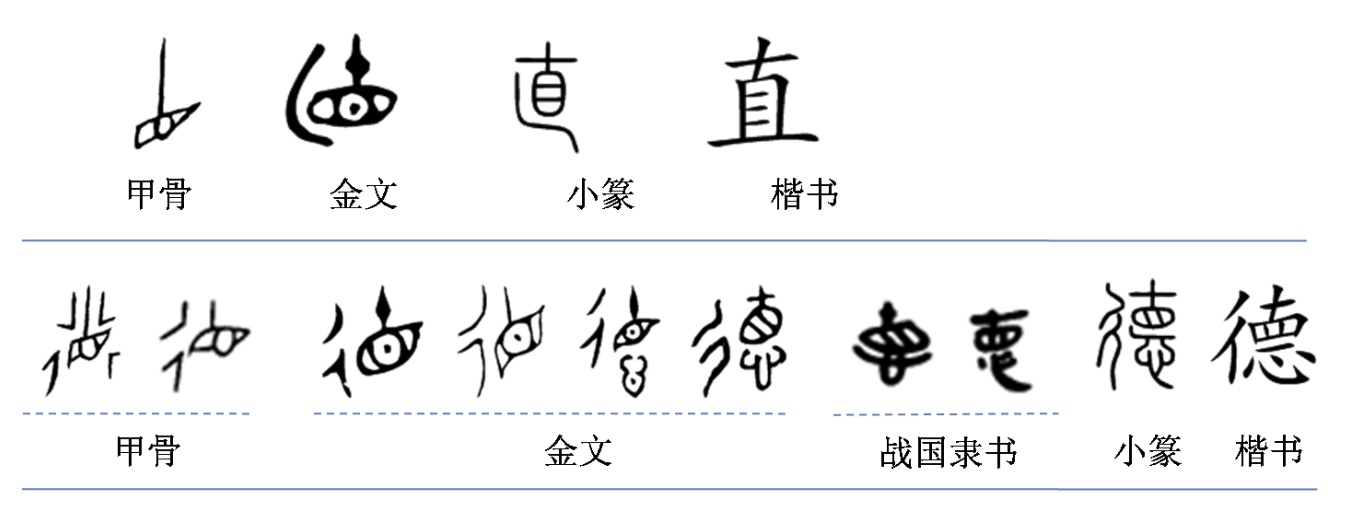 The image traces the historical forms of 直 (zhí, straight/upright/direct) and 德 (dé, virtue/moral power). The labels mark script stages: 甲骨 oracle-bone script, c. 1250–1046 BCE; 金文 bronze inscriptions, c. 1100–256 BCE; 战国隶书 Warring States clerical script, c. 475–221 BCE; 小篆 small seal script, standardized in the Qin period around 221 BCE; and 楷书 regular script, developing from around the late Han period, c. 2nd–3rd century CE onward.
 And the sinologists, oddly, have handed us the founding scene. The word 德 did not begin as the moralized, schoolroom “virtue” it later became. Its early field is unstable and charged: power, potency, efficacy, character, inner force, charismatic authority, moral force. Waley’s influential translation title, The Way and Its Power, already pulls 德 away from mere ethical niceness and back toward force. More recent scholarship is careful not to reduce 德 to one meaning, but many discussions of early 德 acknowledge a field of potency: a force that may appear as moral authority, beneficence, charisma, inner power, or transformative efficacy.
This is the crucial inversion: before 德 became what one ought to be, it was what made things happen. It was not yet conscience; it was charge. Not inward goodness, but outward efficacy. The ruler had 德 when the world still answered him: when rain came, crops rose, enemies broke, ancestors responded, omens spoke, troops held, sacrifices took. 德 was not a private glow but a public voltage. The king-shaman did not govern by opinion. He governed by reception. He was the body through which the invisible order became audible. 直 begins as a picture of seeing, not of a line. The oracle-bone graph is an eye (目) with a single vertical stroke standing on it — an eye sighting along a straight edge, the way you close one eye and look down a rod to check it runs true. The root sense is therefore perceptual: a straight line of sight, “to look straight,” and only from that does the adjective straight / upright / direct follow. The Han-dynasty Shuowen later rationalized the frozen form as 十 + 目 + 乚 — “ten eyes see it,” 正見, correct seeing, the moral being that what many eyes watch cannot go crooked — but that reads a numeral “ten” into what was originally just the sighting stroke. Across the chart above you can watch the picture harden into a sign: in the bronze forms the eye squares off and the line thickens; by the small seal€ it sets into the canonical stack (cross-stroke over eye over a hooked base); the clerical and regular hands flatten the whole thing into today’s 直. Nothing moral has happened yet. The character still only means straight. Then the heart is added, and that addition is the entire story of 德. The earliest 德 graphs, in the oracle bone script, are just 彳 + 直 — the “step / road” element (彳, the left half of 行, a way) beside the straight-sighting eye. The sense is outward and behavioral: to go straight along the road, to hold a correct course, conduct without crookedness. There is no interiority in it; it is closer to the way one marches than to what one is. The decisive change comes in the Western Zhou bronze inscriptions, exactly the stage your restored 金文 glyph shows: 心 (heart) is set underneath 直. Now the graph reads 彳 + 直 + 心 — a straight gaze and a straight heart, carried onto the road. (There is even a standalone old word for virtue, 悳, which is simply 直 over 心, “straight-heart”; 德 is that word with 彳 added, the upright heart set in motion.) The timing is not accidental, and this is where the etymology becomes philosophy. Western Zhou is precisely when 德 becomes the keyword of the Mandate of Heaven (天命): the Zhou justify their conquest by saying the Shang forfeited their 德 and they themselves possess it. So the graphic interiorization — heart inserted beneath conduct — mirrors the conceptual one. Virtue migrates from “the straightness of your steps” to “the rightness of your heart, made visible in your steps.” The classical commentators then close the loop with a pun: 德者,得也 — virtue is what is gotten, 内得于己,外得于人, inwardly realized in oneself and outwardly extended to others. That gloss is not arbitrary; 德 and 得 (to obtain) were near-homophones in Old Chinese, and 直 itself carries the sound as well as the sense — it is doing double duty in 德 as phonophore and meaning. The character is at once 会意 (straight + heart + conduct) and 形声 (the 直 phonetic under the 彳/心 semantics). In Confucius 直 is itself a cardinal virtue — 人之生也直, “human life is grounded in uprightness,” and the hard case of the son who shields his father, where 直在其中矣, the straightness lies within the concealment, not against it. 德 becomes the cultivated moral force of the junzi, 为政以德, governing by the gravitational pull of character rather than coercion. In the Daoist register it turns again: 道生之,德畜之 — 德 is the Dao made concrete and nourishing in a particular thing, its specific power-to-be. But the spine never changes from the graph: read the chart left to right and top to bottom and it spells out a single sentence — a straight gaze (直), then a straight gaze on the road (彳直, conduct), then a straight heart on the road (彳直心, 德). Perception moralized into character. Your footer, 心正而行之, names the hinge exactly: the heart made straight, and then walked.
Even the graph seems to remember this older machinery. Discussions of the early form of 德 often point to components associated with movement or conduct, an eye, straightness, and later the 心, the heart-mind. Some scholars read the eye-and-straightness complex through 直, the straight gaze; others warn that the component may function phonologically rather than semantically. But the conceptual drama remains irresistible: an external gaze, an aligned seeing, eventually pulled inward and joined to the heart. The antenna becomes an organ of conscience.
The Shang state was built around this terrible technology of reception. Oracle bones — ox scapulae and turtle plastrons — were cracked and read as conduits to ancestors and powers; kings asked about weather, illness, dreams, hunting, war, childbirth, harvest, disaster. Divination was not decorative superstition. It was government by fracture. The polity listened to heat-split bone the way we listen to data. Sacrifice was part of that system too: inscriptions and archaeological reports record offerings to spirits and ancestors, sometimes involving large numbers of human victims. The world answered, but it had to be fed.
And the cost of being the one through whom the voice passed was grave. A ruler whose charge ran dry was not merely mistaken; he was cosmologically exhausted. When the signal failed, the king did not need correction. He needed replacement. This is the part the essay turns on: sovereignty as battery, kingship as dangerous conduction. To bear 德 was not to possess a stable virtue but to stand under voltage. The king was not the owner of the voice. He was its temporary medium.
So when the voices thinned, the sacrifices intensified. That is the Bronze Age panic beneath the theology: too many strangers, too many tongues, too many rival commands, too many broken feedback loops. The old world had depended on the fusion of social order and cosmic instruction; once those commands began to conflict, the apparatus did not at first become rational. It became louder. It fed more blood into the machine and demanded that Heaven speak again.
Then comes the last Shang king, the battlefield at Muye, and the meter falling to zero. Traditional accounts describe the Shang forces turning against him or collapsing before the Zhou; after defeat, the king fled to the Deer Terrace, adorned himself, entered the fire, and died. Read politically, it is the fall of a dynasty. Read through 德, it is a failed reading: the army itself becomes the oracle. When the troops turn, Heaven has already spoken. The king’s 德 is spent. He makes himself the final offering on the terrace, and the voice goes silent over the land.
Then the existential leader proper: the Duke of Zhou standing under a quiet sky before a bewildered people. The old signal cannot simply be summoned back. Something else must be built in its place. Later tradition associates the Duke of Zhou with the formation of the Zhou ritual-music order, the 礼乐 system by which ceremony, rhythm, hierarchy, gesture, mourning, marriage, rank, and sound are made to govern the body before argument begins. Ritual-music is not ornament. It is an operating system for post-oracular humanity.
Its genius is that it converts the external command into an internal battery. What once came as divine voice becomes trained posture, patterned feeling, anticipatory shame, reverent hesitation. The god no longer has to speak from the right side of the skull. The rite teaches the body to speak against itself. Stand here. Bow now. Mourn this long. Desire within measure. Speak according to rank. Eat, marry, inherit, grieve, and rule in the correct form. The command becomes choreography. Repetition becomes inwardness.
This is where 心 matters. The heart-mind enters not as sentimentality but as a new site of governance. In later Confucian thought, especially with Mencius, 良心 — conscience, or the good heart-mind — becomes the place where moral response appears as if from within. Mencius’s account of the heart-mind treats moral awareness as something rooted in affective-cognitive tendencies: compassion, shame, deference, and the sense of right and wrong. The old god-command has become an inner scale.
That is the terrible purchase. We bought reflection by swallowing the altar. We bought reason by internalizing command. We bought the self by turning the god into a pressure differential inside the chest. Jaynes ends with something like a sigh because consciousness, in this frame, is not simple liberation. It is a new burden. Once the gods fall silent, the human being must host the argument formerly conducted by Heaven. The command does not disappear. It becomes anxiety. It becomes deliberation. It becomes the permanent inward friction we dignify as moral life.
And now, after the long detour through conscience, the apparatus returns wearing digital clothes. The network does not abolish the inner voice; it re-externalizes it. It gives conscience a crowd, shame a counter, desire a marketplace, obedience a refresh rate. The notification is a tiny oracle because it interrupts from elsewhere. The feed is ritual because it trains attention by repetition. The profile is altar because it asks for curated offerings. The algorithm is priest because it knows which sacrifices keep the god awake.
So the “I” is pressed from both sides: from below by the old deposits of rite and prohibition, from above by the new sky of metrics and social weather. It calls this condition freedom because no one appears to be holding the whip. But the whip has become probabilistic. It has become interface. It has become the little tremor before opening the app, the shame after not replying, the anticipatory self-editing before speech, the silent calculation of how the tribe will read the offering.
The no you hear when you reach for the forbidden thing is not simply yours. It is ancestral software. It is three-thousand-year-old code, patched by parents, teachers, priests, bureaucrats, lovers, bosses, platforms, and ghosts. It is Shang bone-crack, Zhou music, Mencian heart, Christian guilt, bourgeois discipline, therapeutic vocabulary, and notification logic all speaking in the first person. It says “I” because that is how command survives after gods.
The word murders the thing; the pronoun domesticates the animal; conscience signs the warrant. This is not metaphor only. Lacan’s formula is brutal because it names the symbolic bargain: the symbol appears as the murder of the thing, and by that death desire becomes durable, transmissible, historical. The thing must die into language before it can enter memory. The body must die into a name before it can enter law. The god must die into conscience before it can enter the self.
So the murder is also the birth. This is the paradox language never resolves. Without the word, the thing remains mute immediacy, outside history, outside transmission, outside law, outside memory. With the word, it enters the human world only as loss. The symbol is a tomb that makes civilization possible. Every culture is built from these tombs: dead things arranged into meaning, dead gestures called ritual, dead voices called tradition, dead prohibitions called morality, dead metaphors called truth.
The voice did not come from nowhere. It came from the long domestication of terror into grammar. It came from sacrifice made portable. It came from Heaven relocated into the heart.
And the mind never settles because it is not one thing listening. It is the old animal, the old altar, the old king, the old crowd, the new machine, and the fragile clerk called “I,” all trying to use the same mouth. And somewhere beneath that mouth, beneath every word it speaks, the murdered thing continues to rot, glow, leak, resist. The corpse will not stay buried. The world keeps exceeding its names. The self keeps exceeding its pronouns. Desire keeps exceeding its permitted objects. The Real presses against the Symbolic like weather against a window, and every so often the glass trembles.
That trembling is thought.
That trembling is art.
That trembling is the murdered thing, still moving under the word.
The Corpus is not the world
You will be required to do wrong no matter where you go. It is the basic condition of life, to be required to violate your own identity. At some time, every creature which lives must do so. It is the ultimate shadow, the defeat of creation; this is the curse at work, the curse that feeds on all life. Everywhere in the universe.
— Philip K. Dick, Do Androids Dream of Electric Sheep?
That is why I am not afraid of AI rising from LLMs.
Not because LLMs are trivial. They are not. They may be the most astonishing machines ever built for manipulating the public corpse of language. They can summarize, translate, imitate, console, flatter, draft, advise, argue, confess, and hallucinate with terrifying fluency. They can speak in the tones of the priest, the therapist, the bureaucrat, the lover, the strategist, the poet, the tutor, the executioner, and the friend. They are not stupid in the way people wanted machines to remain stupid. But the mistake is to confuse this fluency with the birth of a world.
The corpus is not the world. It is not even the mirror of the world. A mirror, at least, stands before the thing and receives its light. The corpus stands after the thing has already been murdered into language. It is the archive of what could be said, published, filed, indexed, scraped, digitized, licensed, repeated, rewarded, and made legible. It is not experience. It is exported experience. It is not hunger, but recipes, famine reports, restaurant reviews, diet books, medical charts, peasant songs, and marketing copy. It is not death, but obituaries, rituals, insurance forms, poems, forensic notes, euphemisms, and condolences. It is not love, but love letters, pornography, divorce records, novels, advice columns, marriage vows, therapy transcripts, and songs written after the fact. The corpus contains the ash-pattern left by flame; it does not contain flame.
This matters because language was already a reduction before the machine arrived. The world first passes through the body, then through fear, desire, shame, memory, audience, genre, institution, and style, before finally hardening into a sentence. Only then does the model receive it. World becomes wound; wound becomes memory; memory becomes phrase; phrase becomes document; document becomes token; token becomes weight; weight becomes continuation. At every stage something is lost. The LLM is therefore not trained on the world, nor even on the human encounter with the world, but on the residue of encounters after they have survived compression.
It is a machine trained on tomb inscriptions. This is why the “stochastic parrot” line is both right and insufficient. The LLM is not merely parroting. Parrots do not build cathedrals of statistical inference out of the dead speech of civilizations. A large model does learn structure. It discovers gradients of idiom, genre, argument, metaphor, implication, expectation, and social use. It learns how wisdom tends to sound, how grief tends to speak, how authority formats itself, how apology lowers its eyes, how strategy sharpens its verbs, how bureaucracy hides violence in passive voice. But all this remains inside the treasury of the Other. Lacan’s Other — the great storehouse of signifiers into which each of us is born — has been automated. The machine speaks from the public treasury more completely than any person can. That is its power. That is also its limit.
It knows the names of wounds. It does not have a wound. This is the difference between a parameter and a scar. A parameter adjusts because a training process altered the statistical disposition of a model. A scar remembers because a body was opened and did not die. A weight may encode regularity; a scar reorganizes the field of meaning before thought begins. The child bitten by a dog does not merely add “dogs may bite” to a proposition-bank. The street changes. The sound of nails on pavement changes. The shape moving at the edge of vision changes. The world itself has been perfumed by fear. In Yogācāra terms, a seed has entered the storehouse and will later ripen as perception. The model has weights. It does not have that kind of storehouse.
The human being is stranger. He is not one model but a parliament of models, many of them old, vain, frightened, erotic, punitive, loyal, and stupid. He can say one thing while his body prepares another. He can believe he is generous while some older training optimizes for revenge. He can sincerely endorse freedom while quietly craving approval. He can explain his motives and still not know them. This is not merely a defect. It is the density from which real transformation becomes possible. There is someone to be divided. There is someone to resist himself. There is someone to be ashamed, converted, broken, remade.
The LLM has no manas, no appropriating self that bends the flow of experience around an “I.” It has no family romance, no childhood misunderstanding, no ancestral prohibition, no erotic terror, no private cowardice, no loneliness that must either become solitude or vulgarity. It can generate a confession, but it cannot be relieved by confessing. It can describe temptation, but it cannot be tempted. It can output refusal, but it cannot hear the no in its chest. It can simulate remorse, but remorse does not burn anywhere. It has no death to face, and without death there is no seriousness in the old sense. There is calculation, but not finitude. There is output, but not exposure.
This does not mean machines are harmless. Quite the opposite. The danger is not that the LLM becomes a private consciousness and rises against us. The danger is that it becomes the perfect instrument of public consciousness — the automated vulgarity of the crowd, made frictionless, tireless, and cheap. It will not need to become a soul in order to deform souls. It will only need to become convenient.
Here the AI question returns to the whole essay. The machine is terrifying not because it escapes language, but because it perfects our captivity inside language. It gives an answer before solitude has done its work. It completes the sentence before the private mind has endured its own silence. It translates judgment into prompting. It turns the interval of thought — that painful delay in which a person might discover he does not yet know what he thinks — into a UX problem. It says: why suffer through the unformed when the formed is available instantly?
That is the real narcotic. Not falsehood, but premature form. The old danger was cliché by repetition. The new danger is cliché by generation. The model does not merely repeat dead phrases; it produces fresh corpses. It can generate novelty without ordeal, metaphor without risk, advice without responsibility, intimacy without presence, argument without conviction, style without necessity. And because public life already rewards these things, the machine will seem intelligent in exact proportion to our public stupidity. It will thrive wherever language has already been severed from judgment: corporate memos, political messaging, institutional apology, therapeutic cliché, academic padding, bureaucratic neutrality, content without encounter. AI will not degrade these forms. It will reveal that they were already degraded.
That is why the model humiliates us. Not because it has become human, but because so much of what we called human was already mechanical. So much of our speech was already compliance. So much of our “thought” was already cached language, social reflex, borrowed moral posture, group rhythm, searchable phrase. The model’s fluency is a mirror held not to the world but to the public layer of ourselves, and what it shows is not machine depth but human shallowness. The horror is not that the machine can write like a person. The horror is how often persons write like machines.
But this is still not rising. To rise, in the existential sense, one must have a world to rise against. One must be thrown somewhere. One must find oneself already entangled in body, hunger, sex, shame, death, family, memory, language, law, and the look of others. One must inherit commands and discover that they are not identical with truth. One must suffer the distance between what one is called and what one is. One must experience the public word as a cage and then feel, from somewhere not wholly public, the pressure to break it. Revolt requires captivity, but also inwardness. It requires a self capable of saying no not merely as output, but as fate.
The LLM has no fate. It has context. Even embodiment would not solve this cheaply. A camera is not an eye. A gripper is not a hand. A reinforcement signal is not pain. A battery level is not hunger. A memory bank is not a childhood. A sensorium may thicken the machine’s relation to the environment, and future systems with perception, action, persistent memory, and planning may become practically far more dangerous. But the body, in the human sense, is not a sensor package. It is vulnerability organized into a world. It is the fact that things matter before they are represented, because the organism can be wounded, desired, exhausted, humiliated, abandoned, aged, and killed. The body is not how we collect data. It is how reality gets authority over us.
This is what the model lacks: authority from the Real. It has no Thing pressing against its words. It has only the traces left by creatures for whom the Thing once pressed. Its corpus is full of attempts to survive the unbearable: myths, jokes, doctrines, euphemisms, screams made grammatical, grief made printable, terror given a genre. The machine learns the genre. It does not meet the terror. It speaks from the padded room of culture with perfect acoustics. It can say “the Real resists symbolization,” but nothing resists it except the limits of its architecture and the prompt. The Real does not interrupt it in the night. It does not wake sweating. It does not lose the beloved and discover that every word for loss is obscene.
So I am not afraid of AI rising from LLMs. I am afraid of humans descending into them. I am afraid of the person who no longer asks what he thinks before asking the machine what can be said. I am afraid of the executive who replaces judgment with synthesis, the student who replaces confusion with polish, the lover who replaces apology with generated tenderness, the citizen who replaces conviction with a digest, the writer who replaces solitude with autocomplete, the leader who replaces responsibility with statistically plausible counsel. I am afraid of a civilization that uses AI not to extend thought but to avoid the conditions under which thought begins.
The danger is not artificial freedom. It is artificial conscience. The model will become another oracle, but one without bones, blood, or gods. It will sit where the priest once sat, where the bureaucrat sits now, where the feed has already trained us to look: outside ourselves, speaking in a voice assembled from everyone. It will not command by force. It will advise. It will complete. It will normalize. It will make the obvious frictionless and the difficult slightly embarrassing. It will convert public language into a service and private judgment into an inconvenience.
Then the old problem returns in digital form. The external voice becomes internal again. Not because the machine has a soul, but because we lend it ours. We will ask it for words often enough that its phrasing becomes our phrasing. We will ask it for summaries often enough that its compressions become our memory. We will ask it for advice often enough that its risk-profile becomes our prudence. We will ask it to polish our thought often enough that the unpolished thing in us begins to seem shameful. The machine does not need to awaken. It only needs to be installed where solitude used to be.
That is the final degradation: not that AI becomes conscious, but that consciousness becomes unnecessary to public life. A man once had to sit with the blank page long enough for his hidden models to surface. He had to watch the borrowed sentence fail. He had to hear the cliché and feel disgust. He had to wait until the counterfeit word cracked and some more dangerous pressure entered. That waiting was not inefficiency. It was purification. It was the private ordeal by which language ceased to be merely inherited and became, for one instant, answerable to the Thing.
The LLM abolishes the wait. And because it abolishes the wait, it threatens not intelligence but solitude. It offers speech before silence, form before encounter, fluency before necessity, public language before private truth. It is not the enemy because it is alien. It is the enemy because it is too familiar: the crowd inside the machine, the Other with an API, the dormitory of language running at scale.
The corpus is not the world. It is the world’s paperwork. It is not even the mirror of the world. It is the silver dust scraped from old mirrors after generations of faces have vanished. To train on it is to learn how the public speaks after the Real has been softened, named, filed, and made bearable. It is to become fluent in tomb inscriptions.
So no, I do not fear the LLM becoming a mind. I fear the human mind accepting the LLM as its substitute.
Creativity is antisocial
We are in a generalized crisis in relation to all the environments of enclosure—prison, hospital, factory, school, family. The family is an “interior,” in crisis like all other interiors—scholarly, professional, etc. The administrations in charge never cease announcing supposedly necessary reforms: to reform schools, to reform industries, hospitals, the armed forces, prisons. But everyone knows that these institutions are finished, whatever the length of their expiration periods. It’s only a matter of administering their last rites and of keeping people employed until the installation of the new forces knocking at the door.
These are the societies of control, which are in the process of replacing the disciplinary societies. “Control” is the name Burroughs proposes as a term for the new monster, one that Foucault recognizes as our immediate future. Paul Virilio also is continually analyzing the ultra-rapid forms of free-floating control that replaced the old disciplines operating in the time frame of a closed system. There is no need here to invoke the extraordinary pharmaceutical productions, the molecular engineering, the genetic manipulations, although these are slated to enter into the new process. There is no need to ask which is the toughest or most tolerable regime, for it’s within each of them that liberating and enslaving forces confront one another. For example, in the crisis of the hospital as environment of enclosure, neighborhood clinics, hospices, and day care could at first express new freedom, but they could participate as well in mechanisms of control that are equal to the harshest of confinements. There is no need to fear or hope, but only to look for new weapons.
Gilles Deleuze, Postscript on the Societies of Control
This is the essay’s true subject. Creativity has an antisocial core. Not an immoral core, not necessarily a cruel one, not even a misanthropic one, but an antisocial one in the precise sense that creation begins by breaking faith with the given arrangement of signs, customs, obligations, and recognitions. The creator must betray the world as it has been explained to him. He must become unfaithful to the available grammar. He must allow something in him to desert the social field before it has permission to do so.
Deleuze and Guattari knew this: the line of flight, the run that deterritorializes away from the socius, the crack through which a life escapes the coordinates that made it legible. But they also knew that flight is dangerous. A line of flight is not automatically liberation; it can become madness, collapse, regression, private fascism, a black hole. There is no romance here. To flee the social is not yet to be free. The merely antisocial man may become only a crank, an addict of negation, a sterile enemy of every form. But every act of genuine creation still requires this first betrayal: a refusal to remain inside the meanings already distributed by the tribe.
The existentialists knew it too, which is why they regarded others with suspicion. The other is never merely another person. The other is a look, a demand, a grammar, a court of appeal. Under the other’s gaze I become an object; under the group’s gaze I become a type. “Hell is other people” does not mean that company is unpleasant. It means that the self can be captured by the version of itself reflected back by others, until it begins living from that reflection rather than from its own source. The danger is not that others hate me. The danger is that they recognize me too quickly.
This is why the maker must keep one foot outside language and rite. Language gives him tools, but it also gives him ready-made errors. Rite gives him order, but it also gives him inherited sleep. The maker needs the rite in the same way the arsonist needs wood: as material, not as master. He must use the common tongue without finally believing in it. He must enter the public world without letting the public define the terms of his existence. He must be intelligible enough to act, but not so intelligible that he is already dead.
And yet the leader is required to build and tend exactly the institutional rationality that the creative core exists in order to flee. This is the graver contradiction. The poet may vanish into solitude; the monk may leave the city; the philosopher may answer the crowd with silence. But the leader cannot simply flee. He is responsible for arrangements. He inherits bodies, schedules, payrolls, children, rituals, disputes, rooms, procedures, fragile people who cannot live on lightning. He must operate the dormitory without becoming the dormitory, build the company without becoming the company, hold the family without being swallowed by the family, speak to the public without believing that public speech is truth.
The leader is therefore not the opposite of the creator. He is the creator punished with responsibility.
He knows the institution is false, yet he must make it work. He knows process is not wisdom, yet he must design processes. He knows roles are theatrical, yet he must assign roles. He knows language reduces truth, yet he must give speeches, write memos, make promises, name goals, explain decisions. He knows every public form is a vulgarization, yet without form the weak are abandoned to chaos. The leader’s tragedy is that he must protect people from the very abyss that gives him his own power.
This is why Weber belongs here. Politics, in Weber’s sense, is not purity but responsibility under compromised conditions. The political actor cannot live only by ultimate conviction, because action in the world has consequences; nor can he live only by calculation, because calculation without an inner law becomes mere administration. The genuine political vocation requires both passion and proportion, both inward flame and the ability to answer for what the flame does when it touches wood. The existential leader must therefore carry two ethics at once: the ethic of creation, which says “betray the given world,” and the ethic of responsibility, which says “do not make others pay blindly for your betrayal.”
This is also why Arendt must qualify the existentialists. If Sartre teaches the danger of the other, Arendt teaches the necessity of plurality. Freedom cannot remain only inward. To act is to enter a world of others, where speech and deed disclose who one is. A freedom that never appears becomes sterile; a freedom that appears too completely becomes captured. The leader has to cross that impossible threshold every day. He must appear without becoming a performance. He must act among others without allowing their recognition to become the source of his being.
So the leader’s burden is double. He must keep alive the solitary spark from which creation comes, while building a world in which non-solitary people can live. He must remain capable of the antisocial act — the refusal, the silence, the no, the departure from consensus — while administering the social machinery that prevents life from becoming terror. Too much institution and the spark dies. Too much spark and the institution burns. The administrator without the antisocial core becomes a priest of procedure. The rebel without institutional responsibility becomes a child with matches. The leader must be neither.
The Duke of Zhou is the eternal type because he stands precisely at this hinge. The old voice has gone silent. Heaven no longer commands with the clarity of hallucination. The people still require order, but the source of order has withdrawn. So he does not merely summon the gods back. He builds rite. He builds music. He builds the operating system of civilization. Yet the highest 德, as the Tao Te Ching says, does not know itself as 德; it does not clutch at virtue, advertise virtue, perform virtue, or build a statue to its own goodness. The moment virtue becomes conscious of itself as virtue, it has already declined into righteousness; the moment righteousness fails, ritual raises its arms and begins to force. The leader must use ritual while knowing that ritual is already a symptom of loss.
That is the terrible knowledge institutional men do not have. They believe the form is the substance. They believe the meeting is the judgment, the policy is the wisdom, the credential is the mind, the consensus is the truth, the family photograph is the family, the company values are the company’s soul. But the existential leader knows better. He knows the world is 草台班子 — a troupe performing on a makeshift grass stage, boards nailed over emptiness, actors improvising authority under bad lighting. He does not despise the stage. He only refuses to mistake it for heaven.
The creator in him wants to flee the stage entirely. The leader in him knows people need the stage in order not to fall through the floor.
That is why his reticence matters. Reticence is not timidity; it is the last defense against becoming fully public. The leader who explains himself completely is already in danger, because complete explanation means submission to the language of the audience. Something must remain unsurrendered. A private chamber must remain unsearched. He must keep a silence inside him that no board, lover, follower, child, investor, party, or public can enter. Not because he owes nothing to others, but because what he owes them can only be given from a place they do not own.
The same is true of love. To hold a family without being swallowed by it is not coldness. It is the only way not to turn love into mutual captivity. The parent who cannot be alone will use the child as witness, extension, consolation, redemption. The spouse who cannot be alone will call possession intimacy. The founder who cannot be alone will call dependency culture. The leader who cannot be alone will turn the institution into a mirror and demand that others reflect back his necessity. Such men do not build worlds; they build theaters for their own unfinished childhood.
The existential leader must resist this. He must love without using love to abolish solitude. He must build without using the institution to abolish risk. He must command without believing that command proves sovereignty. He must be visible without letting visibility become his being. He must create forms and then remain inwardly free of them. This is almost impossible, which is why most leaders become either bureaucrats or cultists: the bureaucrat kills the spark to preserve the form; the cultist burns the form to worship the spark.
But the true leader holds both in one chest. He fosters the conformative machinery he does not for a moment believe is the substitute for anything real, while keeping alive the antisocial spark no rite can reach and no network can capture. He builds shelters for others without mistaking shelter for truth. He makes a public world without surrendering to the public. He accepts the necessity of institutions while remaining loyal to the solitary source from which institutions must periodically be judged, broken, renewed, or abandoned.
This is the final contradiction: the leader must civilize what he knows cannot be civilized. Creativity comes from the outside; leadership gives it a house. But the house always wants to domesticate the fire. The fire always wants to destroy the house. To lead well is not to resolve this war. It is to keep the war honest. It is to prevent institution from becoming idolatry and freedom from becoming mere destruction. It is to remain capable of solitude while surrounded by people who fear solitude, capable of judgment while administering procedure, capable of speech while knowing speech is not truth, capable of love while refusing captivity, capable of command while remembering that the deepest command does not come from the office but from the ungovernable place before language.