Selling modern financial products: comparing SMAs, SaaS, and asset management
Introduction
Separately Managed Accounts (SMAs) have experienced surging adoption and asset growth, driven by demand for personalized, tax-efficient portfolios. Based on an SS&C report, nearly half of hedge fund managers now offer SMAs. FUSE Research Network, an asset management research and consulting provider, projects that total SMA assets will top $5.1 trillion in 2026, reflecting a 15.4% CAGR over 2025 and 2026.Global hedge fund assets are on par with SMAs in size but expanding more slowly. HFR reports hedge fund AUM at about $4.7T in 2025, with forecasts pointing to ~$5.0–$5.3T by 2026—a mid-single-digit CAGR versus the 15%+ pace expected for SMAs. This momentum creates opportunity, but scaling an SMA business isn't as simple as signing on more accounts. Unlike mass-market funds or ETFs, SMAs are high-touch, customized services rather than one-size products.
SMAs occupy a unique position in the investment world, blending the investment expertise and scale of a traditional asset manager with a service model reminiscent of Software-as-a-Service. At their core, SMAs are individually managed portfolios tailored to a single client's objectives — much like a personalized mutual fund — but delivered as an ongoing service rather than a one-off product. Providers often stress that SMAs are a service model, not just a container of securities: the relationship emphasizes continuous customization, transparency, and collaboration in portfolio decisions.In essence, an SMA relationship involves continuous portfolio adjustments, consultations, and service updates to align with each client's goals, much like a SaaS platform would regularly update and tailor its offerings for users. This lets advisors offer clients tailored strategies (tax-efficient portfolios, values-based screens) with the backing of professional asset management, treating the mandate as an evolving framework that grows with the client's needs.
The business consequence: sales growth is only half the equation. An SMA generates recurring fees the way a SaaS subscription generates recurring revenue, and the provider must continually earn those fees. Unlike a mutual fund, which can absorb unlimited new investors with little incremental effort, each new SMA account brings a standing claim on personalized attention. Retention and client satisfaction — driven by service quality — matter as much as inflows.
This essay maps that hybrid position from three angles: who the players are, how the technology is shaped, and how the sale actually unfolds — ending with the question growth forces on every SMA provider: how do you scale the people?
The players: PM, Ops, Sales
Every commercial organization — whether an asset manager, a SaaS company, or an SMA platform — ultimately revolves around three functional cores: PMs, Ops, and Sales. These functions define how any business creates, delivers, and captures value.
(Product Makers / Subject-Matter Experts) are the intellectual and technical engine of the organization. They own the product — whether that product is an investment strategy, a software platform, or a customized portfolio solution. PMs, engineers, and solution consultants translate expertise into something tangible that clients can trust and use. They are responsible for innovation, performance, and clarity of value proposition. Without them, there is nothing to sell, no differentiator to protect, and no foundation for credibility.
(Operators / Enablers) make the system run. They transform ideas into reliable, scalable, and compliant processes. This category includes operations, compliance, client service, and marketing enablement — the people who ensure accuracy, repeatability, and control. In an asset manager, Ops handles reconciliations, reporting, and client service. In SaaS, it's customer success and implementation. In SMAs, it's platform listing, servicing, and day-to-day oversight. These functions don't create the product, but they make it deliverable at scale.
(Commercializers / Relationship Builders) monetize what the firm creates. They generate and retain revenue by turning intellectual value into client relationships and contracts. Business developers, account executives, and wholesalers are the face of the firm — they tell the story, win trust, and manage ongoing relationships. Effective sales teams are not just closers; they act as translators between what the PMs build and what the market needs.
Together, these three functions form a continuous loop of value creation: PMs build, Ops deliver, and Sales monetize, with feedback from clients and markets flowing back to PMs to refine the product and strengthen the next cycle. Every mature firm — regardless of sector — converges on this triad because it is the simplest, most durable architecture for turning expertise into an enduring business.
Table. Three functional pillars compared
| Function | Asset Managers & Hedge Funds | SaaS (Enterprise) | SMAs (Wealth Platforms) |
|---|---|---|---|
| Investment / Product / Technical | Portfolio Managers • Product Specialists • Investor Relations | Sales Engineers • Solution Consultants • Professional Services | Portfolio Managers • Overlay / Tax / ESG Specialists • Product Specialists |
| Operations / Enablement / Support | RFP / Proposal Specialists • Legal & Compliance • Operations / Reporting | Legal / Compliance • Customer Success Managers • Support Engineers • Marketing Ops | Client Service Reps • RFP / RFQ Specialists • Platform / Database Specialists • Compliance |
| Distribution / Relationship | Institutional Sales Directors • Business Development Officers • Consultant Relations • Client Relationship Managers | Account Executives • SDRs / BDRs • Sales Managers / VP Sales • Account Managers | External Wholesalers • Internal Wholesalers • Advisor / Platform Gatekeeper Relations • Post-Sale Wholesaler Coverage |
Titling can be deeply confusing — and it varies dramatically across organizations, creating one of the biggest challenges in building scalable, interoperable teams. A "Product Specialist" in one firm might function as Sales in another; a "Customer Success Manager" could sit in Ops or Sales depending on culture and structure. Titles reflect legacy, politics, and branding far more than true function. What matters is how someone contributes to the value loop — creating the product (), enabling its delivery (), or driving its commercialization (). In a well-designed organization, people are aligned by the substance of their contribution, not by reporting lines, title semantics, or aspirational career framing. Function should follow purpose, not nomenclature.
The same triad fans out into a thicket of titles across the three verticals:
Table. Role map across verticals
| Role Category | Asset Managers & Hedge Funds | SaaS (Enterprise) | SMAs (Wealth Platforms) |
|---|---|---|---|
| Frontline Sales / BD | Institutional Sales / BD Officers: win mandates from pensions, endowments, consultants; run finals, negotiate terms. | Account Executives: own the cycle from discovery to signature. Sales Managers / VP Sales: coach, approve big deals. | External Wholesalers: travel to advisors, pitch, close allocations. Internal Wholesalers: set meetings, prep materials from the desk. |
| Marketing & Lead Generation | Marketing & Content: whitepapers, thought leadership, compliance-friendly decks. | Marketing: inbound campaigns, lead generation, sales enablement. | Marketing: performance decks, advisor education. Platform / Database Specialists: manage wealth-platform approvals and listings. |
| Proposal / Technical Support | RFP / DDQ Specialists: compliance-rigorous proposals. PMs / Product Specialists: join pitches for technical depth. | SDRs / BDRs: prospect and qualify. Sales Engineers / Solution Consultants: demo, validate fit. External advisors (Deloitte, Accenture, Gartner) influence buying. | RFP / RFQ Specialists: institutional mandates, bank platforms. PMs: join advisor meetings to demonstrate customization (tax, ESG, liquidity) as strategic partners. |
| Client Relationship / Post-Sale | Client Relationship Managers: service, reviews, retention. IR Officers: investor communication. | CSMs: adoption, onboarding, renewals. Account Managers: upsells. Support Engineers: technical assistance. | Client Service Reps: reports, tax docs, restrictions. Wholesalers: nurture advisors post-funding. PMs: quarterly reviews, overlays, commentary. |
| Consultant / Gatekeeper Relations | Consultant Relations: Mercer, Callan, Cambridge, etc. | External Consultants / Analysts: Gartner and advisory firms shape enterprise buying. | Platform Gatekeepers: wirehouses, banks, and RIAs approve strategies — the consultant's role, played by the platform. |
| Legal / Compliance | Approve communications, contracts, mandates. | Deal terms, data privacy, SLAs. | Mostly handled at platform level; SMA differentiation is PM-driven service quality more than compliance. |
Table. Sales phases
| Phase | Asset Managers & Hedge Funds | SaaS (Enterprise) | SMAs (Wealth Platforms) |
|---|---|---|---|
| Pre-Sales | Roles: Institutional Sales / BD, Marketing / RFP, PMs for credibility. Process: Thought-leadership marketing, consultant outreach, and education-based awareness. | Roles: SDRs / AEs, Marketing Automation, Sales Engineers. Process: Inbound + outbound prospecting, lead qualification, demo setup. | Roles: Wholesalers, PMs / Strategists, Platform Specialists. Process: Platform approvals, advisor targeting, showcasing customization (tax / ESG). |
| Pitch / Evaluation | Roles: Institutional Sales, PMs / Product Specialists. Process: Finals presentations, consultant meetings, performance reviews. | Roles: AEs, Solution Consultants. Process: Demos, proof-of-concepts, ROI validation. | Roles: Wholesalers, PMs. Process: Advisor meetings, customized portfolio illustrations, model comparisons. |
| Closing | Roles: BDOs, Legal / Compliance. Process: Mandate negotiation, fee schedule, onboarding prep. | Roles: AEs, Legal / Implementation. Process: Contract signing, procurement, project kickoff. | Roles: Wholesalers, Operations / Platform Teams. Process: Account opening, custodial setup, funding coordination. |
| Post-Sale / Service | Roles: Client Service, PMs for updates, Relationship Managers. Process: Reporting, performance reviews, retention. | Roles: CSMs / Support, Account Managers. Process: Onboarding, training, renewals, upsells. | Roles: Client Service, PMs, Post-Sale Wholesalers. Process: Advisor follow-up, quarterly reviews, retention. |
Table. Role involvement by phase
Asset Managers & Hedge Funds
| Phase | |||
|---|---|---|---|
| Pre-Sales | ✔️ | ✔️ | ✔️ |
| Pitch / Evaluation | ✔️ | — | ✔️ |
| Closing | ⚪ | ✔️ | ✔️ |
| Post-Sale / Service | ✔️ | ✔️ | ⚪ |
SaaS (Enterprise)
| Phase | |||
|---|---|---|---|
| Pre-Sales | ⚪ | ✔️ | ✔️ |
| Pitch / Evaluation | ✔️ | — | ✔️ |
| Closing | ⚪ | ✔️ | ✔️ |
| Post-Sale / Service | ⚪ | ✔️ | ✔️ |
SMAs (Wealth Platforms)
| Phase | |||
|---|---|---|---|
| Pre-Sales | ✔️ | ✔️ | ✔️ |
| Pitch / Evaluation | ✔️ | ⚪ | ✔️ |
| Closing | ⚪ | ✔️ | ✔️ |
| Post-Sale / Service | ✔️ | ✔️ | ✔️ |
Technology topology
| Asset Managers & Hedge Funds | SaaS (Enterprise) | SMAs (Wealth Platforms) |
|---|---|---|
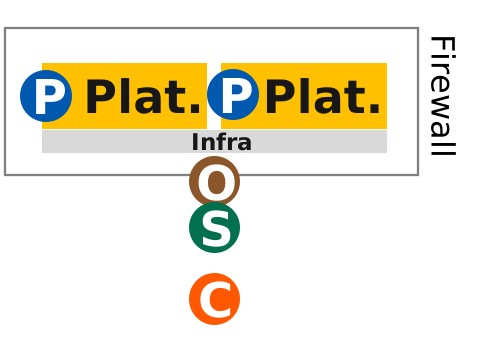 | 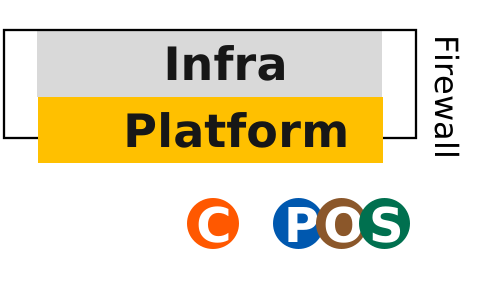 | 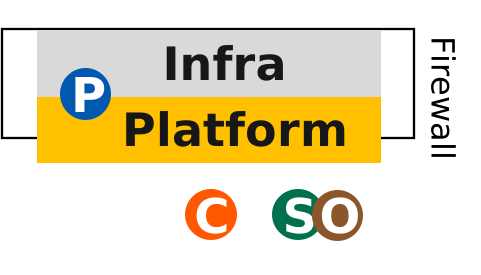 |
| In asset managers and hedge funds, each PM pod maintains its own stack behind firm infrastructure. These systems are private, unintegrated, and inaccessible to clients — optimized for alpha generation rather than scale. | In SaaS, a single shared platform serves all clients; PMs, Ops, and Sales continuously refine it based on aggregated feedback. Clients are direct users, and the platform itself is the product. | In SMAs, PMs build and maintain the core platform, but Sales, Ops, and clients interact only partially — relying on PMs to interpret and customize. The model combines SaaS-like structure with human-driven service. |
The diagram shows three distinct technology topologies — each a direct consequence of how the business is structured.
In many asset management firms and multi-manager hedge funds, each PM team runs behind its own "firewall," maintaining a private stack of proprietary analytics, data feeds, and execution tools. The firm provides only a thin shared layer — connectivity, common market data, compliance, and risk controls — and very little in shared application platforms. One PM's tools and data are siloed from another's, often by design. There is minimal transparency or reusability across teams.
In SaaS enterprises, the topology is the inverse. A single multi-tenant platform sits at the core, shared by all clients and internal teams; the platform is the product. Rather than each client having a separate instance or custom code, everyone uses the same standardized infrastructure, configured for their needs but largely uniform in codebase. Because every client interacts directly with the software, an improvement made in one place benefits all users simultaneously. This yields tremendous leverage and consistency.
The SMA model sits somewhere between the two extremes. There is typically a shared platform or foundation, but it is operated and customized by portfolio managers on behalf of each client. The technology supports multiple clients — it is not one separate system per client or PM — but self-service is limited. The platform serves as an internal collaboration layer across PM, Ops, and Sales, rather than a product clients drive directly.
This is a deliberate trade: personalization against scalability. The SMA delivers a tailored experience that SaaS standardization cannot match, on a common foundation that avoids the hedge fund's total duplication of effort. But it never reaches true SaaS efficiency — each additional client incurs incremental PM and operational time, since settings must be tuned and maintenance grows with volume. Ops and technology teams must ensure the platform absorbs added accounts and complexity, or costs and errors rise rapidly.
Many modern fintech and wealth management firms are trying to straddle both models — running SMA-style managed accounts on SaaS-style shared infrastructure. The goal is the high-touch, customized service of an SMA with the scalability and transparency of a SaaS platform: personalized portfolios powered by a unified, cloud-based system. Blending the models is not trivial. It requires rethinking incentives and culture: technology and data stop being internal tools for one PM and become shared products, which means encouraging teams to contribute to a common platform and sometimes opening historically proprietary analytics for broader use. The platform must also encode enough expert knowledge that customization doesn't rely solely on manual effort. Nevertheless, the industry direction is clear: to serve more clients with personalized solutions, you need a scalable platform. As one wealth-tech provider noted, adopting a SaaS solution can improve operational efficiency while enabling a more customized, responsive service for clients.
The sale, end to end
The org charts converge on the same triad; the sales motions do not. A compact map first, then each phase in detail.
Table. Sales process at a glance
| Phase | Asset Managers & Hedge Funds | SaaS (Enterprise) | SMAs (Wealth / Institutional) |
|---|---|---|---|
| Pre-sales | BD + marketing + RFP teams. Thought leadership, consultant outreach, DDQs; CRM and consultant databases (eVestment) under tight compliance constraints. | SDRs/BDRs + marketing automation. Inbound and outbound prospecting, qualification, demo setup; sales engineers for technical pre-qualification. | Wholesalers + platform specialists, PMs for credibility. Platform approvals and listings, advisor screening (YCharts, Morningstar), education on customization (tax, ESG). |
| Pitch / evaluation | Sales directors + PMs / product specialists. Finals presentations, consultant meetings, exhaustive due diligence, GIPS-compliant materials. | AEs + solution consultants. Tailored demos, pilots and POCs, ROI cases, security questionnaires, reference calls. | Wholesalers + PMs. Customized portfolio illustrations and backtests, iterated with the advisor; heavy disclosure requirements on hypothetical performance. |
| Closing | BDOs + legal/compliance. IMA or subscription docs, side letters, committee sign-off, KYC/AML, funding-window timing. | AEs + legal/implementation. MSA and SLA negotiation, procurement review, implementation plan, signature and kickoff. | Wholesalers + ops/platform teams. Account opening, custodial setup, restriction coding into the IMA, funding coordination; often phased. |
| Post-sale / service | Client service + IR; PMs for reviews. Reporting, review meetings, watch-list management, retention of AUM. | CSMs + support; account managers. Onboarding, adoption, renewals, expansion revenue. | Client service + PMs + wholesaler coverage. Advisor follow-up, quarterly reviews, bespoke per-account reporting. |
Prospecting & lead generation
Asset managers & hedge funds: These firms rely on targeted networking, industry databases, and intermediaries — investment consultants or placement agents — to source institutional prospects. Public marketing is constrained by regulation; hedge funds, as private offerings, historically could not advertise specific funds openly. So prospecting means conferences, capital-introduction events, and personal referrals to reach the CIOs of pensions, endowments, and family offices. The key hurdle is breaking through gatekeepers and lengthy approval channels: many institutions require formal RFPs and due diligence reviews before even considering a new manager. Top-of-funnel is slow — institutional sales cycles traditionally ran 12–18 months just to cultivate and qualify leads, and for hedge funds, introduction to final commitment can stretch well beyond two years. Establishing credibility early, via a proven track record or a genuinely differentiated strategy, is what keeps prospects engaged through this long phase.
SaaS companies: Enterprise prospecting focuses on identifying organizations that fit an ideal customer profile and then engaging multiple stakeholders within them. Tactics span outbound outreach (email, LinkedIn, events) and inbound marketing — there are no prohibitions on broad advertising. The challenge is cutting through noise in a crowded market and finding true decision-makers: enterprise buyers usually involve a buying committee, so sales teams must map and reach influencers across IT, finance, and the business unit early. Lead qualification for budget, need, and authority is critical. Smaller deals can move fast, but institutional-scale clients are a longer play — enterprise cycles typically run 6–12+ months from first contact to deal.
SMAs: SMA providers face a distinct landscape. Target clients include high-net-worth individuals and families (reached via financial advisors), wealth platforms, and institutions wanting bespoke portfolios. Generating leads often means getting approved on distribution platforms or model marketplaces, which entails stringent due diligence by the platform's research team. Direct prospecting may run through private bankers or family offices. The major obstacle is visibility: SMAs are not mass-marketed, so managers must educate gatekeepers — consultants and advisor networks — on their strategies. The process is high-touch and relationship-driven, much like other institutional sales; for a large mandate, months can pass working through platform approvals and advisor introductions. In the U.S., regulatory requirements (ADV disclosures, fiduciary standards) add complexity but also serve as trust signals once met. Sales cycles run several months to a year for meaningful mandates.
Pitching & engagement
Asset managers & hedge funds: Once interest surfaces, the manager presents a pitch deck covering strategy, track record, team, risk management, and fees. Strict compliance rules govern these materials — performance claims need proper disclosures, and managers often adhere to GIPS standards for composites when pitching institutional separate accounts. The pain point is the exhaustive due diligence that follows: detailed data requests (attribution, holdings, operations), multiple follow-ups, on-site or virtual diligence meetings, references. The "product" here is an intangible promise of future returns, so demonstrating expertise and integrity carries extra weight; managers must overcome skepticism with transparency within regulatory limits. The process stalls easily — a performance dip, internal bureaucracy at the investor — and effective engagement requires polite persistence: regular, insightful updates without pushiness. Maintaining momentum through calls, emails, and meetings over a year or more is common before an institutional investor is ready to proceed.
SaaS companies: The pitching phase is product-centric and interactive. After discovery, teams run tailored demos showing how the software addresses the prospect's specific pain points, and often trials or pilots — which lengthen the engagement but build buyer confidence. Sales engineers handle technical questions such as integration with the client's IT systems. The value proposition must land with both end-users and the C-suite, and common obstacles are objections around cost, security, and implementation difficulty; enterprise buyers may require reference calls or a formal security review. Unlike asset management, SaaS pitching can leverage live software and metrics — ROI calculators, prototypes — to make a tangible case. But relationship-building is just as vital: reps spend months cultivating internal champions and aligning decision-makers, and the engagement culminates in consensus across the buyer's organization. The best sellers here run education and consultative selling rather than a hard sell.
SMAs: Pitching an SMA almost always requires customizing the presentation to the client's objectives — and, increasingly, backtesting the proposed approach. Unlike a one-size fund pitch, SMA proposals may involve building a sample portfolio tailored to the investor's goals (equity and fixed-income sleeves for a risk profile, ESG screens) and demonstrating how it would have behaved historically. This adds real operational weight: the team must produce compliant, client-specific pitch materials and accurate, disclosure-compliant backtests with all assumptions, benchmarks, and limitations.This operational burden is a double-edged sword — it appeals to investors seeking personalization and data-driven evidence, but it creates significant strain on internal resources. A major challenge is producing compliant, client-specific pitchbooks and backtest reports quickly. Firms must show performance composites for each strategy, disclose strategy-specific fees/minimums, and include all required disclaimers (e.g., GIPS and regulatory disclosures), especially when presenting hypothetical or backtested results. Manual preparation is time-consuming and error-prone, and advisors often request multiple iterations, asking the manager to act as a co-investment strategist proposing and backtesting several scenarios. Portfolio managers join salespeople in these meetings to answer questions on approach, backtest methodology, and how the account can be tailored — excluding sectors, accommodating tax needs, optimizing for specific outcomes. The pitch stage commonly spans 3–6+ months of meetings as the offering is fine-tuned and the client runs parallel due diligence on the manager.
Closing & contracting
Asset managers & hedge funds: Closing is protracted and detail-heavy. Once serious intent is signaled, a period of final due diligence and legal negotiation begins. For a commingled vehicle, the investor reviews the PPM and subscribes; negotiations may produce side letters — fee discounts, liquidity provisions, reporting rights. For a separate account, an Investment Management Agreement must be drafted: a complex contract defining guidelines, benchmarks, reporting, and compliance responsibilities, with lawyers trading redlines for weeks. Aligning all stakeholders — investment committee, board, counsel — is the final hurdle, and timing adds friction: many institutions commit capital only in certain windows (quarterly funding cycles, fiscal year-end), so even after a "yes" there may be a wait. Closing also means KYC/AML vetting, background checks, and regulatory filings. The full cycle shows its length here: one hedge fund allocation famously took 30 months from introduction to commitment. Success comes from patience, precision, and continual communication, so nothing derails the commitment at the eleventh hour.
SaaS companies: Closing an enterprise deal is a coordination exercise across the client's procurement, legal, and executive teams — any dissenting department can stall the signature. The workflow centers on the Master Service Agreement plus SLAs and data-privacy addendums; enterprises push back on liability clauses and security provisions, and procurement may run competitive benchmarks even after the business teams agree. Keeping momentum is critical: leading vendors address concerns quickly and avoid protracted silences, offer flexible commercial terms (multi-year discounts, pilot periods), and reassure late-stage buyers with a detailed implementation plan. Contracting runs from weeks for simple deals to several months for complex ones — shorter than multi-year fund commitments, but full-cycle enterprise deals still take 6–12 months or more. A misstep here — a failed security review, an inflexible stance on terms — can reset the negotiation or kill the deal.
SMAs: SMA contracting straddles asset management and custom service agreements. For an institutional client, closing means negotiating an IMA — guidelines, fees, reporting, termination rights — with the added wrinkle that SMAs demand customization in the contract itself: client-specific restrictions (no tobacco stocks, say) must be written into the document. For SMAs accessed via a wealth platform or TAMP, closing means being onboarded into the platform's system: standardized paperwork, platform fees, and possibly a model-delivery agreement if the manager supplies a model rather than trading each account. Operational readiness is part of the close — the manager must be set up to trade at the client's custodian with reporting in place. Timing and minimums are a real risk: HNW clients may wait for tax or market reasons to fund, and some deals die when assets never transition. Commitment is often gradual — an initial funding to test the waters, then additional contributions — so "closing" can be a phased event. Cycle length varies: a large institutional SMA sourced via RFP mirrors the 9–12 month institutional timeline, while an advisor convincing a single HNW client may wrap in a couple of months. Throughout, clients must receive the required disclosures (ADV brochures) and suitability confirmations.
Onboarding & post-sale support
Asset managers & hedge funds: After signature or funding, the relationship enters servicing. Institutional onboarding covers KYC/AML completion, reporting setup, and — for separate accounts — custody accounts and asset transfers; fund subscriptions are simpler but may carry side-letter provisions to operationalize (bespoke transparency reports, for instance). Post-sale, client service and IR teams deliver quarterly reports, market commentary, and regular update calls. If performance falters, institutional clients demand explanations and may put the manager on watch. Regulatory obligations shape the cadence too: advisers must promptly disclose material changes — personnel, strategy shifts. Cross-selling is delicate; any new fund requires fresh due diligence. The real goal is retention: institutional money can be redeemed or reallocated, so responsiveness, accuracy, and transparency directly determine the relationship's longevity.
SaaS companies: Onboarding is where the client actually starts deriving value — and where churn risk is decided. Customer success teams project-manage deployment, configure the system, migrate data, and train users; large enterprises may roll out in phases over weeks or months. The central risk is adoption: if employees don't embrace the tool, renewal is in jeopardy, so post-sale support is proactive — regular check-ins, usage monitoring, a dedicated CSM. Common friction points are feature requests (saying "no" gracefully is a skill) and support quality on bugs and downtime. Contracts are annual or multi-year, so the vendor spends the year proving ROI; at renewal, account managers seek to expand modules or seats — feasible only if the product has delivered. Best practice is to start the renewal conversation early, with achieved value in hand. Where asset management post-sale is about monitoring investments, SaaS post-sale is about driving usage and business outcomes, with the vendor an active participant in the client's success.
SMAs: Onboarding an SMA combines investment ops with client servicing. The manager sets up the account at the custodian, receives funds or transferred securities, and often must transition a legacy portfolio — selling and buying to align with the agreed strategy, tax-efficiently and with minimal market impact. Client-specific restrictions must be coded into compliance systems so the portfolio stays within its parameters. As advisory relationships, SMAs carry a fiduciary duty: ongoing disclosures, suitability, best execution. Post-sale support then looks like institutional asset management, but per account: customized performance reports, review meetings, and availability for strategy or life changes.A particular pain point in SMAs can be scalability of service – unlike a commingled fund where one performance report is sent to all investors, each SMA client's report is unique, and high-net-worth clients may expect a lot of hand-holding or bespoke analysis. Ensuring accuracy (performance calculations, attributions) is critical, especially if clients compare results to benchmarks or other managers. Platform-delivered SMAs add data-feed and SLA obligations to the platform itself. The cycle doesn't end at onboarding — a satisfied client allocates more or refers peers, while early missteps (trade errors, poor communication) erode trust fast. Retention rests on transparent reporting, responsiveness, and adapting the portfolio to the client's evolving needs — a tax change, a liquidity need — while staying inside the mandate.
What actually differs across the three
Regulation. Asset managers and hedge funds operate under heavy SEC/FINRA constraint, which makes prospecting and pitching conservative and documentation-heavy. SaaS sells with relative freedom — aggressive marketing is fine — though selling into regulated industries imports requirements (HIPAA, vendor security standards) into the process. SMA providers sit in the advisory world: performance must be presented fairly, fiduciary obligations disclosed. Compliance lengthens the cycle (legal review at close) and shapes the register of engagement — financial salespeople cannot over-promise and must use approved language.
Operational complexity. SMA and mandate sales carry more operational weight than SaaS. Customizing portfolios means tailoring materials and contracts per client — the pitchbook and backtest bottleneck — and onboarding an account means coordinating custodians, compliance, and legacy transfers. SaaS can demo instantly and spin up a trial with ease; its operational pain arrives later, at integration. An investment product cannot be trialed live — only argued from hypothetical or historical data — so investment sales must manage a gated due diligence process that cannot be rushed without costing trust.
Stakeholders and decision process. Enterprise SaaS deals run through a diverse buying committee — users, managers, IT, procurement, finance — so the seller equips an internal champion to sell the idea internally. Institutional investing funnels through a hierarchy: analysts evaluate, an investment committee or CIO decides, often with a consultant's recommendation in the loop. So investment sales optimize for due diligence criteria and the trust of a small expert group; SaaS sales address a broad array of concerns — technical fit, ROI, user experience, support.
Cycle duration. All three run long at institutional scale, but asset management (SMAs included) runs longest: a traditional institutional cycle easily exceeds a year, with extreme cases past two. Enterprise SaaS averages 6–12 months and rarely stretches to multiple years. SMA cycles fall in between — advisor-led HNW sales move faster than a pension search; institutional SMA mandates mirror it. Market conditions modulate everything: a hot strategy closes faster, a risk-averse climate slows decisions, and in SaaS, downturns tighten budgets and add scrutiny.
Post-sale focus. SaaS is sold on subscription, so renewal and expansion are built into the relationship — the sale never truly ends, and customer success is a continuation of the sales effort. Asset management relationships don't "renew" contractually; clients can withdraw, but otherwise the manager earns fees as long as performance and service hold. The incentive is retention of AUM rather than a renewal event, and SMAs work the same way. The intensity differs accordingly: SaaS engagement is deep and continuous (usage must be fostered — training, user questions), while finance engagement is periodic (quarterly updates, annual reviews) with performance carrying as much weight as service. Team structures follow: SaaS builds large customer success organizations; asset managers build client service and portfolio communication teams.
Scaling the SMA machine
A common misconception is that scaling SMAs is about expanding distribution — more wholesalers, more platforms, more advisors reached. In reality, adding accounts without expanding the ability to service them creates a bottleneck. Winning new assets is the easy part; servicing them well at scale is the harder part. Each SMA advisor and client expects personalized guidance, custom portfolio solutions, and ongoing strategic input — not just access to a product. Revenue capacity is therefore coupled to service capacity: the number of skilled people who can sit across from advisors, explain positioning, and tailor portfolios to client-specific needs (tax, ESG, liquidity, restrictions).
That is why scaling SMAs means scaling investment professionals, not just salespeople. Wholesalers open doors, but they cannot sustain relationships on their own. The real differentiator is the bench of portfolio managers, strategists, and investment consultants — the SaaS equivalent of customer success managers. They don't just distribute the product; they ensure it is adopted, understood, and continually valuable. Industry practitioners frame it as a mix of art and science: "The technology is the science, providing efficiency and scale. The art comes from human insight – a real-life person to monitor trades, interpret model results, provide commentary, and act as a sounding board for the client." Even the most sophisticated automation must be paired with people who can translate it into strategic advice.
Leading firms staff accordingly. BlackRock emphasizes that its SMA platform gives advisors direct access to a team of specialists — portfolio managers, strategists, tax economists, values-aligned experts — who work "directly with you and your team to deliver highly tailored SMA solutions." These experts help advisors implement client-specific requirements (ESG screens, concentrated stock management) credibly, effectively acting as an extension of the advisor's team: constructing portfolios, conducting reviews, supplying ongoing analytics to advisor and end investor alike. This support is criticalAdvisors themselves recognize the value of this support. In a 2023 Cerulli survey, "quality of client service" was cited by 52% of advisors as a very important factor in choosing asset managers – on par with a manager's performance track record. High-touch service is a clear differentiator. One of the biggest advantages an asset manager can offer is providing resources and expertise that independent advisors don't have in-house, such as portfolio construction help or specialist research. Cerulli's report urged managers to "fill gaps for RIA advisors" by offering model portfolio design, advanced planning support, and other value-add services. The impact of such investment support on an advisor's business can be significant. As RIA founder Andre Jean-Pierre describes, "Asset managers do help you build your book, and they do help you scale your time." By assisting with client events, sharing best practices, and handling complex portfolio tasks, a good SMA provider enables advisors to serve clients better and grow faster. This underscores why scaling the SMA platform's service team (PMs, strategists, consultant liaisons) is as crucial as adding salespeople – it directly affects advisor satisfaction, retention, and capacity to take on more clients. — it ensures each account is managed with institutional-quality rigor and personalized insight that a generalist sales team cannot supply. These professionals' domain expertise (fixed income credit research, municipal bond taxes, equity factor tilts) is what earns advisors' trust and buy-in; as one provider put it, today's market "demands high-touch client service and institutional investment management capabilities" beyond what most advisors can deliver solo.
The practical constraint is a ratio: advisors served per portfolio manager. Too few experts across too many advisors erodes precisely the personalized experience that defines the product. Firms that get this right pair scalable technology (trading, rebalancing, reporting at scale) with scalable talent — hiring and training professionals to partner with advisors through calls, meetings, and reviews — so that growth doesn't hollow out the service.
Robust investment support also compounds on the distribution side: it frees advisors to focus on clients and growth. A KPMG analysis observed that by outsourcing portfolio monitoring and trading to SMA managers, advisors were able to spend more time growing their client base; BlackRock likewise notes that advisors who adopt SMAs spend less time on investment minutiae and more time with clients than peers managing portfolios in-house. The capacity boost on the manager's side becomes capacity on the advisor's side — a win-win in which the advisor serves more clients and those clients receive more attention.
The delivery team
Delivering an SMA program at scale is a relay across four roles.
Wholesalers are the frontline evangelists. They work with financial advisors to promote and explain the strategies, increasingly using technology to propose tailored solutions — customizing equity and bond portfolios through the platform, emphasizing tax-loss harvesting or values-based tilts for a client's priorities. They spark interest, coordinate due diligence, and build the initial credibility that sets the stage for implementation.
Client service representatives take the lead after the sale, providing daily high-touch support: onboarding new accounts, facilitating funding and transfers, fielding inquiries, and liaising across legal, operations, and portfolio teams so every request is addressed promptly.
Platform specialists own the technical and operational side of scale. They integrate strategies across custodians, broker-dealer platforms, and TAMPs, and ensure trades, reconciliation, and reporting execute efficiently — developing the processes that let many individualized accounts run in parallel without quality loss. Their systems free advisors from operational burdens and build trust that customization can be handled at volume.
Portfolio managers design and run the portfolios — and, in the SMA model, far more than that, as the next section argues.
Table. Key roles across verticals
| Function | Asset Managers / Hedge Funds | SaaS | SMAs | Focus, seniority, skills |
|---|---|---|---|---|
| New business sales | Institutional Sales Director | Account Executive (Enterprise) | External Wholesaler | Full-cycle prospecting to close; long cycles, negotiation, deep product/domain knowledge. Mid–senior; FINRA licenses in finance, solution-selling in SaaS. |
| Inside sales / lead gen | Internal Wholesaler | SDR / BDR | Internal Wholesaler | Outreach, qualification, meeting-setting; feeds the pipeline rather than closing. Entry level; persistence, CRM fluency, Series 7/63 where licensed. |
| Client service / account mgmt | Client Service Manager / IR | CSM / Account Manager | Client Relationship Manager | Onboarding, reporting, retention, upsell; coordinating internally on the client's behalf. Mid level; product depth, responsiveness, analytical care. |
| Marketing | Institutional Marketing | Demand Gen / Product Marketing | Advisor Marketing | Collateral, campaigns, events — compliance-bound in finance (FINRA fair-and-not-misleading rules), metrics-driven in SaaS. Entry–mid; writing, analytics, regulatory awareness. |
| Compliance | Compliance Officer / Analyst | Legal / Security Compliance | RIA-BD Compliance Officer | Finance: marketing review, KYC/AML, filings, sales-practice oversight. SaaS: data privacy and security standards (GDPR, SOC 2) rather than sales regulation. Mid–senior. |
The portfolio manager at the center
The portfolio manager's first job is running the strategy: selecting securities, managing risk, meeting objectives. But in an SMA, the role extends well past the stock picking. Asset managers advertise that their SMA offerings come with "a team of experienced portfolio managers and analysts" with proven track records precisely because that experience lends the product its credibility — advisors need to know seasoned professionals are at the helm.
SMA portfolio managers are consultative partners, not just asset allocators. Many firms make PMs available to discuss holdings, outlook, and customization with advisors directly; one boutique manager emphasizes that its PMs are "always available to discuss SMA holdings" and hold regular presentations explaining how portfolios are managed and why securities are held. This transparency makes the PM a visible, trusted figure rather than a name on a fact sheet — a sharp contrast with mutual fund managers, who rarely speak with end clients. BlackRock's SMA PMs build client portfolios, conduct client reviews, and provide ongoing reports and analytics as an extension of the advisor's team; the PM joins review calls, explains performance, and guides the advisor on changes.
The PM is also how a high-touch service scales without degrading. Working with advisors, PMs customize accounts to individual needs — adjusting for tax, implementing exclusion lists, accommodating concentrated positions — by setting the investment model and parameters that can then be personalized at the margins. Customization stops being ad hoc and becomes a managed process; even as the account count grows, each portfolio retains professional oversight and can be fine-tuned as needed.
Portfolio managers, in short, are not behind-the-scenes operators in the SMA world — they are core members of the client-facing team. Alongside the wholesalers who introduce the strategies and the client service and platform specialists who handle logistics, the PM brings the strategy to life for the advisor and client. Their advice, customization, and credibility are what make the personalized, high-touch experience deliverable — and what make SMA relationships sticky.
Sizing the team
The argument above is quantifiable. Each growth driver draws hours from a different pillar: onboarding volume loads Ops (paperwork, custodial setup, transitions) and PMs (construction, backtests); platform relationships load Sales (wholesaler coverage) and Ops (feeds, listings, SLAs); inquiry rates load client service with escalations to PMs; and strategy complexity — long/short sleeves in particular, with their performance-attribution explanations — multiplies PM servicing time per account. The calculator below turns those drivers into monthly hours and FTEs per pillar; every coefficient is editable under the assumptions panel.